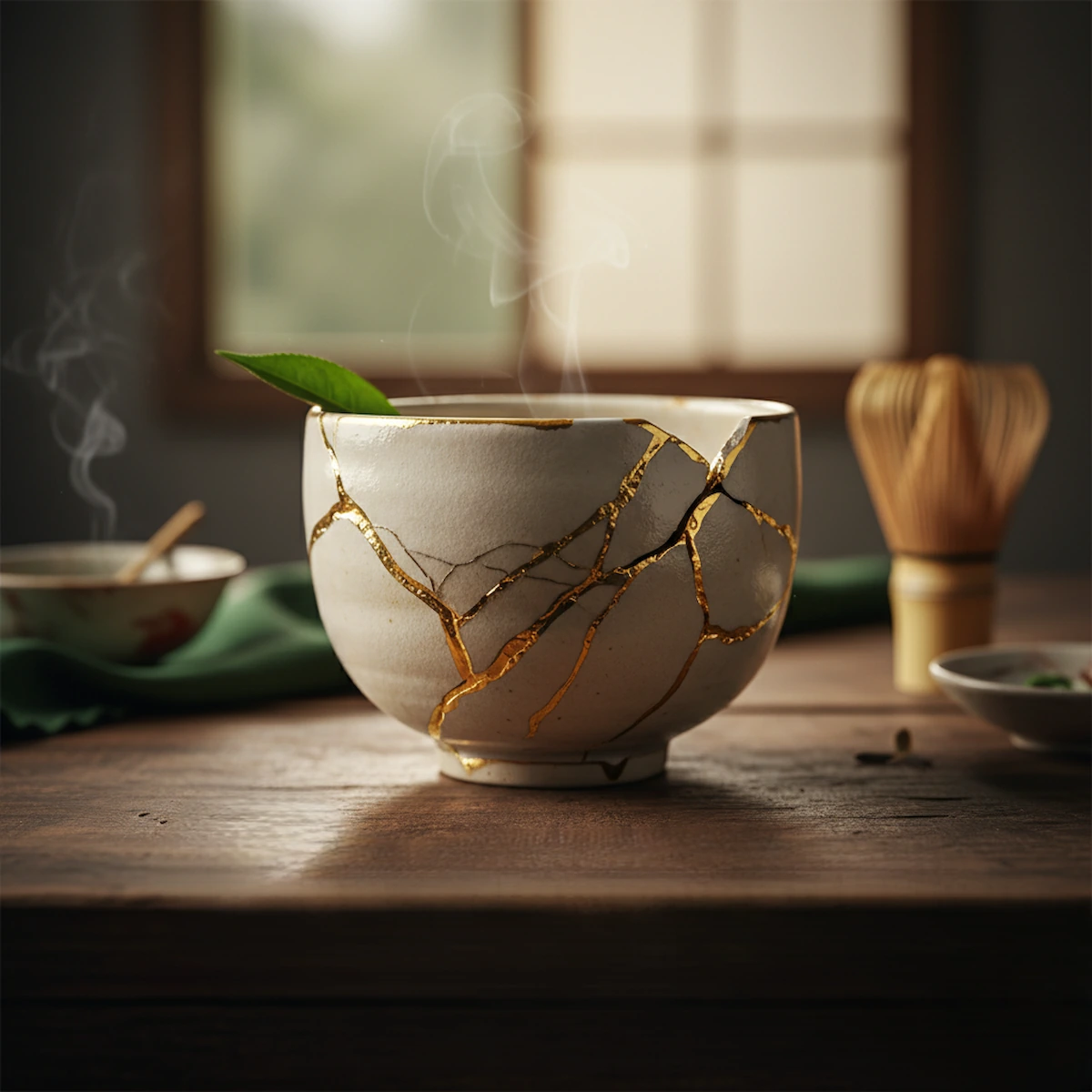
In a world obsessed with perfection, novelty, and the flawless, an ancient Japanese philosophy offers a radically different perspective. Imagine a teacup, a piece of ceramic treasured for generations, that one day falls and shatters.
In our Western culture, its most likely destination would be the trash, a silent end for an object that has lost its “perfection.” But in the universe of Kintsugi, this is not an ending, but the beginning of a new and more beautiful story.
Kintsugi (金継ぎ), which translates to “golden joinery,” is the art of repairing broken pottery with a special lacquer mixed with powdered gold, silver, or platinum.
Far from hiding the fracture, the technique highlights it, transforming scars into the object’s most beautiful features. It is much more than a method of repair; it is a profound philosophy that teaches us about resilience, the beauty of imperfection, and the value of history.
It invites us to see our own cracks, our wounds, and our failures not as a source of shame, but as an integral part of our journey—proof of our ability to heal and become stronger.
This article explores Kintsugi in all its facets: from its origin in Zen aesthetics to its powerful application as a metaphor for a more authentic and resilient life in the 21st century.
Beyond repair: what Kintsugi truly means

To understand Kintsugi, we must shed our modern notion of “fixing.” The goal is not to return the object to its original state, erasing all traces of the accident.
On the contrary, it is to honor its history, to celebrate the wound as an event that has conferred upon it a new identity. The true essence of Kintsugi is transformation—an alchemy that turns trauma into beauty.
More than glue: the art of golden joinery
Unlike modern adhesives that aim for an invisible repair, Kintsugi operates in plain sight. The fracture is not disguised; it is proclaimed. The fine veins of gold that trace the surface of a repaired piece act as a map of its past.
They do not say, “nothing happened here,” but rather, “something happened here, and the piece survived.” The material used is key: urushi lacquer, a natural and incredibly durable sap, serves as the healing agent, while powdered gold, a precious metal, symbolizes the value bestowed upon that healing.
The process is deliberately slow and meditative. It is not a quick fix but a ritual of patience and care. Each fragment is joined with diligence, each crack filled and polished in multiple layers.
The result is an object that not only regains its function but also acquires a new aesthetic and symbolic dimension. The golden lines create a new pattern, a unique composition that tells a story of fragility and strength.
This act of “golden joinery” teaches us that healing is not about forgetting, but about integrating the wound in a way that enriches us.
From brokenness to beauty: reimagining flaws as features
The Kintsugi philosophy represents a radical paradigm shift: imperfection is not a defect, it is a virtue. In a culture that glorifies the immaculate and the mass-produced, Kintsugi celebrates the unique, the personal, and the lived-in.
The broken and repaired piece is inherently more interesting than its perfect counterpart. It possesses a character, a depth, and a singularity that an intact object can never have.
This perspective invites us to re-evaluate our own relationship with “flaws.” The wrinkles on a face, the scars on skin, the mistakes in a professional career—we tend to see these marks as failures to be concealed.
Kintsugi proposes we see them as the golden lines of our own history. They are the tangible proof of the battles we have fought, the lessons we have learned, and the resilience we have shown.
By reimagining our flaws as distinguishing features, we stop fighting against our own story and begin to celebrate it. Beauty, Kintsugi tells us, does not lie in the absence of flaws, but in the way we integrate and illuminate them.
A metaphor for life: resilience, healing, and growth
Perhaps the most powerful application of Kintsugi is as a metaphor for the human experience. All of us, at some point in our lives, break. We suffer losses, failures, heartbreaks, and traumas that leave us feeling fragmented.
Social pressure often pushes us to “pull ourselves together” quickly, to hide our wounds and pretend they never happened. Kintsugi offers an alternative, more compassionate path.
It teaches us that the healing process is valuable in itself. The cracks are filled with “gold,” which can symbolize self-compassion, therapy, the support of loved ones, time, and the wisdom gained through pain.
At the end of the process, we do not return to being the same person we were before the break; we emerge transformed. The scars do not weaken us; they become symbols of our strength.
A broken heart that has healed with gold is a heart that has learned to love more deeply. A broken trust that has been rebuilt is based on a more solid honesty.
Kintsugi assures us that it is not only possible to survive adversity, but it is possible to become more beautiful, strong, and valuable precisely because of it.
The roots of Kintsugi: history and craft
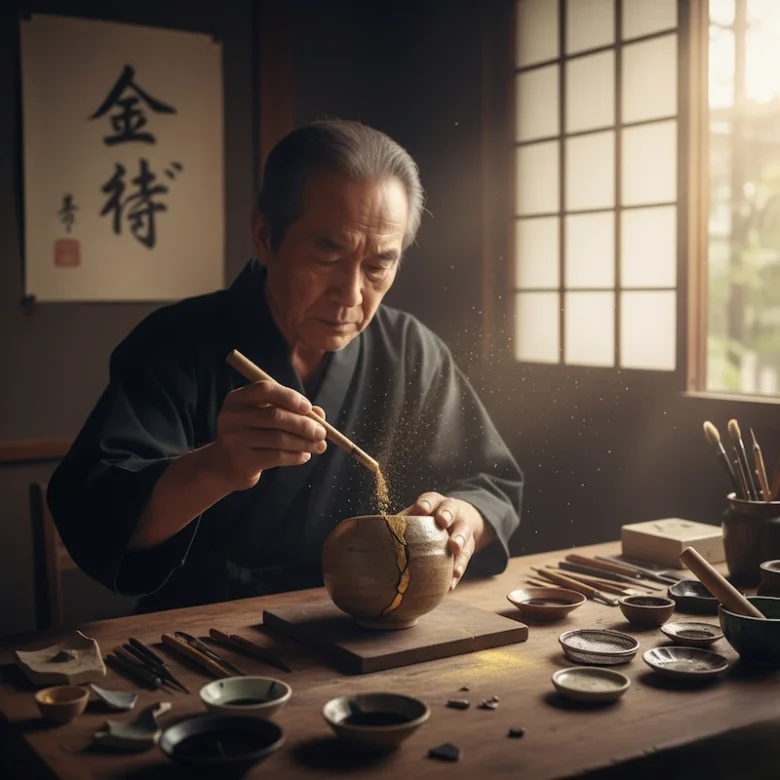
Kintsugi did not emerge in a vacuum. It is the culmination of centuries of philosophical thought and artisanal refinement, deeply rooted in the history and aesthetics of Japan. Understanding its origins allows us to appreciate its depth and meaning on an entirely new level.
Zen aesthetics: wabi-sabi and the impermanence of form
At the heart of Kintsugi beats the philosophy of wabi-sabi (侘寂). This Japanese aesthetic concept, derived from Zen Buddhism, finds beauty in what is imperfect, impermanent, and incomplete.
Wabi evokes a rustic, simple beauty, an appreciation for modesty and life in harmony with nature. Sabi refers to the beauty that comes with age, the patina of time, and the serenity that emerges from accepting the natural cycle of life and death.
Kintsugi is the perfect embodiment of wabi-sabi. A bowl repaired with gold accepts its impermanence (it broke), honors the marks of time (the fracture), and finds a simple, profound beauty in its “imperfect” state.
It is also connected to the concept of mushin (無心), or “no-mind,” which implies a fluid acceptance of change and an absence of attachment to perfection.
In repairing an object this way, the artisan does not fight against the damage but flows with it, accepting it as a new stage in the object’s life.
A legacy of value: treasuring the mended object
The most cited legend about the origin of Kintsugi dates back to the 15th century, with the shogun Ashikaga Yoshimasa. It is said that he sent his favorite tea bowl to China to be repaired.
The bowl was returned, but held together with ugly metal staples, a common practice at the time. Disappointed, the shogun commissioned his own craftsmen to find a more aesthetic solution. Thus, the art of repairing with lacquer and gold was born, transforming a practical need into a high art form.
This story illustrates a fundamental shift in the perception of value. Over time, a piece repaired with the Kintsugi technique could become more valuable and coveted than a similar object that had never been broken.
Collectors appreciated the unique history the piece told, the mastery of the artisan who had repaired it, and the profound philosophy it embodied.
In a world where value is often equated with newness and perfection, Kintsugi established a radical legacy: value also resides in history, survival, and the beauty of scars.
Kintsugi in modern life: applying ancient wisdom
Although its roots are ancient, the philosophy of Kintsugi has never been more relevant. In a society that pressures us to be perfect and to discard what is broken, its lessons offer a powerful antidote.
Applying this wisdom to our daily lives can transform our relationship with ourselves, with others, and with the world around us.
Personal resilience: mending our own cracks with gold
The most intimate application of Kintsugi is in our own personal development. We all face adversities that leave us feeling “broken”—a professional failure, an illness, the loss of a loved one.
Our instinctive reaction is often to hide these wounds, to be ashamed of our vulnerability, and to pretend we are invincible. Kintsugi encourages us to do the opposite: to treat our wounds with care, to give ourselves time to heal, and to see the resulting scars not as weaknesses, but as the source of our strength.
Mending our cracks with “gold” means practicing self-compassion, seeking help when we need it, learning from our mistakes, and, most importantly, integrating those painful experiences into our identity.
We are not the same person we were before the trauma, and that is not a bad thing. We are someone with more depth, empathy, and wisdom.
Accepting our golden scars is an act of self-love that frees us from the tyranny of perfection and allows us to live with radical authenticity.
Relationships and healing: finding strength in shared vulnerability
The Kintsugi metaphor extends beautifully to our relationships. Friendships, families, and romantic partnerships also break. Conflicts, betrayals, or simply the erosion of time can create painful rifts.
Often, fear of confrontation or shame leads us to ignore these fractures until it’s too late. However, a relationship that faces a crisis and actively works to overcome it can emerge stronger and more resilient than before.
The repair process in a relationship requires honesty, communication, and vulnerability—that is the “lacquer” that joins the pieces. The “gold” is the forgiveness, mutual understanding, and renewed commitment that comes from having weathered adversity together.
A relationship that has been “mended” with Kintsugi does not pretend to be perfect; it acknowledges its past fractures but integrates them as part of its shared history.
These golden scars become a reminder of its ability to overcome difficulties, creating a bond based on a much deeper authenticity and trust.
Sustainable living: valuing repair over disposal
On a more practical and global level, Kintsugi is a powerful manifesto against the “throw-away” culture. We live in a linear economy that encourages us to discard objects at the first sign of a defect or wear and to replace them with something new.
This mentality is not only unsustainable from an environmental standpoint, but it also deprives us of an emotional connection to the objects that surround us.
Kintsugi is the ultimate expression of the philosophy of repair. It teaches us to see the value in the old, to invest time and effort in caring for our possessions, and to extend their lifespan.
This principle aligns perfectly with contemporary movements like the “right to repair,” the circular economy, and conscious minimalism.
By choosing to repair rather than dispose, we are not only reducing our ecological footprint, but we are also cultivating a deeper, more meaningful relationship with our material world. We are recognizing that objects, like people, acquire value through their history and use.
Kintsugi beyond ceramics: art, fashion, and design
The powerful visual and philosophical aesthetic of Kintsugi has transcended the world of pottery to inspire creators across a wide range of disciplines. Artists, designers, and architects have adopted its visual language to explore themes of imperfection, memory, and healing, taking its principles into new and exciting territories.
Visualizing imperfection: kintsugi as an aesthetic principle
The image of a crack filled with gold is instantly recognizable and deeply evocative. Contemporary artists have used this principle to create works that celebrate the beauty of fracture.
South Korean artist Yee Sookyung, for example, collects ceramic shards discarded by master potters and joins them into organic, fluid sculptures, using the Kintsugi technique to create new forms from the “failures” of others.
French photographer and artist JR, in his project on the US-Mexico border, pasted a giant image of a child over the border wall—an image that tore and was “repaired,” creating a powerful metaphor for human and political fractures. These artists use Kintsugi not as a technique, but as a language to speak of fragility and resilience on a grand scale.
Fashion’s mended narratives: celebrating wear and repair
The fashion industry, traditionally driven by novelty and perfection, has begun to embrace the aesthetic of mending and repair. “Visible mending” has become a trend that, like Kintsugi, does not hide the repair but turns it into a decorative element and a statement of principle.
Japanese techniques like Sashiko (a type of traditional embroidery for reinforcing fabric) are used to create beautiful patterns on worn jeans and torn garments.
Avant-garde designers like Martin Margiela and Rei Kawakubo have built their careers around deconstruction and reconstruction, presenting garments with exposed seams, raw edges, and an aesthetic of the “unfinished.”
These mended narratives celebrate a garment’s history, the wear from use, and the act of caring for it. It is a quiet rebellion against fast fashion, encouraging us to see our clothes not as disposable items but as life companions whose scars deserve to be honored.
Architectural scars: the beauty of integrated damage
Even in architecture, a discipline associated with permanence and solidity, the principles of Kintsugi are finding a place. Instead of completely erasing the ravages of time or history, some architects choose to integrate damage as part of a building’s new identity.
A famous example is the Neues Museum in Berlin, rebuilt by architect David Chipperfield. Instead of perfectly recreating the sections destroyed during World War II, Chipperfield chose to preserve the building’s “scars,” leaving walls with bullet holes and faded frescoes alongside clean, modern elements.
The result is a building that is a palimpsest of its own history. The new parts do not hide the trauma but frame it, creating a moving dialogue between the past and the present.
This approach, like Kintsugi, recognizes that damage is part of the narrative and that true restoration is not about pretending it never happened, but about building a future that honors the memory of the past, with all its fractures.
The enduring message: a philosophy for our time
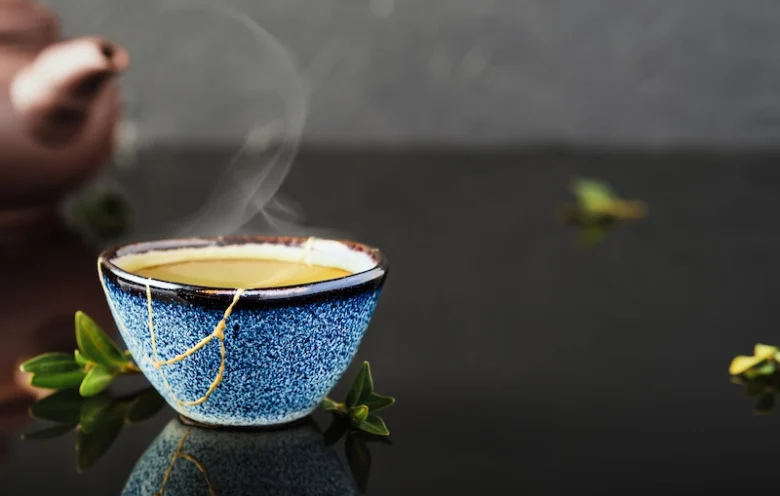
In an era marked by anxiety, polarization, and a relentless pressure for perfection, Kintsugi emerges not as a relic of the past, but as an essential guide for the present. Its message of acceptance, resilience, and authenticity is a balm for many of the wounds of modern society.
Countering perfectionism: the freedom in accepting flaws
We live under the tyranny of perfectionism, exacerbated by social media, where lives are edited and filtered to an unreal sheen. This incessant pursuit of an unattainable ideal is a source of anxiety, depression, and burnout. Kintsugi offers us liberation. It gives us permission to be imperfect, to make mistakes, to have bad days, and to show our vulnerabilities.
Accepting our flaws is not an act of resignation, but of empowerment. When we stop wasting energy hiding our cracks, we can begin to invest it in filling them with gold: in learning, in growing, and in taking care of ourselves.
This philosophy teaches us that true beauty is not symmetrical or flawless, but is authentic, lived-in, and full of character. The freedom found in accepting our imperfections is profound and transformative.
Growth through adversity: every scar tells a story
Kintsugi refutes the idea that adversity diminishes us. Instead, it posits that suffering and failure, if met with mindfulness and care, are catalysts for growth.
Each time we overcome an obstacle, we become more resilient. Each time we heal a wound, we gain a new layer of wisdom and empathy. Our scars, far from being marks of shame, become the map of our life’s journey.
Each golden line on a Kintsugi bowl corresponds to an event, a moment of crisis that was overcome. In the same way, our own scars, visible and invisible, tell the story of our survival.
They remind us of the times we thought we couldn’t go on, but we did. They connect us to our own strength and allow us to connect with others on a deeper level, recognizing the battles we all fight.
A call for authenticity: finding gold in our imperfections
Ultimately, the most enduring message of Kintsugi is a radical call to authenticity. It encourages us to stop aspiring to be perfect copies of an ideal and to start celebrating the unique, complex, and “beautifully broken” version of ourselves.
Our true worth lies not in a flawless facade, but in the unique mosaic of our experiences, our joys, our pains, and the way we have joined all those pieces together.
Finding the gold in our imperfections means recognizing that our vulnerability is a source of connection, that our mistakes are our teachers, and that our history, with all its fractures, is what makes us who we are.
Kintsugi teaches us that life is not about avoiding the breaks, but about learning to repair ourselves with love, patience, and a touch of gold, creating in the end a work of art far richer and more resonant than perfection could ever be.
Like the golden seams in a Kintsugi bowl, some ideas are too valuable to be overlooked. They challenge our view of beauty, resilience, and what it means to be human. At Neomania Magazine, we are dedicated to uncovering these stories.
Join a community of curious minds. Subscribe to our weekly dispatch and find the beauty in the ideas that mend our world.