For centuries, the story of art has been written on canvas, carved from marble, and projected onto screens. But in the mid-20th century, a group of artists, feeling the confines of the gallery and the weight of commercialism, looked outward.
They turned their backs on the pristine white walls and the auction houses, venturing into the vastness of deserts, coastlines, and open fields.
Their vision was both simple and radical: if art is a profound expression of life, why not create it within the very heart of nature itself?
This bold departure gave birth to Land Art, a movement that not only revolutionized aesthetics but fundamentally redefined what an artwork could be.
It was an escape from the studio, from the concept of possession, and from the expectation of permanence. The creations were a profound dialogue with the environment, often ephemeral and always site-specific.
From colossal lines etched into the earth to delicate arrangements of leaves on a riverbank, these artists were not seeking to dominate nature, but to collaborate with it.
The work they created could not be hung on a wall; it had to be experienced, felt, and often, documented through the lens of a camera. This is the story of a rebellion—a manifesto written with rocks, earth, and a vision that remains more relevant than ever.
The organic rebellion of art
In an art world that was becoming increasingly institutionalized and market-driven, the act of creating a work that could not be sold or easily displayed was a provocation.
The pioneers of Land Art were not seeking fame through conventional channels, but a raw, unfiltered connection to the primal, the immutable, and the universal.
Their rebellion was as much philosophical as it was aesthetic. They abandoned the city, the cultural epicenter of modern art, to seek inspiration and raw materials in the silence of remote landscapes.
Their art was meant to merge with its surroundings, to become an integral part of the place, changing with the seasons and, in many cases, disappearing completely.
The manifestos that left the museums behind
To these artists, the pristine, controlled environment of a museum was the antithesis of their vision. Robert Smithson, one of the movement’s most articulate thinkers, not only created monumental works in the open air but also penned manifestos that challenged the very notion of the gallery as the sole legitimate space for art.
His writings questioned the objectification of art, paving the way for a new understanding of art as an experience, a process, and an interaction. The manifesto of Land Art was not printed on paper; it was inscribed in the expansive space of the great outdoors.
The pioneers who sculpted the Earth
You cannot discuss the origins of Land Art without acknowledging its two most influential figures: Robert Smithson and Michael Heizer.
With a mind fascinated by concepts of entropy and chaos, Smithson gave us the iconic Spiral Jetty on the Great Salt Lake in Utah—a work that merges with the landscape, disappearing and reappearing, challenging the idea of permanence.
Heizer, on the other hand, gravitated toward monumentality and scale, carving immense trenches into the desert floor to create pieces like Double Negative.
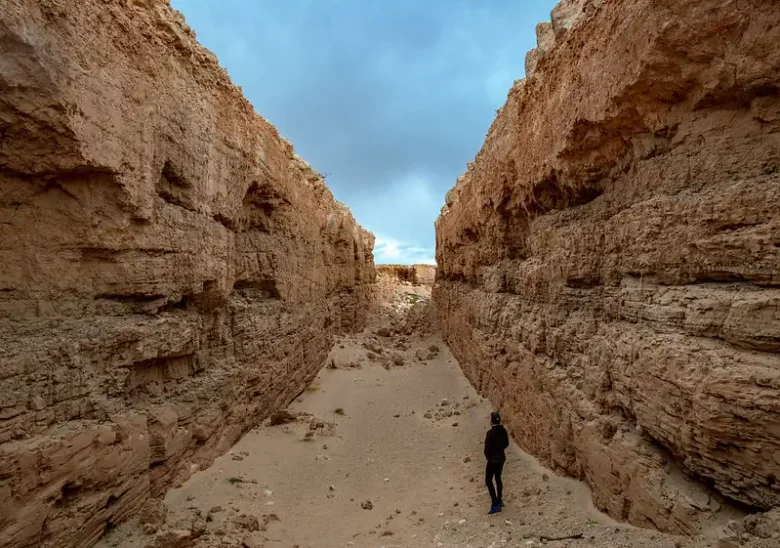
His work was not merely an artistic gesture but an act of excavation, an intervention that reshaped the landscape with a sense of geologic time.
When nature became the medium
Land Art not only changed where art was made, but it also changed what was considered art. The Earth itself became the material, the canvas, and the subject matter.
The “canvas” was no longer a static, flat surface but a dynamic, three-dimensional landscape with its own textures, colors, and rhythms.
Artists used rocks, branches, snow, and soil as their pigments. In this way, Land Art was more than just a style; it was a radical re-thinking of the relationship between the creator, the work, and the viewer—a challenge that resonated with the counterculture of its time and, in our era of environmental awareness, feels as vital as ever.
The scale of land art from the ephemeral to the monumental
If there is one thing that defines the audacity of Land Art, it’s its ability to exist at two opposite ends of the spectrum. On one hand, we find works of an almost geological monumentality, capable of altering a landscape for generations to come.
On the other, there are pieces that are a mere whisper—an intervention so delicate and temporary that its very existence depends on a fleeting moment, a tide, or a change in light.
This duality is not a contradiction but the very core of a movement that constantly questioned the relationship between time, space, and the human hand.
The artists were not just working with the earth, but with time itself, turning erosion and change into an integral part of the work.
The monumental impact of the Spiral Jetty
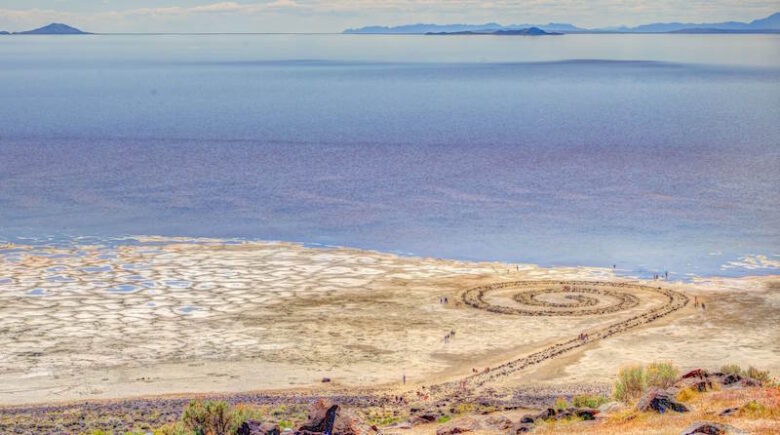
Few works encapsulate this monumentality as powerfully as Robert Smithson’s Spiral Jetty. Built in 1970 on the Great Salt Lake in Utah, this iconic 1,500-foot-long spiral is made of black basalt rocks and earth.
Its construction, which involved heavy machinery and a work crew, was a massive intervention that challenged the idea of nature as an untouchable space.
The Spiral Jetty is more than a sculpture; it is a pier that juts into the lake’s rose-colored waters, a work that submerges when water levels rise and reappears, covered in salt crystals, when they recede.
Its essence lies in this transformation—in its constant dialogue with the environment and the idea that the artwork is not static but a living entity that evolves with time. It is Land Art at its most imposing.
The poetic subtlety of Andy Goldsworthy
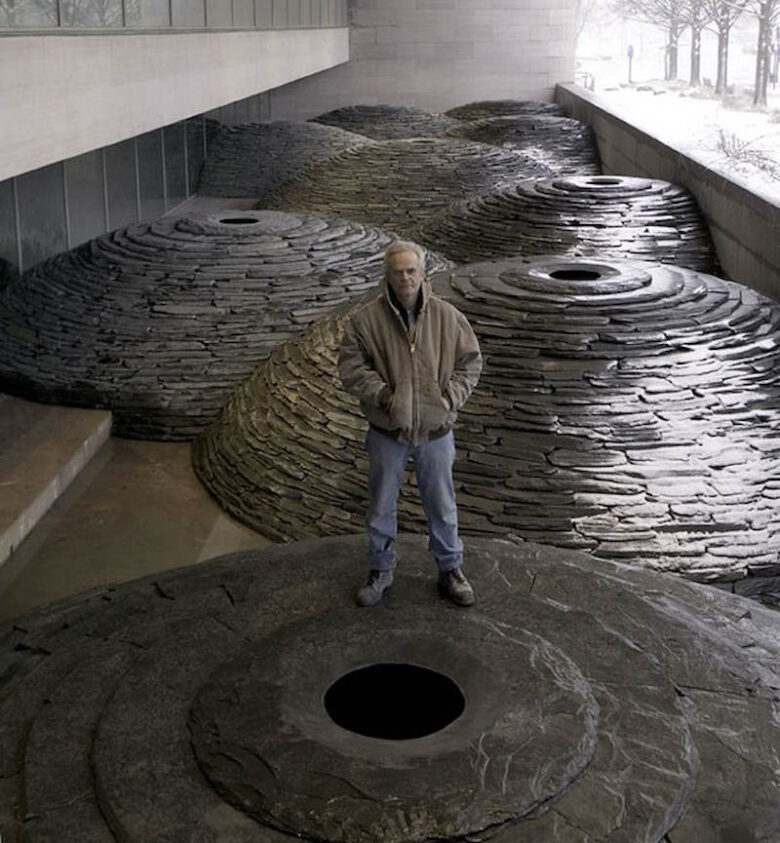
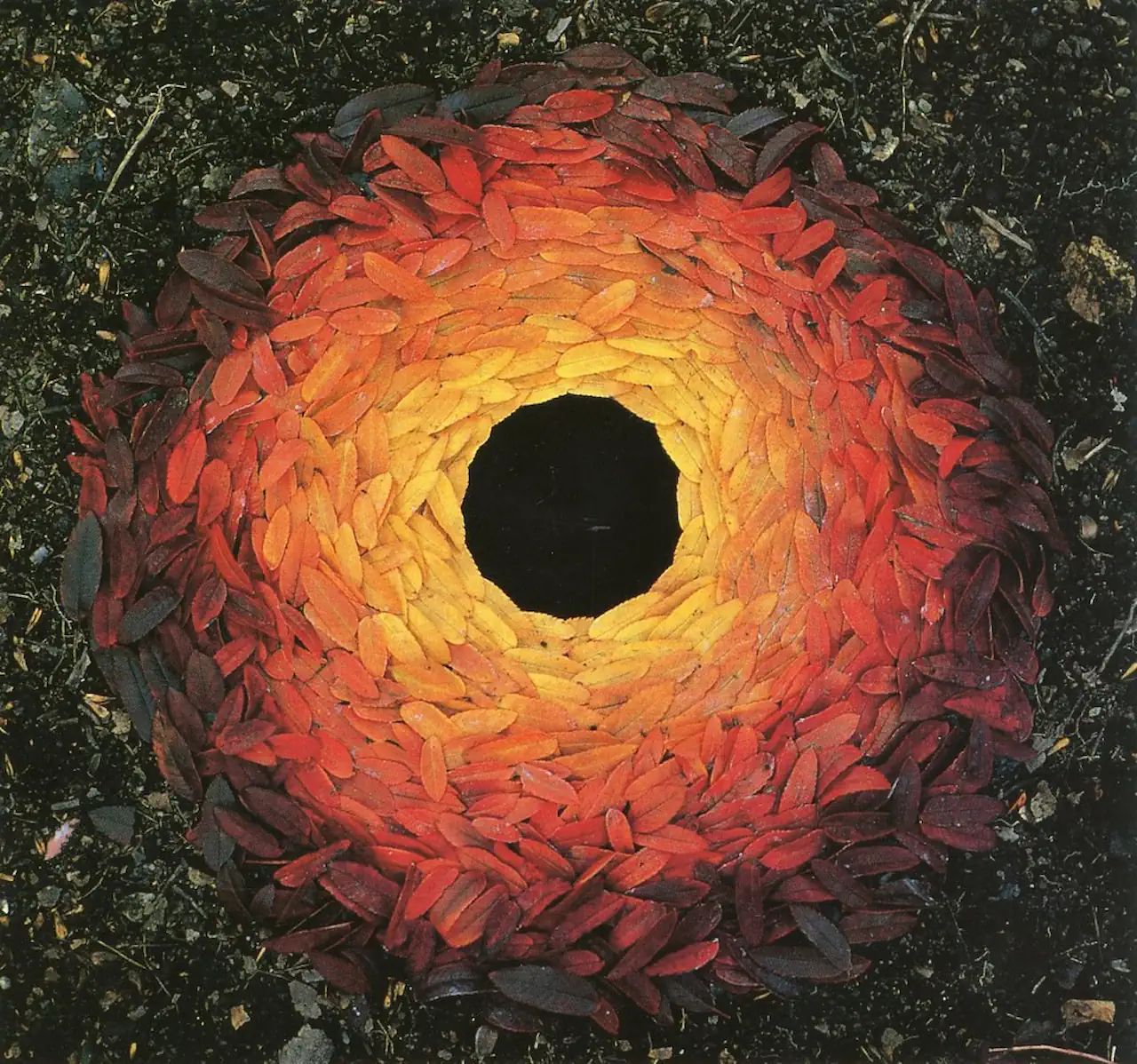
On the opposite pole of the scale, we find the work of Andy Goldsworthy. His sculptures are the personification of the ephemeral.
Using materials found on-site—leaves, branches, petals, ice, or stones—Goldsworthy creates compositions of stunning beauty that are destined to disappear.
A spiral of leaves floating down a river, a line of melting icicles, a circle of red flowers in the grass. His work is not about permanence but about celebrating the moment.
The artwork is the precise instant when the material and the composition coexist. The only way to preserve these creations is through photography, which immortalizes them in the single moment they exist, making their transience the true essence of their beauty.
Geometry that dialogues with the landscape
The monumentality of Smithson and the subtlety of Goldsworthy converge in their shared use of geometry as a language. Smithson employed the spiral, an archetypal shape, to connect with the site’s geology and mythology.
Goldsworthy, in his turn, uses circles, lines, and spirals to impose an aesthetic order on the natural world, creating a visual harmony that feels both alien and deeply rooted in the landscape.
For these artists, geometry is not an end but a tool to create a dialogue—a conversation between the human mind and the immensity of the environment. Their forms are not intrusive; they are invitations to look at the landscape with new eyes.
The earth speaks art as an ecological cry
Land Art emerged from a context of aesthetic rebellion, but its legacy has evolved into a powerful tool for social consciousness.
Today, in an era defined by the climate crisis, the loss of biodiversity, and the urgent need to rethink our relationship with the planet, Land Art has taken on a new and vital purpose.
Many artists are no longer content to simply create beauty in the landscape; they use their interventions as a vehicle for critique, protest, and hope. Their art becomes a mirror that forces us to confront the impact we have on the Earth.
Art as a collaborator, not just a canvas
In contemporary practice, the relationship between the artist and nature has become more symbiotic. While the pioneers of the movement often made large-scale interventions with heavy machinery, many modern artists adopt a more subtle and respectful approach.
The act of collaboration has become central to their work. They use organic materials that reintegrate into the ecosystem, they work with natural processes like erosion and growth, and they even invite local communities to participate in the creation of the works.
Nature is no longer just a canvas but an active partner in the creative process, whose life cycle determines the ultimate fate of the piece.
The new wave of environmental activism in art
A powerful example of this new direction is found in the work of artists who engage in environmental activism. For some, the art is a direct act of protest. For others, it’s a way to restore and heal the land.
Artists like Agnes Denes, with her iconic Wheatfield—A Confrontation in 1982, or the collective Fallen Fruit, have created massive interventions that combine aesthetics with a tangible ecological purpose.
Their work demonstrates that Land Art can be a tool for environmental restoration, transforming the landscape in a way that benefits both the ecosystem and the community.
How art confronts climate change
Contemporary Land Art also serves as a potent form of critique against human-induced damage. Pieces that use plastic waste washed ashore to create sculptures on the beach, or installations that visualize the effects of rising sea levels, confront us with the consequences of our actions.
These interventions don’t seek to find beauty in the chaos; they use it to spark reflection. The Earth, wounded and fragile, becomes the protagonist telling a story of warning, turning the art into a powerful echo of the global environmental crisis.
Documenting the unseen capturing a fleeting art form
From its beginnings, Land Art presented an inherent paradox: how can you share a work that exists in a remote location and is often destined to disappear? The answer was found in documentation.
Artists understood that the true reach of their work was not just in the physical intervention but in the photographs, videos, and maps that bore witness to its existence.
Today, this paradox has become even more fascinating with the rise of digital technologies. A circle of stones in the desert can gain global attention from an Instagram post, and a sculpture of ice can be visited by millions through a viral video.
Documentation has transformed from a simple record into an integral, and sometimes the most important, part of the artwork itself.
The camera as the only witness
For the pioneers of the movement, photography was the primary way to bring Land Art into the broader art conversation. Works like the Spiral Jetty, which is only visible at certain times of the year, became globally famous through Smithson’s photographs.
These images were not mere mementos; they were the artwork itself for the majority of viewers who could never visit it. Photography became a medium for telling the story of an ephemeral art, capturing the scale, texture, and relationship of the piece to the environment in a way words couldn’t.
It is the witness that proves the audacity of the artistic gesture, the bridge between the physical intervention and the public.
From the desert to the digital realm
In the 21st century, this relationship has expanded exponentially. Artists no longer just use high-quality cameras but also drones to capture aerial perspectives that reveal the monumentality of their work in an unprecedented way.
Social media has become the new gallery, where ephemeral creations find a massive, instant audience. Contemporary artists like Jim Denevan, known for his gigantic sand drawings that are erased by the tide, base a large part of their practice on digital documentation.
His timelapse videos or drone photos become as important as the creation itself, making the process and the disappearance part of the artistic narrative.
The new frontiers of documentation
Beyond photography and video, technology has opened up new possibilities. Virtual reality and 3D scans allow viewers to “walk” through a piece of Land Art that no longer exists.
Geolocation installations and augmented reality apps are creating new ways to interact with the landscape. These tools not only preserve the art; they reimagine it, inviting the public into an immersive experience that blurs the boundaries between the physical and the digital worlds.
Documentation no longer just saves the art from oblivion; it enhances it, giving it new dimensions and an unparalleled reach.
The organic future of art and culture
Land Art is not a movement frozen in the past but a vision that continues to resonate and evolve. Its influence has filtered into other disciplines, proving that the idea of creating in collaboration with nature is more than a trend; it is a philosophy that shapes our present and future.
From architecture to urban design, the legacy of the pioneers has inspired a new generation to reconsider the function, form, and impact of our creations on the environment.
The fluidity of their forms, the sustainability of their materials, and the respect for the landscape have gone from being an artistic statement to an imperative necessity.
The legacy in modern design and architecture
Architects and designers today look to Land Art for solutions that transcend mere aesthetics. The idea of a structure that integrates with the landscape, rather than dominating it, is a central principle in sustainable architecture and ecological design.
The use of local materials, biomimicry that draws inspiration from organic forms, and the creation of spaces that adapt to the natural environment are a direct inheritance of Land Art principles.
The art of Smithson and Heizer didn’t just sculpt the earth; it laid the foundation for a new way of thinking about how to build and inhabit our world.
Towards a new form of bioconstruction
Land Art has fueled the idea that building materials don’t have to be invasive or prefabricated. Today, we see a resurgence of ancient techniques and a surge in the experimentation with bioconstruction, where materials come directly from the environment and are reintegrated without leaving a toxic footprint.
Works that use rammed earth, bamboo structures, or living walls of moss and plants are a testament to the idea that construction can be as organic and respectful as a sculpture by Andy Goldsworthy.
The form and function of harmony with nature
Ultimately, Land Art taught us that form and function don’t have to be separate concepts. An artwork can be a reflection of the landscape that surrounds it, a pier that juts into a lake, or a reforestation project that revitalizes an ecosystem. }
This principle has transcended into design and urban planning, where the goal is to create greener, more functional cities that are in harmony with nature.
The idea that a human intervention can be both useful and profoundly beautiful, while respecting the cycles and life of the environment, is the most lasting gift that Land Art has given to culture and humanity.
The journey of Land Art, from its rebellion in the desert to its resonance in contemporary design, is a story about the search for meaning beyond convention.
It is a reminder that the Earth is not merely a stage but a collaborator in the creative process; a canvas that is at once alive, monumental, and ephemeral.
The artists who dared to sculpt the landscape left us a legacy that is more relevant today than ever before, forcing us to reflect on our impact, our permanence, and the beauty of an art that respects and celebrates life itself.
It’s not just about art; it’s about a new way of seeing and living in the world.
Join the Avant-Garde
Land Art redefined the canvas, and at Neomanía Magazine, we redefine the conversation. If you are moved by the ideas that are shaping the future, if you understand that art and culture are a manifesto in constant evolution, don’t stay on the sidelines.
Subscribe to Neomanía Magazine. Discover with us the currents that are building tomorrow, today.