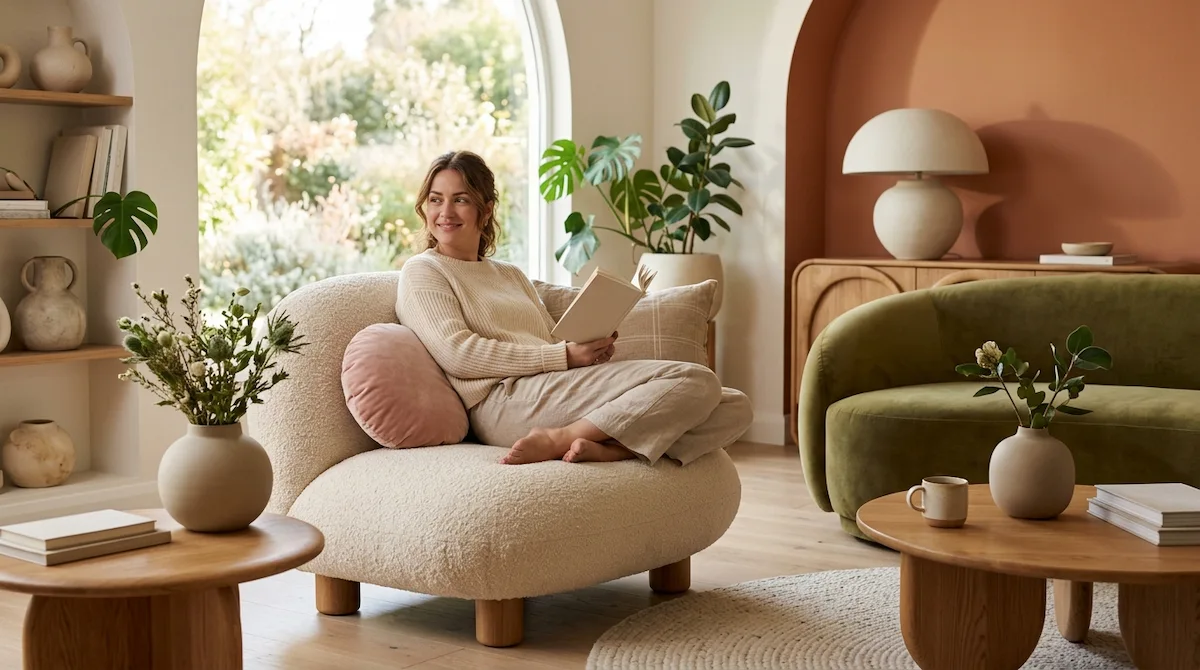
Furniture has stopped being just functional and started being friendly. If you look around the most interesting homes and galleries today, you will notice a shift away from sharp angles and cold, clinical lines.
Instead, there is a growing presence of objects that look almost like they could give you a hug. This movement toward “chubby” furniture and exaggerated proportions is more than just a passing whim; it is a response to our deep-seated need for comfort and emotional connection in an increasingly digital world.
The objects we choose to live with speak volumes about our internal state. For a long time, the trend was about “less is more,” leading to a minimalism that often felt sterile.
Now, we are seeing a “more is more” approach when it comes to volume and softness. These pieces don’t just sit in a room; they inhabit it with a personality that feels almost human.
By using shapes that remind us of youth and safety, designers are tapping into a biological response that makes us feel instantly more at ease.
This shift represents a bridge between high art and the most basic human instincts. It challenges the idea that sophisticated design must be serious or inaccessible.
By embracing a sense of play, creators are opening up a new dialogue about what it means to live in a space that nurtures the soul.
As we look closer at this aesthetic, we can see how it blends the spiritual comfort of soft forms with a provocative challenge to traditional rules of proportion.
Why we are drawn to rounded shapes right now
There is a specific biological reason why certain shapes make us smile. In the mid-20th century, ethologists identified what they called “baby schema”—a set of physical features like large eyes, round faces, and chubby limbs that trigger a nurturing instinct in humans.
When these traits are applied to inanimate objects, we experience a similar emotional pull. This is the heart of neotenic design, a style that intentionally incorporates youthful, “infant-like” characteristics into adult environments.
We live in a time that can often feel harsh and unpredictable. The furniture we bring into our homes serves as a protective barrier against that outside noise.
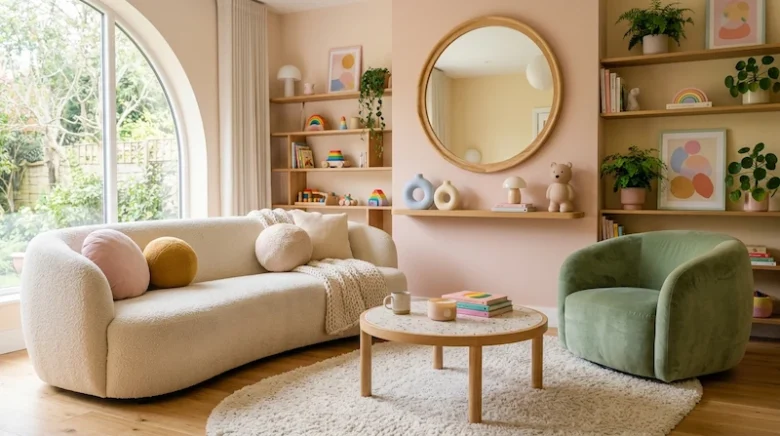
A chair with thick, tubular legs or a lamp with a soft, bulbous head acts as a visual “reset button.” These pieces invite touch and interaction, breaking the “don’t touch” rule that often governs high-end interior design. They encourage us to be more present and less guarded.
As you might have noticed, this isn’t just about being “cute.” It is about a sophisticated use of geometry to create a sense of stability. A heavy, rounded base on a table feels more grounded than thin, spindly legs.
This perceived weight gives a room a sense of permanence and safety. It is a design language that speaks to our subconscious, telling us that we are in a place where we can truly let our guard down.
Identifying the hallmarks of the neotenic look
Recognizing this style becomes easy once you know what to look for. The most obvious sign is the exaggeration of parts. Imagine a chair where the legs are as thick as the seat itself, or a sofa that looks like a series of oversized marshmallows joined together.
These pieces ignore the standard “human-scale” proportions in favor of something more sculptural and animated. The goal is to create a silhouette that feels alive.
Materials play a huge role in how these shapes are perceived. To make a large, bulky object feel approachable, designers often use textures that are soft to the touch.
Bouclé fabric, with its looped yarns and nubby surface, has become a favorite because it adds a layer of organic warmth to rounded forms.
Similarly, matte resins and smooth ceramics allow light to glide over curves without the harsh reflections you get from polished metal. This creates a visual softness that matches the physical shape.
Color choice is another way this trend expresses itself. While you will see many of these pieces in neutral tones like cream, sand, or terracotta to emphasize their organic nature, there is also a vibrant side to the movement.
Bright, primary colors can turn a bulbous chair into a piece of pop art, making the room feel energetic and daring. Whether the palette is muted or loud, the focus remains on the silhouette and the way it occupies space with a sense of confidence.
The masters of chubby furniture and soft forms
The rise of neotenic design didn’t happen in a vacuum. It was propelled by visionary designers who were tired of the rigid constraints of modernism.
Faye Toogood is perhaps the most famous name associated with this shift. Her Roly-Poly chair, with its scoop-like seat and four massive, trunk-like legs, became an instant icon.
It challenged the idea of what a chair “should” look like, proving that something could be both a serious piece of art and a playful object.
Before the current wave, designers like Pierre Paulin were already experimenting with these ideas in the 1960s and 70s.
His designs for the Elysée Palace or his famous Ribbon chair showed a fascination with continuous curves and the way foam could be molded into body-hugging shapes.
Today’s creators are taking those mid-century experiments and pushing them even further, using new manufacturing techniques to create even more daring and seamless forms.
Other contemporary figures like Misha Kahn or the Campana Brothers use soft shapes to explore the boundary between the natural and the synthetic.
Their work often looks like it grew in a lab or under the sea, rather than being built in a factory. This “organic-alien” look is a key part of the trend, offering a provocative take on how we perceive the objects around us.
It forces us to ask questions about our relationship with the material world and why we find certain shapes so inherently comforting.
The role of technology in shaping the trend
We can’t talk about these shapes without mentioning how they are made. In the past, creating perfectly rounded, seamless furniture was incredibly difficult and expensive.
You had to carve wood or bend metal in complex ways. Now, with the help of 3D printing, advanced CNC milling, and high-quality rotational molding, designers can realize these bulbous visions with much more freedom.
This has led to an explosion of creativity, as the technical barriers to making “weird” shapes have largely disappeared.
These tools allow for a level of precision that makes the furniture feel more like a single, cohesive unit rather than a collection of parts.
When a chair looks like it was poured into a mold rather than assembled from pieces, it gains a certain “monolithic” quality. This simplicity is part of the appeal.
It strips away the visual clutter of joints, screws, and hardware, leaving only the pure, emotive form. It is a perfect example of how high-tech processes can be used to create something that feels deeply low-tech and human.
Creating a space that feels like a hug
If you want to bring this feeling into your own home, you don’t need to replace every piece of furniture you own. In fact, these soft, rounded pieces often look best when they are contrasted with more traditional, linear items.
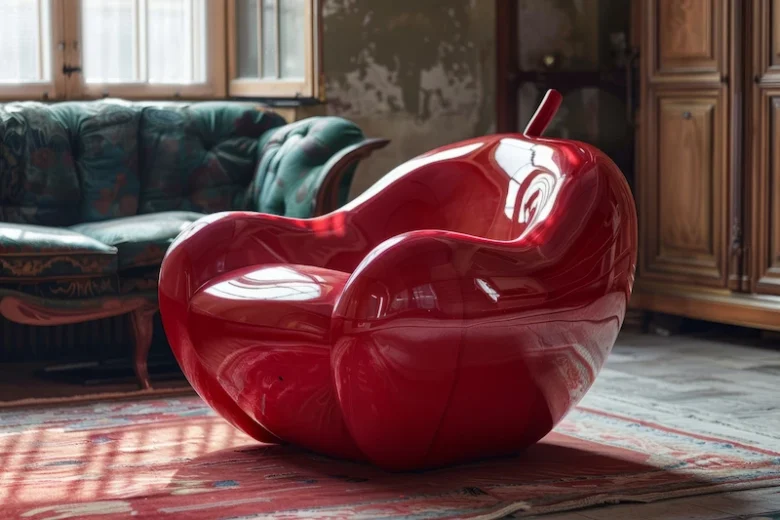
A chunky, rounded lounge chair sitting next to a slim, mid-century bookshelf creates a dynamic tension that makes the room feel curated rather than “themed.” It’s about finding a balance between structure and softness.
Start small with accessories if you aren’t ready for a major furniture investment. Look for vases with “bellies,” lamps with thick bases, or rugs with wavy, organic patterns.
These smaller touches can soften the overall feel of a room and introduce a sense of rhythm. The key is to look for objects that feel “heavy” in a good way—pieces that have a clear presence and don’t just disappear into the background. You want items that invite you to reach out and run your hand over them.
Lighting is also a great way to experiment with this look. Soft, diffused light works beautifully with rounded shapes because it emphasizes the gradients of the curves.
Avoid harsh, directional spotlights that create deep shadows. Instead, use lamps with frosted glass or fabric shades that cast an even glow.
This enhances the “dreamy” quality of the space, making the environment feel more like a sanctuary and less like a showroom. As we saw earlier, the goal is emotional resonance, and lighting is a powerful tool to achieve that.
- Focus on silhouettes: Look for pieces that have a strong, recognizable outline from across the room.
- Prioritize touch: Choose fabrics like velvet, bouclé, or smooth matte finishes that feel good against the skin.
- Play with scale: Don’t be afraid of one or two oversized items that act as “anchors” for the space.
- Mix textures: Combine hard, smooth surfaces like ceramic with soft, plush textiles to create visual interest.
Why this aesthetic matters for our well-being
Beyond the visual appeal, there is a growing body of evidence suggesting that the shapes we surround ourselves with impact our mental health.
Sharp angles and cluttered spaces can increase cortisol levels, the hormone associated with stress. On the other hand, curved lines and soft surfaces are linked to a sense of relaxation and safety.
In a world that often feels sharp and demanding, neotenic design offers a necessary softening of our daily reality.
This isn’t just about “decorating”; it’s about creating an environment that supports emotional regulation. When you walk into a room filled with soft, approachable forms, your nervous system receives a signal that it is okay to relax.
This is especially important in the areas where we rest, like bedrooms and living rooms. By choosing objects that trigger a positive, nurturing response, we are essentially practicing a form of environmental self-care.
This trend also encourages a more mindful way of living. Because these pieces are so tactile and visually engaging, they pull us out of our screens and back into our physical surroundings.
They remind us to appreciate the weight of a ceramic mug or the curve of a chair arm. In this way, the aesthetic acts as a bridge to the present moment, helping us stay grounded in a fast-paced world. It’s a move toward a more conscious, felt experience of our homes.
The intersection of art and utility
One of the most exciting things about this movement is how it blurs the line between a functional object and a sculpture. Many of these pieces are produced in limited editions or by independent artists, making them feel more like “collectible design” than mass-market furniture.
This adds a layer of exclusivity and personal expression to a home. You aren’t just buying a place to sit; you are acquiring a piece of a designer’s vision.
This shift toward “art-furniture” reflects a change in how we value our possessions. We are moving away from disposable culture and toward a more thoughtful selection of items that have a story and a soul.
A bulbous, hand-crafted stool is something you might keep for a lifetime and pass down, rather than something you replace every few years.
This longevity is part of the spiritual side of the trend—finding meaning and connection in the things we use every day.
As we look at the future of our living spaces, it’s clear that the demand for objects that make us feel something will only grow. We want our homes to be more than just containers for our stuff; we want them to be extensions of our personalities and sources of joy.
The move toward softer, more playful forms is a bold step in that direction, proving that design can be high-end, provocative, and deeply comforting all at once.
The long-term impact of the rounded movement
While some might see this as just another cycle in the world of fashion, the underlying principles suggest something more permanent.
The move toward emotional design is a direct response to the “coldness” of the digital age. As more of our lives happen behind glass screens, the physical world must become more tactile and responsive to compensate.
We need the “real” world to feel more “real,” and nothing feels more real than a shape that reminds us of life itself.
We are also seeing this influence spread beyond furniture into architecture and urban planning. Architects are experimenting with curved walls, rounded windows, and “soft” public spaces that encourage social interaction rather than just moving people through a corridor.
The goal is to create environments that feel more human-centric and less like machines for living. This holistic approach suggests that the “chubby” aesthetic is just the tip of the iceberg in a much larger shift in how we build our world.
As you have noticed throughout this article, the power of these shapes lies in their ability to bypass our logical mind and speak directly to our feelings.
They don’t ask us to admire their technical complexity (even if it’s there); they simply ask us to enjoy them. This simplicity is a radical act in a complicated world.
By embracing the “childlike” and the “soft,” we are reclaiming a part of ourselves that often gets lost in the rush of adulthood.
Finding your own path through the curves
The beauty of this trend is that there are no strict rules. You can go full “cartoon” with bright colors and wild shapes, or you can keep it sophisticated with neutral tones and subtle curves.
The most important thing is to choose pieces that resonate with you on a personal level. Does a particular chair make you feel safe? Does a lamp make you smile? Those are the questions that should guide your choices.
Don’t be afraid to take risks. The most memorable rooms are the ones that have a bit of a “wink”—a piece that is unexpected or even slightly disconcerting.
A giant, rounded sofa in a small room might seem like a “mistake” according to traditional design rules, but it can create a sense of cozy drama that a perfectly scaled piece never could. Trust your instincts and let your home be a place of exploration and play.
As we move forward, the conversation around design will continue to evolve, but the human need for comfort and connection will remain constant.
The objects we’ve discussed here are more than just furniture; they are companions in our daily lives. They remind us that it’s okay to be soft, it’s okay to play, and it’s okay to want our surroundings to feel like a warm embrace.
This is the true legacy of the current shift toward a more emotive and youthful aesthetic.
If you find yourself drawn to these stories that challenge the status quo and explore the deeper meaning behind our aesthetic choices, you are exactly who we write for.
At Neomania Magazine, we don’t just follow trends; we look at the soul of the work and the risks taken by the creators. Our pages are filled with narratives that aim to move you, shake you, and inspire you to see the world through a more refined lens.
We invite you to join our community of thinkers and dreamers. Subscribe to Neomania Magazine today and let us take you on a journey through the most provocative and beautiful corners of contemporary culture.