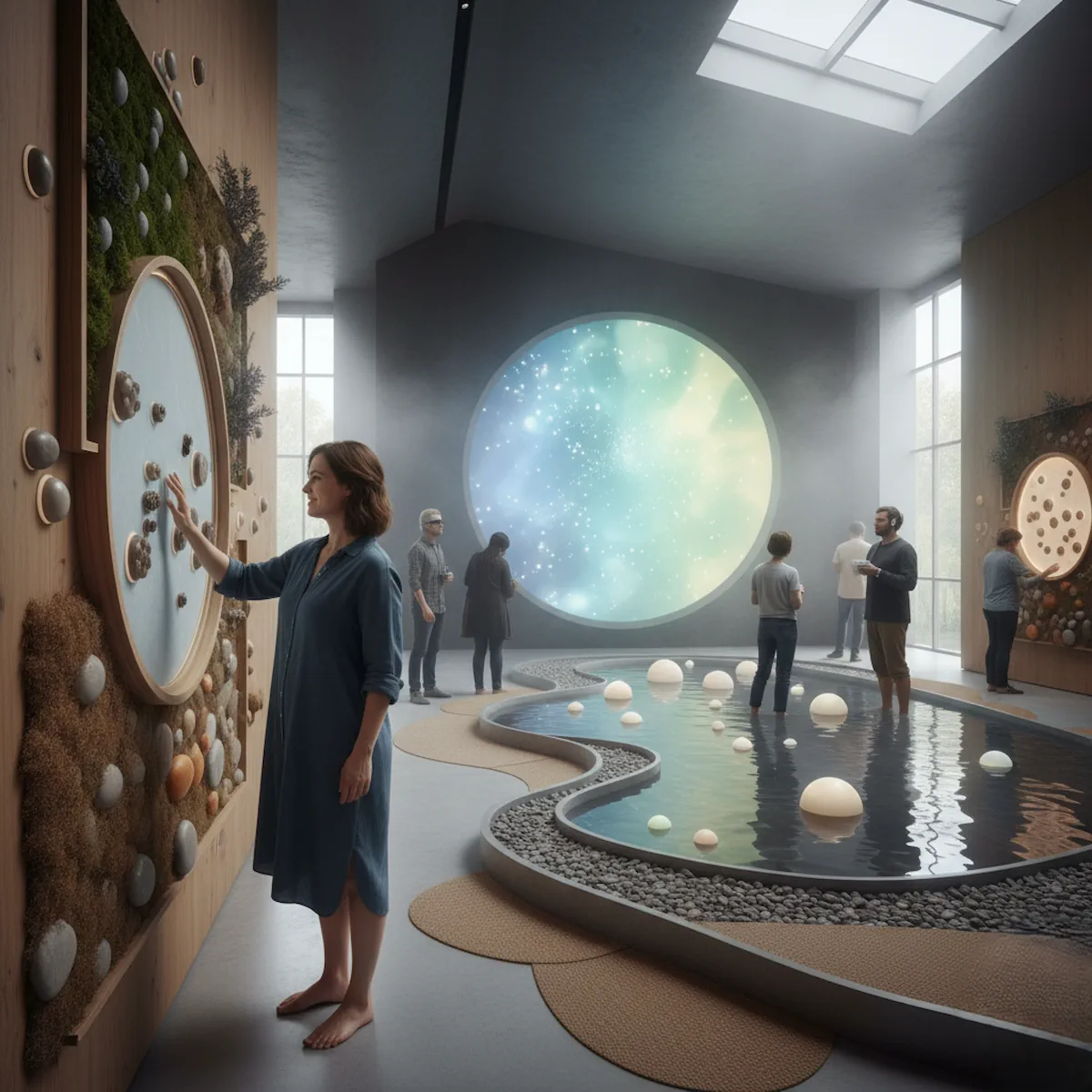
In a world drowning in images, where screens are the windows to reality and aesthetic success is dictated by the viral flatness of social media, Sensory Design emerges not as a mere trend, but as a crucial act of reclamation.
For centuries, Western architecture and design have been enslaved to the eye, operating under a philosophy known as ocularcentrism—the prioritization of vision above all other sensory inputs.
We design for the photograph, not for the phenomenology. While a building’s façade or an object’s form is judged by its visual appeal, its true, profound impact occurs deep within the brain, where the distinct inputs of light, sound, texture, aroma, and temperature merge into complex, lasting experiences.
Sensory Design is the rebellion against visual tyranny. It is a profound philosophical shift that proposes an architecture that is not merely seen, but deeply felt—a built environment engineered to mold not just perception, but consciousness itself.
This methodology moves past superficial aesthetics to focus on the embodied experience; it asks not what a space looks like, but what it does to the body, how it shapes memory, regulates mood, and dictates interaction.
It is a holistic practice that recognizes that the human experience is always multisensory, and that by intentionally designing the entire sensorium, we can create environments that are more therapeutic, authentic, and genuinely engaging—a necessary antidote to the disembodiment of modern life.
The haptic rebellion: architecture for the skin
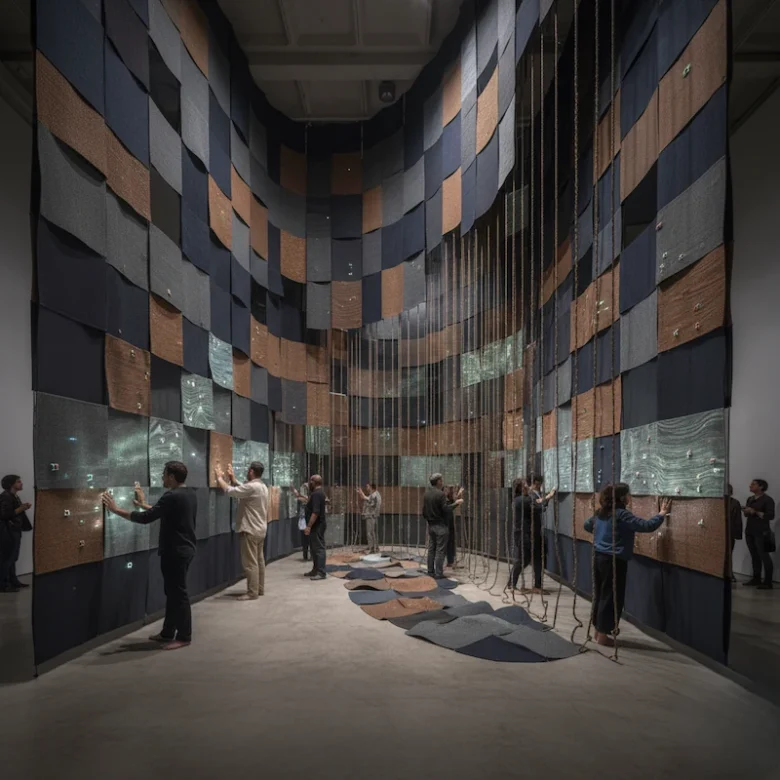
The skin is the body’s largest organ, the boundary between self and world, and our primary medium for sensing the built environment.
Haptics, the science of touch, is crucial because it provides immediate, unfiltered information about temperature, density, and texture that vision often idealizes or misrepresents.
This section champions the sense of touch, exploring how its intentional integration into environments creates a deeper, more kinesthetic connection between the body and its surroundings.
Haptic design grounds us in the present moment, anchoring us to reality and counteracting the psychic disembodiment imposed by purely visual or virtual spaces.
Haptic architecture: materials that speak to the body
The materiality of a space is its silent, tactile language to the body. Every surface we encounter—from the cool, unforgiving surface of steel to the warm, smooth grain of sanded wood—imparts essential emotional and functional data.
Architects committed to haptic design treat material choice as a critical component of spatial composition, recognizing that materials influence not only light reflection and acoustic absorption but, most fundamentally, their physical presence.
This analysis focuses on passive touch, where the environment acts upon the body, transmitting information without conscious effort.
Consider the inherent emotional contrast between walking across a polished marble floor (signifying formality, coolness, and monumentality) versus a hand-knotted wool rug (imparting warmth, domesticity, and comfort).
Temperature and density are key passive properties: a thick, earthen or concrete wall communicates stability, thermal consistency, and protection, reducing perceived anxiety and promoting a primal sense of safety.
Conversely, thin, lightweight, and highly reflective surfaces can feel ephemeral and unnerving. In a therapeutic context, natural, less-processed materials like untreated wood or porous stone offer a form of tactile grounding, promoting a sense of natural equilibrium and well-being that hyper-processed, smooth materials cannot replicate.
Haptic architecture, therefore, moves beyond mere appearance; it is about selecting materials that possess the desired physical and textural properties to elicit a specific, embodied emotional and functional response.
Proprioception and unconscious spatial navigation
Beyond direct, active touch (like feeling a railing), our body interacts with space through proprioception—the inherent sense of self-movement and body position.
Proprioception allows us to know where our limbs are in relation to each other and the environment without looking. Architecture that actively considers this sense is essentially one that guides the body, often unconsciously, turning navigation into a fluid, intuitive experience.
Variations in floor texture (e.g., transitioning from smooth epoxy to textured wood planks), subtle gradients, and intentional changes in level (ramps, steps, sunken seating areas) are design tools that communicate spatial information directly to our nervous system.
A slight slope in a pathway can subconsciously slow our pace, encouraging reflection; a change in the roughness of a handrail can alert us to an impending turn.
This constant, subtle sensory information facilitates the unconscious mapping of a space, making complex environments feel intuitive, safe, and less mentally taxing.
For those with visual impairments, or simply navigating a bustling space while cognitively distracted, these haptic and proprioceptive cues are vital anchors, allowing the body to take over the crucial task of orientation from the already overburdened visual system. The space performs the work of orientation, freeing up cognitive capacity.
The future of touch: haptic feedback in extended reality
In the age of screens and virtual reality, there is an inherent danger of disembodiment—a psychic loss of meaningful physical connection to the environment.
The future of Haptics is actively fighting this trend by reintroducing tactile and gestural interaction into digitally mediated spaces, collectively referred to as Extended Reality (XR).
Haptic technology, particularly in wearables (like haptic gloves or full-body suits), aims to restore the missing sensory channel in VR and AR.
By using precise micro-vibrations, force feedback, pressure, and even temperature changes, these technologies can accurately simulate the feel of a virtual object—the coarse texture of a rough stone, the resistance of a virtual tool, or the gentle tap of a friend’s hand in a shared digital space.
This not only dramatically enhances the realism of the digital experience but, more importantly, re-engages the body, transforming passive visual consumption into active, embodied participation.
In design and engineering, the ability to feel the density of a prototype or the surface of a virtual building through haptic feedback fundamentally changes the critique and development process, making the virtual environment feel genuinely substantial and responsive, moving beyond the flat, visual deceit of the render.
Olfactory and auditory cartography
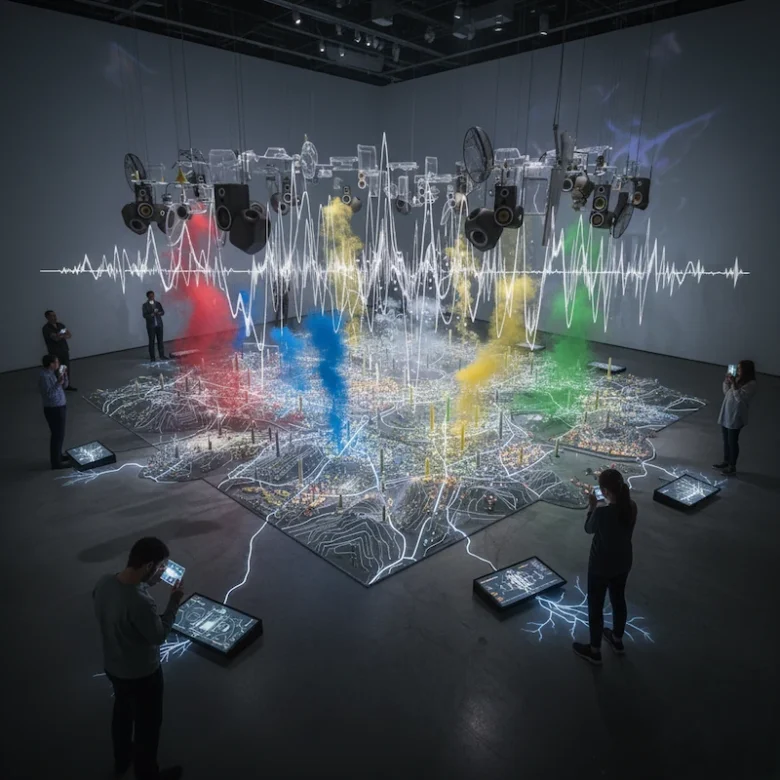
While vision is immediate and precise, sound and scent are arguably the most potent anchors to memory and emotion. They bypass the intellect and travel directly to the limbic system, the brain’s center for emotion and memory, resulting in an unfiltered and profound impact.
This makes them exceptionally powerful, yet often overlooked, tools for the conscious designer. This section details how professionals intentionally craft Soundscapes and Smellscapes to precisely mold mood, memory, and cognitive load.
This practice is about creating an Olfactory and Auditory Cartography—a detailed map of intentional sensory experiences that guide the user’s psychological state.
Sonic architecture: sculpting silence and noise
Effective acoustic engineering must go far beyond simple soundproofing. Sonic Architecture treats sound as a positive design material, focusing on the intentional management of an environment’s acoustic properties to manage stress, encourage interaction, and support concentration.
The goal is not merely to eliminate noise, but to sculpt the intended acoustic territory that enhances the space’s function.
Key acoustic elements include reverberation time (how long sound lingers), echo patterns, and the strategic inclusion of natural sound elements (such as white noise from a discreet water feature or the gentle sound of rustling interior greenery).
A low reverberation time in a library promotes concentration and reduces auditory clutter, while a high, controlled reverberation in a performance hall enhances the feeling of spatial awe and artistic elevation.
In workplaces, the careful introduction of “pink noise” (a softer, more natural version of white noise) or low-frequency ambient music can subtly mask distracting human speech, which is a major source of cognitive distraction, thereby improving focus and reducing perceived stress.
By contrast, a chaotic sonic environment, characterized by unpredictable spikes and competing frequencies, contributes significantly to elevated physiological stress (cortisol levels) and reduced mental performance.
The sonic architect thus designs the acoustic atmosphere to perfectly align with the intended function and emotional state of the space.
The power of olfactory zones: aromatic place-making
The olfactory system is unique; its direct connection to the limbic system means that scent can trigger an immediate, potent emotional connection, memory recall (the famous “Proust phenomenon”), and even biological responses.
Olfactory Zones represent the strategic use of scents for commercial, therapeutic, and cultural purposes—a practice known as Aromatic Place-Making.
In commercial settings (retail, hospitality), a carefully chosen scent acts as an olfactory logo or spatial identity, instantly improving brand recall, creating a sense of luxury, and often subtly influencing consumer behavior (e.g., lavender for relaxation in a spa, citrus for alertness in a fitness center).
In therapeutic and healthcare environments, the use of targeted aromatherapy (such as peppermint for nausea or frankincense for grounding) can directly impact the user’s emotional and physiological state.
The power lies in creating a Smellscape that is congruent with the space’s intended purpose. When an aroma is intrinsically linked to a place, it establishes a powerful spatial identity that endures in memory long after the user has left the physical location, proving that the nose remembers what the eyes quickly forget.
Acoustic gradients: reflection zones vs. social hubs
Effective multisensory design necessitates the creation of deliberate sound transitions and separation—the management of acoustic gradients.
A successful environment, particularly a large, multi-use building like an office or university, cannot function optimally if the diverse acoustic requirements of its distinct activities are merged.
This strategic design establishes clear delineations between reflection zones and social hubs. Reflection zones, such such as individual work pods or quiet libraries, require low acoustic fidelity—meaning limited reverberation, high sound absorption, and minimal competing external sound.
The acoustic design here prioritizes silence or the masking of distracting elements, allowing for deep concentration and mental rest.
Conversely, social hubs (cafeterias, collaboration areas, lobbies) require high acoustic fidelity for clear, open interaction, but also the right level of “sound energy” or human “buzz” to feel vibrant and encourage engagement.
The design challenge lies in managing the transition between these zones, using acoustic barriers, changes in material, or clever space planning to prevent sound bleed, ensuring that the necessary quiet for one activity is not destroyed by the high energy of another. This intentional acoustic planning reduces the internal friction of the building.
Synesthesia and crossmodal alchemy
The most advanced and powerful concept in Sensory Design is Crossmodal Alchemy: the intentional blending and harmonization of the senses.
Synesthesia is the neurological phenomenon where the stimulation of one sensory or cognitive pathway leads to automatic, involuntary experiences in a second sensory pathway (e.g., hearing a sound causes the perception of a color).
While true synesthesia is rare, skilled designers can strategically manipulate one sensory input to influence the emotional or cognitive perception of another—in essence, creating an environment of artificial synesthesia.
This is where the multisensory environment becomes a tool for profound psychological experience enhancement.
Synesthetic design: designing colors that taste
The brain is wired for cross-modal correspondences. For example, high-pitched sounds are consistently associated with brightness and sharp shapes, while low-pitched sounds are associated with darkness and rounded forms. Synesthetic design exploits these inherent, deep-seated brain correspondences to manipulate perception.
A prime example is how visual cues (lighting, color) are engineered to alter perceptions of taste or temperature. Scientific studies have conclusively shown that brightly lit rooms with warm colors (reds, oranges, yellows) can make food taste sweeter and warmer, while dim, cool-colored lighting (blues, greens) can make the exact same food taste more acidic, savory, or even cold.
Similarly, serving a dish on an angular, high-contrast plate can make the flavor profile seem sharper and more intense. This demonstrates the brain’s incredible capacity for cross-wiring, confirming that sensory perception is not compartmentalized but is a fully integrated, malleable, and holistic experience.
Designers use this knowledge to enhance everything from retail packaging to architectural interiors, crafting experiences where the lighting tastes sweet or the sound feels heavy.
Crossmodal congruence: the sensory harmony
The key to a peaceful, restorative, and effective multisensory environment is crossmodal congruence—the science of sensory integration where all inputs align harmoniously.
Incongruence is cognitively jarring and physically taxing; for example, trying to conduct a reflective meeting in a brightly, clinically lit room with a high-tempo, clashing soundtrack creates a pervasive sense of frantic unease.
Congruence is achieved by aligning sensory inputs that the brain naturally pairs: soft, diffuse lighting is congruent with low-frequency, resonant sound and smooth, natural textures.
This harmony does not necessarily mean “low stimulation,” but rather stable and predictable stimulation. When light, texture, sound, and aroma work together seamlessly, the environment feels perceptually rich, emotionally stable, and cognitively effortless.
This subtle unity is the essence of Sensory Harmony, producing an environment that feels intuitively “right,” supporting sustained focus and emotional well-being because the brain does not have to expend energy reconciling conflicting sensory information.
The fifth sense: gastronomy and the architectural plate
Experiential dining is arguably the ultimate multisensory laboratory. It focuses on how the architectural environment and the texture of the tableware fundamentally influence the gustatory perception of food—the so-called fifth sense, taste. Flavor is rarely just about the tongue; it is an integrated experience involving scent, sight, texture, and sound.
The weight, temperature, and even the finish of the utensils or the plate can dramatically alter taste perception. A rough, heavy, dark bowl can make a soup feel more rustic, savory, and wholesome; a smooth, light, white ceramic can make a dessert feel delicate, sweet, and refined.
The acoustic environment is equally crucial: studies show that loud, high-frequency background noise (like traffic) can significantly suppress the perception of sweetness and saltiness, dulling the entire dining experience.
Therefore, the total design of a restaurant—from the shape of its lighting fixtures to the material of its chairs and the sound levels—is as much a part of the culinary experience as the ingredients on the plate. The architectural plate is a canvas where all senses converge to determine the final, perceived quality and flavor of the food.
Therapeutic design and cognitive wellness
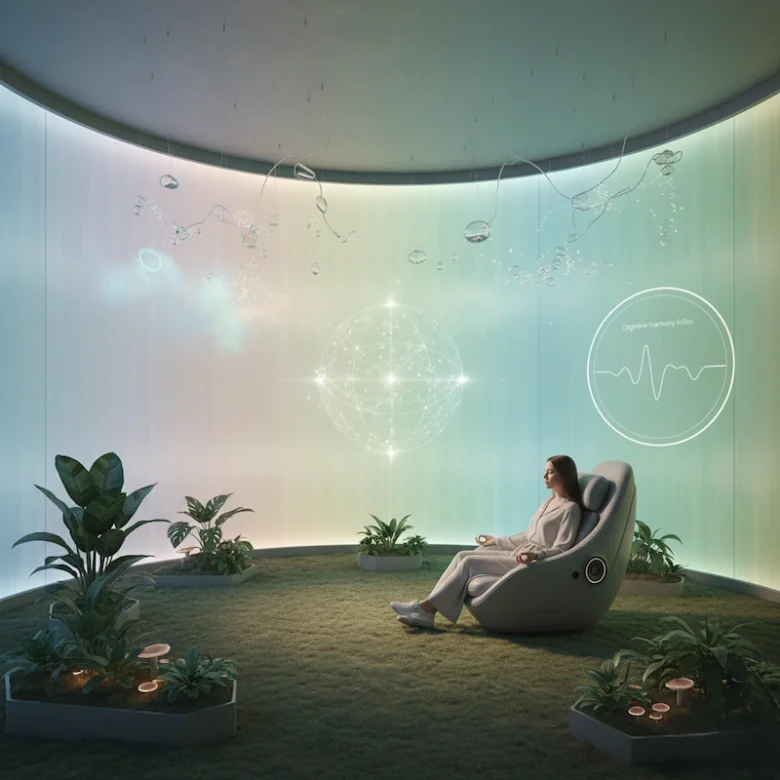
Sensory Design is far more than an artistic pursuit; it is a powerful and precise tool for health and well-being. This section explores environments engineered to reduce stress, improve focus, and provide vital support for a spectrum of diverse neurological needs.
The objective is to create environments that function as therapeutic microclimates, actively managing the body’s physiological state.
Designing for neurodiversity and sensitivity
The modern environment is often overwhelmingly chaotic, particularly for individuals on the autism spectrum or those dealing with other sensory processing challenges.
For these groups, a typical open-plan office, retail space, or bustling corridor can trigger high levels of stress and anxiety due to genuine sensory overload. Sensory-inclusive environments are thus not a luxury, but a core component of equitable design and social responsibility.
This involves providing dedicated spaces that allow for self-regulation. Quiet rooms, low-stimulus zones, and specialized spaces like Snoezelen rooms (controlled multisensory environments) are crucial.
Design strategies focus on providing predictable, controllable sensory input: dimmable, non-flickering lighting; consistent, low-frequency background sound; and a controlled selection of textures and colors that minimize visual crowding and pattern glare—major sources of cognitive distress.
Designing for neurodiversity means recognizing that one person’s stimulating, vibrant environment is another’s source of profound, debilitating cognitive pain.
Environmental stressors and cognitive load
Unchecked sensory inputs function as environmental stressors that silently elevate our physiological stress levels, often without our conscious awareness.
Visual noise (such as cluttered signage, competing patterns, or high-contrast, disorganized color palettes) forces the brain to constantly filter, contributing to what is known as cognitive load.
This sustained mental effort, often unconscious, diverts finite resources needed for focus, problem-solving, creativity, and memory.
Research shows that environments with poor acoustics and high visual complexity contribute directly to rising physiological stress (elevated cortisol levels) and decreased mental performance.
The constant bombardment of chaotic stimuli forces the brain into a state of hyper-vigilance, leading to fatigue and burnout. Therapeutic design actively reduces this load by favoring visual clarity, auditory consistency, and haptic simplicity, effectively creating a low-stress microclimate where the brain can operate efficiently and rest when necessary.
The responsive sensorium: personalizing the environment
The ultimate evolution of therapeutic design is the responsive sensorium: adaptive architecture where environmental systems adjust in real-time based on user needs. This is the move from a static, one-size-fits-all environment to a highly personalized, low-stress microclimate.
Advances in adaptive architecture leverage embedded sensors and user biometrics (heart rate, skin conductivity, eye-tracking) to dynamically control elements like light color and intensity, sound volume and frequency, and temperature zones.
For instance, if a user’s biometrics indicate rising stress, the lighting might subtly shift to a calming, low-intensity amber, and the ambient sound might lower in pitch and volume.
Similarly, systems can learn and apply individual preferences—a user entering a room automatically triggers their personalized acoustic profile.
This hyper-personalization ensures that the environment is always working to support the individual’s unique neurological needs, moving beyond mere comfort to become a truly cognitively supportive prosthetic for the modern mind.
Challenging ocularcentrism in creative practice
The final, and perhaps most critical, step is the self-examination of the creative industry itself. This section questions why design remains so powerfully visually biased and proposes a necessary, systemic shift toward a truly holistic, embodied methodology. The true rebellion is against the design process itself.
The retinal journey: the deficiency of 2D renders
Contemporary architecture and interior design face a profound challenge: an over-reliance on digital visualization. CGI renders, glossy photography, and social media imagery have become the primary tools for both selling and judging design.
The problem is that these tools are inherently retinal—they capture only the visual plane, creating a pervasive deficiency of 2D renders.
This reliance has tragically detached the design process from crucial non-visual, embodied experiences. A render cannot capture the echoing coldness of a marble hallway, the smell of aged timber, the comforting density of a handrail, or the stress induced by a high-frequency ambient hum.
By designing for the camera, we risk creating spectacular visual environments that are awful to inhabit. The creative practice must shift from prioritizing the visual spectacle to prioritizing the phenomenal experience—from the fleeting image to the enduring feeling.
The sensory audit: a methodology for wholeness
To operationalize the principles of Sensory Design, a new methodology must be formally adopted: the Sensory Audit. This is a vital, non-visual methodology implemented in the initial project phases, before a single CGI render is produced, to ensure all senses are addressed by design.
The Sensory Audit is a structured framework that requires the design team to answer specific questions for every space based on all five major senses and the haptic/proprioceptive system:
- Auditory: What is the target reverberation time? What is the background noise goal (dB level)? What intentional sounds will be included?
- Olfactory: What materials contribute scent (natural wood, leather, stone)? What is the intentional olfactory zone (if any)? What ambient pollutants must be eliminated?
- Haptic/Tactile: What is the temperature goal for the surface of the floor? What is the textural journey? How does the material density communicate stability?
- Gustatory (where applicable): How does the environment influence perceived taste?
By making non-visual inputs mandatory and measurable, the Sensory Audit ensures the design process is truly holistic, moving the industry away from mere styling toward conscious, human-centric engineering.
Juhani Pallasmaa’s Manifesto: the homeless senses
We conclude this exploration by referencing the seminal critique of Modernism articulated by Finnish architect Juhani Pallasmaa.
His powerful manifesto asserts that contemporary, visually-obsessed design has tragically “housed the intellect and the eye, but has left the body and the other senses homeless.”
The sterile, visually perfect boxes of modernism, stripped of texture, aroma, and resonant acoustics, are monuments to this ocularcentric tyranny.
Sensory Design is the antidote to this homelessness. It is a philosophy that calls for radical humility from the designer—a willingness to acknowledge that the body, not the eye, is the ultimate sensor of architecture.
By embracing the full spectrum of the sensorium, we move beyond mere function and aesthetics to create environments that are deeply authentic, restorative, and profoundly human.
The future of design is not in what we look at, but in how we feel in the places we inhabit.