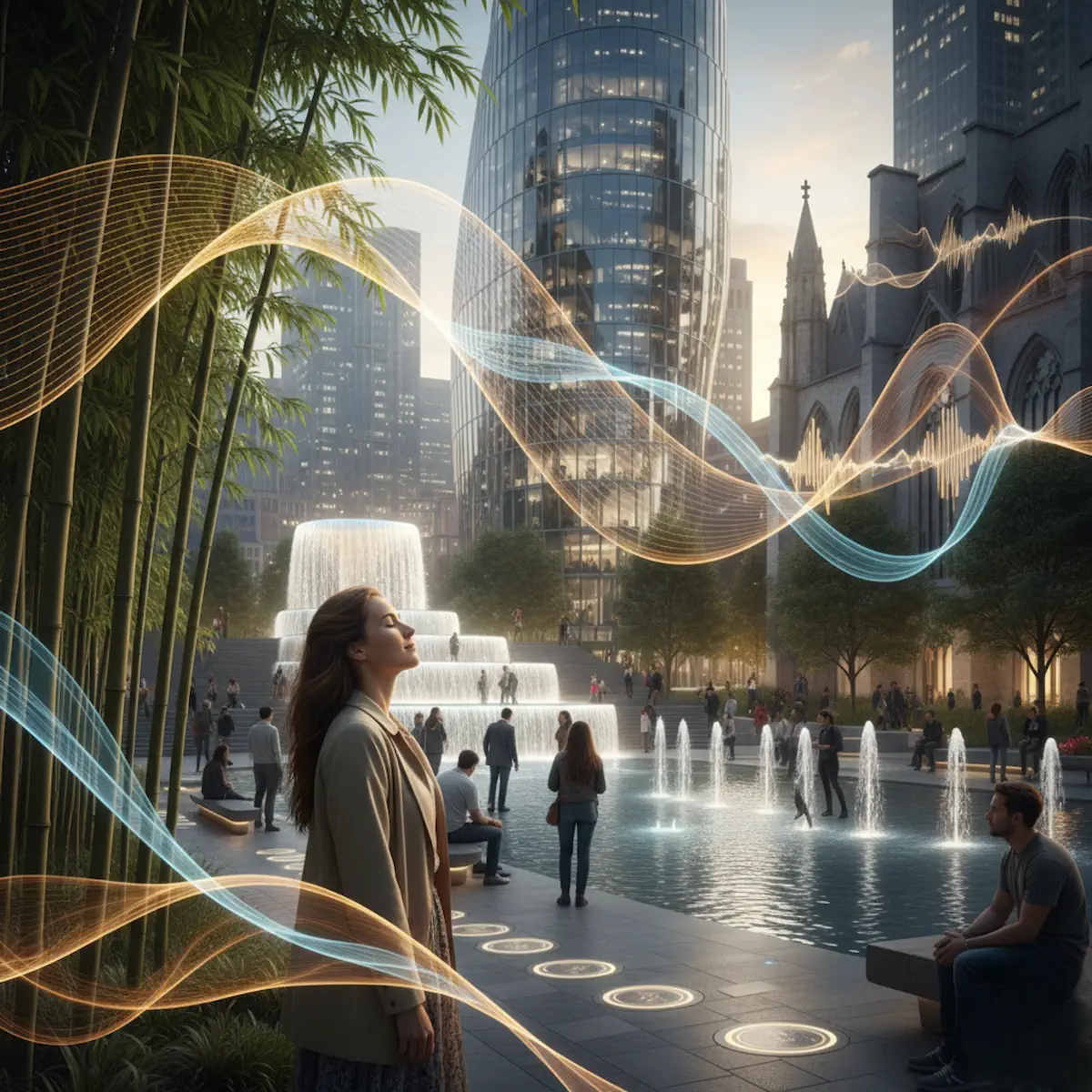
In an age when we are perpetually bombarded with visual information, we often forget that our perception of a space is a multi-sensory act. We navigate the world through a screen, prioritizing what we see to the detriment of what we hear and feel.
Our built environment, from sprawling cityscapes to intimate domestic spaces, is overwhelmingly designed for the eye, with sound often relegated to a secondary, and often overlooked, concern.
This is the premise of Sonic Architecture—a radical discipline that posits the aural environment is as fundamental to a building’s design as its physical form.
This isn’t just about acoustics or soundproofing; it’s a philosophical inquiry into how we build for the ear, not just the eye. Sonic architecture challenges us to consider a space not as a static object, but as a dynamic, responsive instrument waiting to be played.
The philosophy of aural space
Sonic architecture is a quiet revolution that moves beyond the visual primacy of traditional design. It operates on the radical premise that sound is a building material, and that the architect is, in essence, a composer.
This shift in perspective is a critical move from a purely functional approach to a holistic, sensory one, where the invisible and the audible are given equal weight to the visible and the tangible.
Beyond noise control, toward narrative:
Traditional acoustic design aims to minimize unwanted noise. It is a defensive strategy, a reactive measure to block out the clamor of a world that is too loud. The goal is silence, or at least a manageable decibel level.
Sonic architecture, by contrast, seeks to create intentional soundscapes that tell a story. It’s an offensive strategy, a proactive act of creation. A library’s hush, a church’s echoing reverence, or a public square’s lively murmur are not accidental byproducts; they are deliberate components of a designed experience.
The architect is not merely creating a container for life but composing the soundtrack for it. The question shifts from “How do we make this space quiet?” to “What does this space sound like, and what meaning does that sound convey?”
Consider a hospital. A traditional acoustic approach would focus on isolating patient rooms from hallway chatter and machinery noise.
A sonic architect, however, would ask a deeper question: What is the sound of healing? Perhaps the answer lies in gentle, low-frequency hums embedded in the walls, or in water features designed to produce a constant, soothing cascade.
The sound is not simply reduced; it is curated to promote well-being. This deliberate, narrative-driven approach elevates sound from a problem to be solved to a tool for emotional and psychological manipulation, in the most positive sense of the word.
The medium is the message:
Just as a painter chooses canvas and a sculptor selects stone, the sonic architect uses material and structure to shape sound. A room of polished marble will sound vastly different from a room of wood and textiles.
These material choices are not aesthetic add-ons; they are fundamental to the auditory experience, conveying a sense of coldness or warmth, formality or comfort, simply by how they make sound travel.
The reverberation time in a concrete hall, for example, is far longer than in a room with upholstered furniture and thick curtains. This physical reality has a profound psychological effect.
The echo in a cavernous concrete space can feel alienating and sterile, while the muffled softness of a carpeted room can evoke a sense of intimacy and security. A designer who understands this can use a building’s very skeleton—its walls, floors, and ceilings—as a soundboard.
A smooth, curved surface will reflect sound differently than a rough, perforated one. A long, narrow hallway will create a corridor of sound, while a wide-open atrium will disperse it in all directions.
The material and the form are inextricably linked to the aural experience they produce, making them critical components of the philosophical statement the building is making. To truly design a space, then, is to choose its voice.
How sonic architecture is practiced

The application of this philosophy requires a new kind of creative process—one that is both scientific and artistic, blending empirical data with intellectual inquiry.
It’s a departure from the traditional linear path of architectural design, demanding a deeper level of sensory engagement and interdisciplinary collaboration.
Auralization and sensory mapping:
A core tool of the sonic architect is auralization, a technology that uses mathematical and physical models to create an audible representation of a space before it is built.
This allows designers to literally “listen” to their blueprints, hearing how a planned concert hall will sound from every seat, or how a new office layout will affect the flow of conversation.
It’s the aural equivalent of a 3D architectural rendering, making the invisible audible. This process goes hand-in-hand with sensory mapping, where designers analyze and document the existing soundscapes of an environment to understand their psychological impact on its inhabitants.
Before breaking ground on a new urban park, for example, a sonic architect would conduct a “soundwalk” of the area, recording the ambient noises—the distant hum of traffic, the chatter of birds, the rustle of leaves—to understand the existing aural ecosystem.
This data then informs the design, ensuring that the new space harmonizes with, or intentionally disrupts, its surrounding soundscape.
Designing with vibration and resonance:
Every material, from concrete to glass, has a unique vibrational frequency. Sonic architects manipulate these properties to create spaces that resonate with a specific mood or purpose.
They might incorporate low-frequency vibrations into a wellness center floor to promote relaxation or design a facade that acts like a musical instrument, producing unique sounds based on wind and weather.
This is where the practice moves from passive manipulation to active creation. Consider the work of sound artist Bill Fontana, who uses microphones and sensors to create “live sound sculptures” from the very fabric of urban life, transforming the sounds of bridges and buildings into a dynamic, musical composition.
Another example is the use of non-traditional materials for their acoustic properties. Imagine a wall made of bamboo, where each stalk is a different length, creating a subtle chime as air flows through the room.
The building is not just a structure; it’s a living instrument. This deep engagement with the physical properties of matter goes beyond aesthetics and into a realm of physics and sensory experience, where the building itself is an active participant in the creation of its own reality.
Historic and contemporary examples
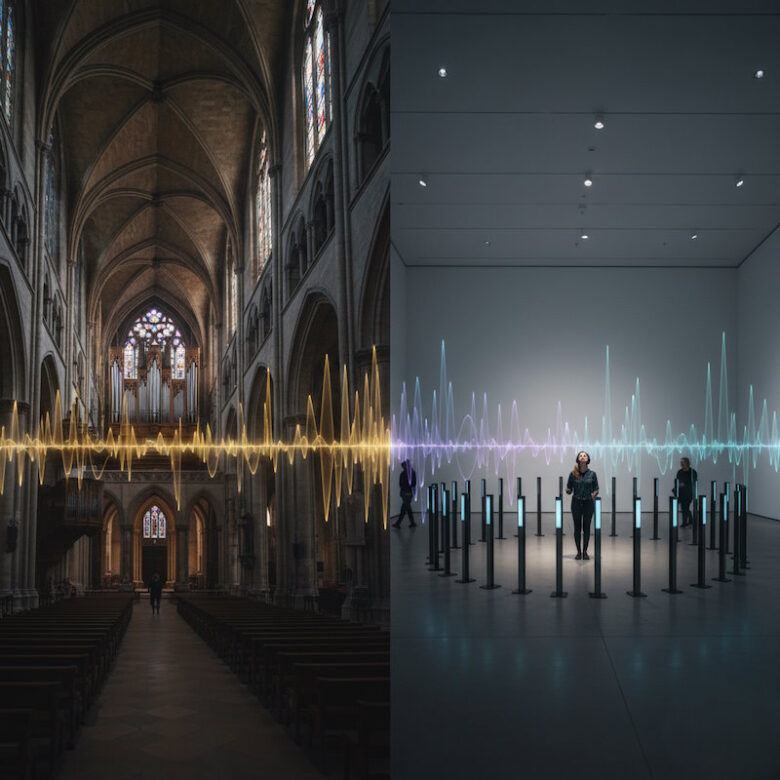
The principles of sonic architecture, while newly articulated, have deep roots in human history. They are also being pushed into new, uncharted territory by contemporary artists and designers who see the built environment as a canvas for aural expression.
From ancient cathedrals to modern installations:
Ancient builders intuitively understood the power of sound, using the vaulted domes of cathedrals to create an otherworldly resonance that amplified religious reverence.
The long reverberation time of a stone cathedral was not an accident; it was a deliberate design choice that made the human voice sound divine and the organ music feel transcendent.
This sonic quality instilled a sense of awe and spiritual connection, making the building feel larger than its physical dimensions.
Today, artists and architects are applying these concepts in new ways. Think of public art installations that use wind chimes or water to create a dynamic sonic landscape, or experimental music venues designed to create a completely immersive, auditory-first experience.
A prime example is the work of Steven Holl, whose “Chapel of St. Ignatius” in Seattle uses differently shaped spaces and light shafts to create a distinct acoustic character for each part of the building, from the quiet meditative space to the resonant gathering hall. The building’s form is, in essence, a musical score.
The deconstruction of the soundscape:
Much like the conceptual fashion designers who deconstruct clothing to question its purpose, sonic artists deconstruct ambient sound to reveal its hidden meanings.
They might record the sounds of a specific street corner, isolate the various layers—traffic, conversation, distant music—and present them as an aural essay on urban life, forcing us to listen to a reality we normally tune out.
This practice of soundscape deconstruction, pioneered by figures like R. Murray Schafer, treats the environment’s sound as a complex text to be analyzed and reinterpreted.
A notable example is Janet Cardiff’s “The Forty Part Motet,” an installation that takes a 16th-century choral piece and plays each of the 40 vocal tracks through a separate speaker.
As the listener walks around the room, they can choose which individual voice to focus on, or stand in the center to hear the complete, complex harmony.
This simple act of spatializing sound deconstructs the unified musical experience into its individual parts, forcing the audience to engage with the composition in a completely new, spatial way.
Sonic architecture in a digital age

The rise of virtual reality and a digital-first culture has opened up an entirely new frontier for sonic architecture, where the constraints of physics and material are dissolved.
The metaverse and digital spaces are not silent; they are an auditory canvas where designers can explore ideas of sound, space, and aural identity without the limitations of the physical world.
The virtual soundscape:
In the metaverse, designers are free to create spaces with impossible acoustics. Sound can defy gravity, change form based on a user’s avatar, or be made of impossible materials like “liquid light.”
This is the ultimate playground for the sonic architect, where the design is the pure expression of an idea, unbound by physical reality. In a virtual world, a user’s footsteps might not create a sound in the traditional sense, but could instead trigger a unique musical note based on the texture of the virtual floor.
A digital waterfall could be designed to sound like a symphony rather than a cascade of water. The potential for narrative and emotional manipulation is boundless, allowing for a level of sensory design that is impossible in the physical world.
Sound as a digital artifact (NFTs):
The concept of owning a sound is now a reality. The rise of NFTs (Non-Fungible Tokens) allows artists to sell unique, verifiable digital soundscapes.
The value lies not in a physical object, but in the singularity of the idea itself—a sound that exists only in a digital space, a kind of conceptual sculpture for the ear.
This is the logical conclusion of an art form that prioritizes idea over object. A sonic architect could create a unique, algorithmic soundscape that evolves over time, and sell it as an NFT.
The “owner” would not possess a physical thing, but the intellectual property of a unique, ever-changing aural experience. This re-contextualizes sound from a fleeting event to a collectible artifact, further cementing its status as a legitimate art form.
An essential critique, not an elitist experiment
Like all avant-garde movements, sonic architecture faces its critics, who dismiss it as an inaccessible, overly intellectual pursuit. They question the relevance of designing with sound when the world is already so loud and so visually saturated.
They ask, “Who has the time or the inclination to think about the sound of a building when we’re just trying to get from A to B?”
The laboratory for the future:
However, this critique misses the point. Sonic architecture is the R&D department of our built world. It is a critical laboratory where our fundamental assumptions about the purpose of spaces are challenged and re-examined.
Without this space for radical thought, our environments would only repeat themselves, endlessly churning out new versions of the same aural experiences.
The work of a sonic architect, even if it is not immediately applicable to a mass-produced building, pushes the boundaries of what is possible. It forces us to ask: What would a city sound like if it were designed like a symphony?
How could our homes soundscapes be tailored to promote sleep and reduce stress? This research, while seemingly abstract, provides the foundation for future innovations that will inevitably shape our everyday lives.
Ultimately, sonic architecture invites us to wear a new set of ears, to let our environments challenge and converse with us. It asks not what a space looks like, but why it sounds the way it does. In that question lies a future where form and frequency are the same thread.
If you believe the deepest style is to wear an idea, you’ve found your home. Neomania Magazine explores the currents of thought shaping art, design, and culture—always seeking the question behind the form.
Explore more radical ideas. Follow Neomania Magazine.