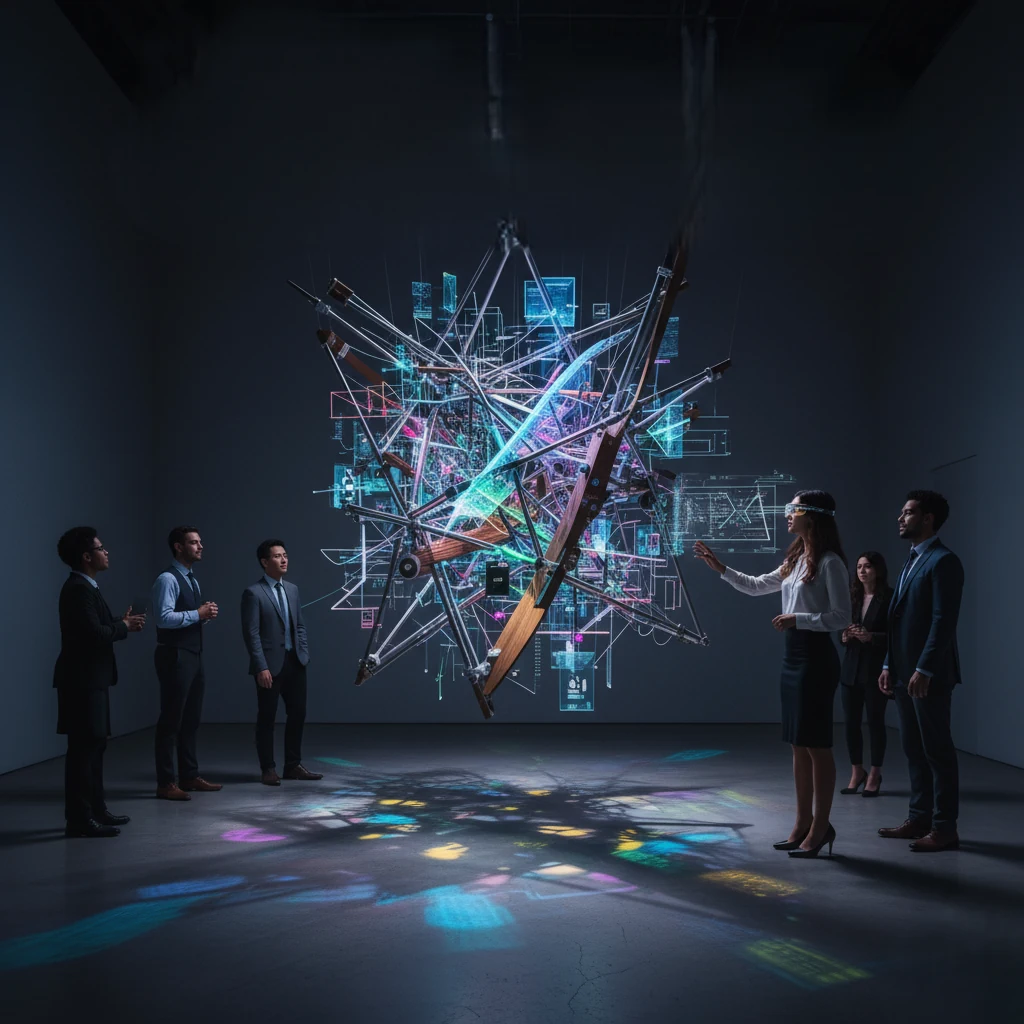
The world is drowning in data. Every click, transaction, weather pattern, and social interaction generates terabytes of information, yet our primary way of consuming it remains fundamentally flat: charts, graphs, and dashboards displayed on two-dimensional screens.
We are afflicted by information fatigue, a dulling of the senses that occurs when abstract complexity is constantly reduced to simplistic, on-screen visuals. The meaning, context, and emotional weight of the data are often lost in this translation.
In response to this crisis of comprehension, a revolutionary artistic and technological discipline has emerged: Data-Sculpture. This is more than just data visualization rendered in 3D; it is the physicalization of information.
It transforms abstract metrics into tangible, sensory experiences, forcing us to engage with data through touch, light, and space.
Data-sculptures are the pioneering frontier where art, science, and design thinking converge, creating a language that is not only beautiful but profoundly effective at communicating complex truths.
This movement challenges the passivity of screen-based consumption, offering a visionary pathway to a more intuitive and empathetic relationship with the data that defines our world.
The crisis of comprehension why data visualization fails us
For decades, we’ve relied on digital bar charts, pie graphs, and line graphs to make sense of our world. While efficient for basic analysis, these methods often fail when dealing with the true scale and multi-dimensionality of Big Data.
Our brains, evolved to navigate a three-dimensional world, struggle to form a deep connection with static, flat representations.
Information fatigue overcoming digital overload
Imagine looking at a graph showing a decade of global climate data. The line on the screen suggests warming, but it rarely evokes the visceral understanding of rising oceans or melting glaciers.
This gap between the data point and the human reality is the source of information fatigue. The brain dismisses the abstract information as background noise.
Data-Sculpture cuts through this noise by harnessing our innate spatial cognition. When a dataset is converted into a physical object—a twisted metallic form, a shifting field of lights, a complex wooden lattice—it acquires mass, shadow, and presence.
It cannot be minimized or scrolled past; it demands a physical encounter. This shift from passive viewing to active sensory engagement is crucial for converting abstract numbers into actionable insight.
Defining data physicalization from abstract to tangible
While data visualization maps data to visual variables like color and position on a plane, data physicalization maps data to physical variables: texture, size, weight, and material. A data point ceases to be a pixel and becomes a module, a rod, or a kinetic piece of an intricate machine.
The key lies in the translation process. Every measurable element in the dataset—a stock market trend, the severity of a drought, the volume of a city’s noise—is systematically assigned to a physical attribute.
For instance, air quality data might determine the hue and opacity of a glass rod, while pollution peaks might dictate the height and spikiness of a 3D-printed mountain range.
This methodological rigor ensures the artistic output remains faithful to the underlying quantitative truth.
The inherent human need to grasp information spatially
The impulse to translate information into physical objects is not new; it predates digital screens by millennia. Ancient civilizations, such as the Mesopotamians, used clay tokens of various shapes to record complex economic transactions, effectively using tangible interfaces to manage data.
Similarly, indigenous cultures have used knotted ropes (like the Peruvian quipu) to record narratives, census data, and history.
Data-sculpture taps into this deep, primal need to touch, manipulate, and explore information within our physical environment.
By moving beyond the screen, it respects how the human brain naturally processes complexity—through spatial relationships, tactile feedback, and object permanence. The information becomes grounded, intuitive, and ultimately, more memorable.
The alchemy of form tools and techniques of the new medium

The sophistication of contemporary data-sculpture is inseparable from the technological revolution in fabrication and generative design.
Modern artists and designers function less like traditional sculptors and more like alchemists, using code and machine precision to transmute raw data into compelling forms.
From algorithm to object generative ai designs
A groundbreaking development in the field is the use of Generative Artificial Intelligence (AI). Artists are now training machine learning algorithms with massive, focused datasets—everything from satellite images to municipal records.
The AI then uses these datasets as the “pigment” or raw material to generate entirely new, complex, and often organic forms.
The celebrated media artist Refik Anadol, for instance, uses vast public data to create fluid, immersive media installations he calls “data paintings” and “data sculptures.”
The algorithm doesn’t just render the data; it finds hidden correlations and patterns within the dataset that a human might never spot, translating that unseen structure into a dynamic, flowing form.
The result is a work of art that is, at its core, a visualization of the machine’s own perception of the information.
Precision fabrication 3d printing and materializing metrics
The leap from a digital model (a data-driven script) to a physical object is made possible by digital fabrication technologies. These tools offer the precision required to assign distinct data points to subtle changes in material form.
- 3D Printing: Ideal for translating complex, organic, or fine-grained datasets. A sculpture representing global internet traffic might use 3D printing to create thousands of interlinked nodes, where the size and thickness of each link precisely correspond to the volume of data transferred between two points.
- CNC Milling and laser cutting: Used for large-scale, intricate structures, often employing materials like wood, metal, or acrylic. These methods ensure high structural integrity while precisely engraving or cutting forms where variables like depth, density, or angle represent different metrics.
The choice of material is itself a critical data mapping. A sculpture tracking fossil fuel consumption might be cast in heavy, opaque metal to convey the weight and permanence of the issue, while one tracking endangered species might use fragile, translucent glass to express vulnerability.
Kinetic narratives data streams driving movement and light
The most engaging data-sculptures are often kinetic and interactive. They don’t just depict data; they perform it in real time, transforming a static object into a responsive environment.
These installations integrate live IoT sensors (Internet of Things) and web APIs to feed constantly changing data streams into the sculpture.
For example, a piece tracking a city’s air quality might use sensors to modulate the color and speed of LED lights embedded within the structure.
As pollution levels rise, the lights might shift from a calm blue to an agitated red, pulsing faster. This dynamic interaction turns the sculpture into a living data display, allowing the audience to witness and feel the subtle rhythms and sudden crises hidden within the urban environment.
The new aesthetics of truth iconic data-sculptures
Data-sculptures are redefining the aesthetic landscape of contemporary art. By giving form to complex and often sobering truths, they imbue beauty with a powerful ethical and intellectual depth.
Capturing the unseen sculpting climate and noise
Some of the most powerful data-sculptures tackle environmental data, making vast, often abstract, phenomena comprehensible at a human scale.
The artist Nathalie Miebach is famed for translating complex weather data—wind speed, pressure, temperature—into intricately woven, basket-like sculptures.
She maps each variable to a unique element: changes in wind direction might be a specific knot, while pressure drops might be a color change in the reed.
The finished piece visually represents a single, massive weather event, like a hurricane. By transforming the overwhelming power of nature into a familiar, domestic craft, she makes the scale of climate data intensely personal and approachable.
Similarly, works dealing with noise pollution or seismic activity use spikes and textures to represent invisible disturbances, giving them physical form so that the viewer can trace the impact of a loud neighborhood or a subtle geological tremor.
The emotional metric giving weight to human data
The true power of this medium lies in its capacity to address human and social issues with empathy. When an artist physicalizes data on topics like poverty, migration, or public health, the scale and material used can generate a strong emotional response.
For example, an exhibition might use a field of thousands of simple, small ceramic figures to represent the number of lives lost to a pandemic in a specific region.
The sheer volume and the repetitive, solemn material choice convey a sense of collective loss far more effectively than a bar chart.
Other works might use the roughness of a texture or the unsettling tilt of a structure to represent inequality or political instability, transforming dry statistics into profound, shared human experiences.
Artists to watch pioneers defining information art
The field is being rapidly defined by a growing cohort of artists and design studios:
- Nathalie Miebach: For her fusion of craft and climate science.
- Refik Anadol: For his groundbreaking use of generative AI in large-scale digital installations.
- Laurie Frick: Known for her colorful, tactile sculptures that map personal, everyday data (steps, sleep, spending) into intricate physical patterns.
- Studio Drift (Lonneke Gordijn & Ralph Nauta): Although known for broader kinetic art, their pieces often use algorithms based on natural data patterns (like starling murmurations) to create mesmerizing, technologically mediated natural beauty.
These pioneers demonstrate that the most compelling Data-Sculpture does not merely illustrate numbers, but uses them as a precise, artistic scaffolding to reveal hidden truths.
From gallery to guild corporate and strategic value
While born in the art world, Data-Sculpture is rapidly gaining traction in the corporate, governmental, and academic spheres. Its ability to simplify complexity and drive consensus offers a distinct strategic advantage over traditional 2D reporting.
Bridging the insight gap physical models for CEO decisions
In the world of high-stakes corporate strategy, communication failure is expensive. When executives are presented with hundreds of digital slides, the crucial insights can be missed. Data-sculptures offer a powerful alternative.
Companies dealing with extremely complex physical logistics—such as supply chain optimization, resource allocation in manufacturing, or urban planning—are commissioning physical data models.
A sculpture representing the global supply chain, for example, allows a team to walk around the model, literally point to bottlenecks (represented by structural constrictions), and physically grasp the interconnectedness of variables.
This tactile interaction leads to faster comprehension, better team alignment, and more informed decision-making, helping to bridge the cognitive gap between the data scientist and the CEO.
Experiential branding immersive public and retail installations
The novelty and high-tech elegance of data-sculptures make them ideal for modern branding and public engagement. A dynamic installation based on live data is a highly effective way for a brand to communicate transparency, innovation, and relevance.
Technology firms and forward-thinking corporations are commissioning real-time data installations in their lobbies, retail spaces, and at conferences.
A piece might dynamically visualize positive social media sentiment about the company’s product, or display live, anonymized data flow across a global network.
These installations serve as powerful, aesthetic conversation starters, transforming what would otherwise be invisible infrastructure into a beautiful, engaging statement about the brand’s connection to the modern world.
The policy impact translating science for public advocacy
For policymakers, scientists, and journalists, data-sculpture is becoming a vital tool for public advocacy and scientific literacy. Many of the most critical issues facing society—climate modeling, epidemiological trends, and demographic shifts—are too complex to explain adequately in a press briefing or a newspaper graphic.
By translating these complex scientific models into physical, tangible objects, the information becomes accessible to non-experts.
A sculpture depicting rising sea levels over the next 50 years, for instance, can be installed in a public square, using literal height and proximity to force the viewer to confront the imminent physical reality of the threat.
This medium allows researchers to communicate complexity without sacrificing accuracy, making it a compelling instrument for shaping public opinion and driving policy change.
The tangible future data-sculpture and the augmented world
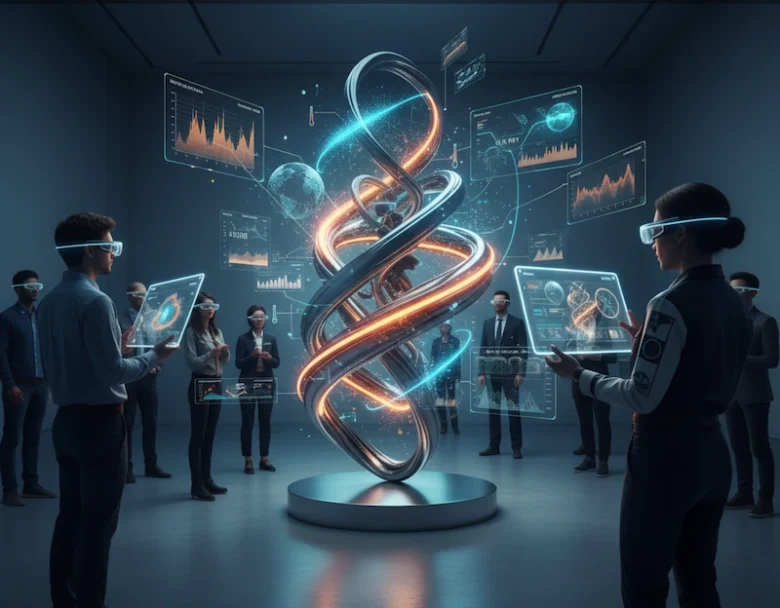
The trajectory of Data-Sculpture is leading toward its full integration with the technological fabric of our lives, transforming our environments into dynamic, data-responsive spaces.
The fusion of real and digital data sculpture meets AR
The next evolutionary stage involves the convergence of physical data-sculpture with Augmented Reality (AR). Imagine viewing a static, physical sculpture that represents a year’s worth of data.
By holding up a tablet or wearing AR glasses, the sculpture instantly comes alive:
- Layered information: Digital annotations, time-lapsed movement, and numerical values appear overlaid on the physical form.
- Interactive exploration: The user can physically walk around the sculpture while using the AR interface to isolate specific data points, change the time scale, or switch between different metrics.
This hybridization—where the physical object provides the crucial, grounded context, and the digital layer offers infinite, fluid detail—promises the most intuitive and powerful data interaction experience yet conceived. The physical form anchors the story; the AR provides the interactive encyclopedia.
Wearable data personal metrics as data-jewelry
The philosophy of data physicalization is also scaling down to the personal level. Data-jewelry or Data-Wearables are a niche trend that transforms an individual’s personal metrics—their sleep cycle, their child’s heartbeat, their daily movement—into elegant, custom-made pieces of jewelry or artistic objects.
A necklace might have beads whose color and number correspond to months of consistent exercise. A ring’s subtle texture might reflect the wearer’s heart rate variability during a specific, memorable week.
This allows individuals to internalize and memorialize their own data narratives, turning the abstract surveillance of a fitness tracker into a tangible, emotional keepsake.
Data humanism an empathetic relationship with information
Ultimately, the rise of Data-Sculpture is a movement toward Data Humanism. It is an acknowledgment that data is not merely objective—it is deeply human, reflecting our behavior, our planet, and our society.
By giving data a body, a texture, and a presence, data-sculpture fosters a sense of empathy and intellectual connection. It reminds us that every data point represents a real-world event, a choice, or a life.
As our world grows infinitely more complex, this discipline offers a vital counterpoint: a tangible, beautiful, and honest way to understand the unseen forces that shape our existence. It is not just the future of visualization; it is the future of clarity.
The question is no longer whether we can visualize data, but whether we can feel it. Data-sculpture answers with a resonant, three-dimensional yes.
If you found yourself fascinated by the convergence of technology, sophisticated design, and human-centric innovation—you’re ready for Neomania Magazine.
Neomania is dedicated to exploring the cutting edge of art, science, and global culture. We cover the breakthroughs that transform the abstract into the tangible, the digital into the dynamic, and the future into the now.
Don’t just observe the future; be fluent in its language.