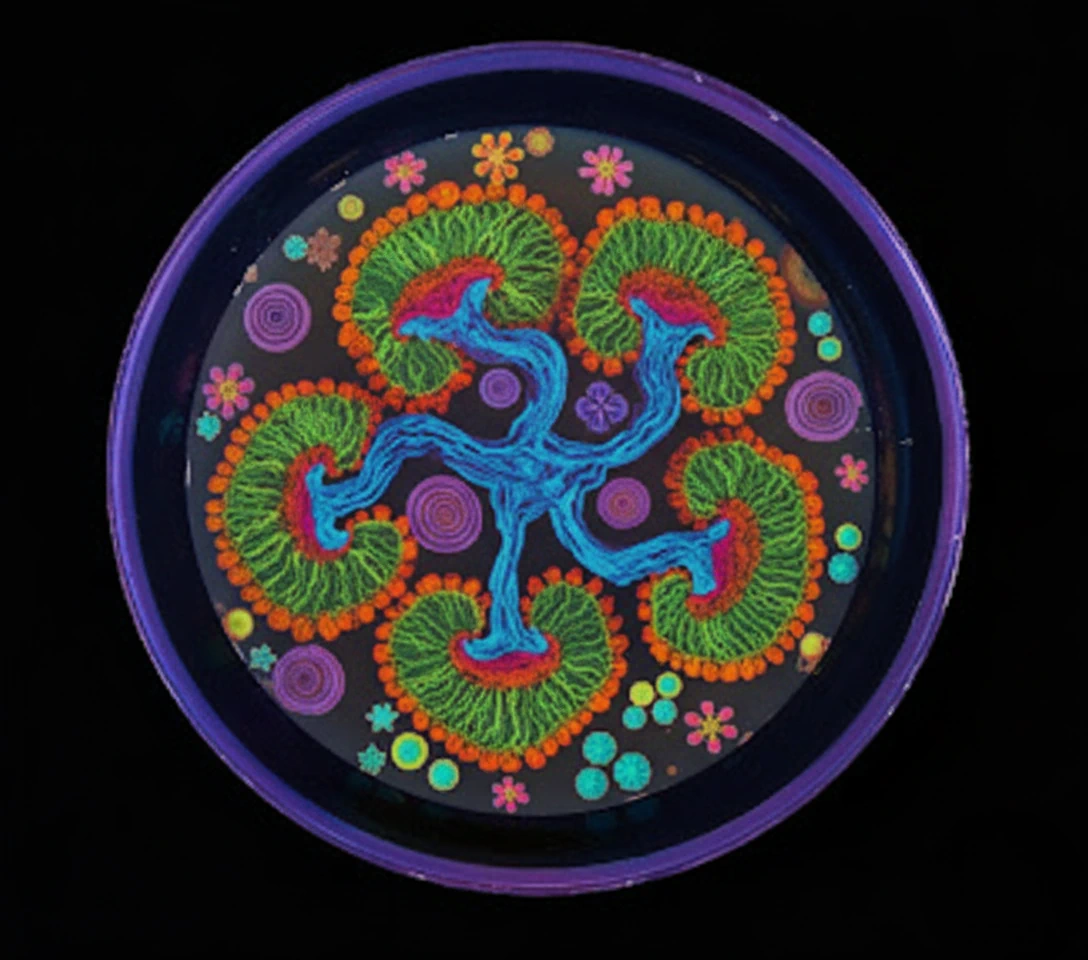
The 20th century saw the death of painting proclaimed countless times. The 21st century, however, has witnessed the death of the inert medium.
Today, some of the most challenging and thought-provoking art is not made of bronze, oil, or stone, but of living matter: flesh, bacteria, DNA, and human tissue.
This is the realm of Bio-Art, a radical discipline where the artist steps out of the traditional studio and into the sterile, buzzing environment of the biological laboratory.
Bio-Art (or Biological Art) is more than just a collaboration between art and science; it is a profound philosophical confrontation. It forces us to reconsider fundamental questions about life, creation, ethics, and our right to manipulate the biological world.
By using techniques like genetic engineering, cloning, and tissue culture, Bio-Art does not merely represent life—it uses life as its very medium, blurring the line between creation and cultivation, between the aesthetic object and the living organism.
This is a field where masterpieces are not judged solely on their visual impact, but on the intensity of the ethical debate they spark.
It is a necessary art for the era of genetic engineering and synthetic biology, acting as a crucial cultural mirror reflecting the immense power—and responsibility—now held by human hands.
Defining life: from canvas to culture dish
Bio-Art is not simply painting pictures of DNA or sculpting figures of viruses. Its defining characteristic is the incorporation of biological material or life processes as the core component of the artwork.
Beyond pigment and stone: what is Bio-Art?
Bio-Art is a field of artistic practice that integrates biological processes and materials, or even “wet-ware,” into the final piece. Unlike conventional sculpture, which is defined by its fixed form, Bio-Art is often characterized by change, growth, and decay. The art piece is less an object and more an ecosystem or a controlled experiment.
The artist becomes a bio-curator, responsible for maintaining the life of the work—feeding the cells, controlling the temperature, and managing the growth.
This shift in role from solitary creator to caretaker of a living system fundamentally alters the relationship between the artist, the artwork, and the audience. The artwork is alive, therefore it is vulnerable, and its inevitable demise is part of the statement.
The Bio-Art toolkit: genetic engineering, tissue culture, and synthetic biology
Bio-Artists utilize the same high-tech tools and protocols as cutting-edge biological research labs:
- Tissue culture: Growing human or animal cells in a laboratory environment (in vitro). This allows artists to cultivate miniature pieces of “living sculpture” that are aesthetically profound and ethically complex (e.g., growing ear-shaped tissue from cells).
- Genetic engineering (Transgenics): Introducing genetic material from one species into another to create a new, modified organism. This is arguably the most controversial technique, as it fundamentally alters the blueprints of life.
- Synthetic biology (SynBio): An extension of genetic engineering, SynBio applies engineering principles to biology. Artists use this to design and construct entirely new biological parts, devices, and systems that do not exist in the natural world.
- Bioreactors and incubators: These specialized containers become the aesthetic presentation vitrines. They are necessary to keep the biological medium alive, thus making the scientific apparatus a crucial part of the artistic display.
The radical shift in authorship: when the work grows on its own
In traditional art, authorship is clear: the person who manipulates the material is the creator. In Bio-Art, the boundaries dissolve. Once the artist introduces the bacteria to the nutrient agar, or modifies the DNA of a seed, the organism takes over. The growth patterns, the color changes, the microbial interactions—these are determined by biological laws, not the artist’s hand.
This raises profound philosophical questions:
- Is the artist the creator, or is the bacteria the collaborator?
- Does the artwork end when the artist stops intervening, or when the organism dies?
The ambiguity of authorship forces the viewer to acknowledge that the artwork is not a static representation, but a co-creation between the artist’s initial concept and the unpredictable agency of life itself.
The pioneers and the ethical edge
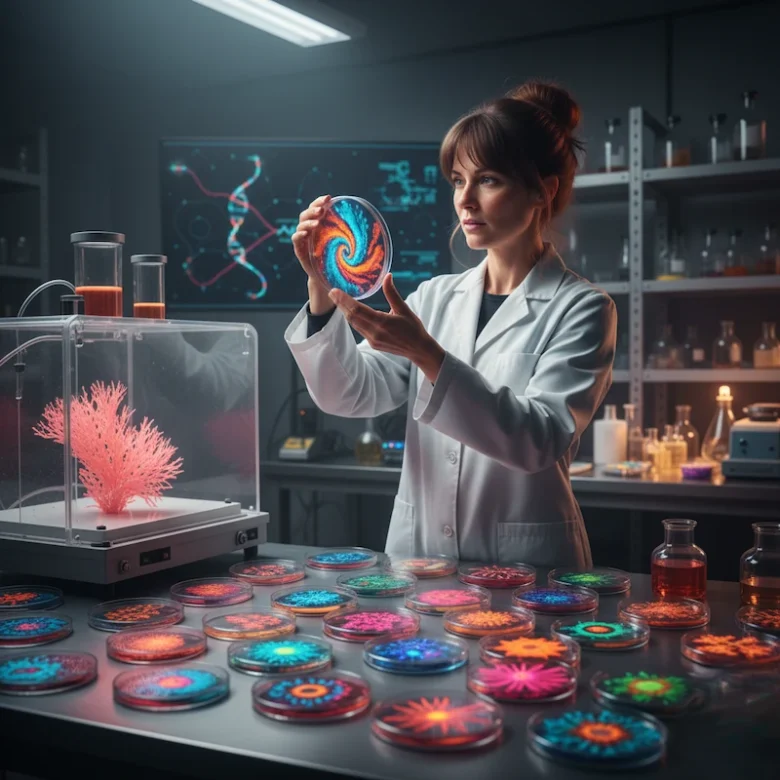
The history of Bio-Art is marked by seminal works that were intentionally provocative, designed to drag the public conversation out of the laboratory and into the gallery.
The GFP bunny (Eduardo Kac): a landmark of transgenic art
Perhaps the most famous and controversial piece of Bio-Art is “Alba,” the GFP (Green Fluorescent Protein) Bunny, conceived by the Brazilian-American artist Eduardo Kac in 2000.
Kac collaborated with scientists to create an albino rabbit that was genetically modified to carry a gene from a jellyfish. This gene made Alba fluoresce bright green when exposed to blue light. The work, known as GFP Bunny, was designed to be a living, breathing commentary on transgenics.
- The conceptual statement: Kac’s work was a form of “transgenic art” intended to start a public dialogue on the integration of genetically modified animals into society, pushing the boundaries of what is considered “natural” and what is “life.”
- The controversy: The laboratory that created Alba initially refused to release the rabbit to Kac, fearing public backlash. This act of censorship inadvertently amplified the artwork’s message: the ethical discussion surrounding transgenic life is fraught with fear, control, and political power. GFP Bunny became a widely recognized piece of art never seen by the public, transforming it into a powerful conceptual critique on the invisible politics of genetic science.
Microbial landscapes: using bacteria and fungi as pigments
Other Bio-Artists use simpler, yet equally compelling, living materials. Artists use bacteria, mold, and yeast—often considered contaminants—as their “paints.”
- The process: Artists culture different strains of brightly colored bacteria on petri dishes (the canvas) with nutrient agar (the medium). The artwork develops over days or weeks as the colonies grow, compete, and form unique, intricate patterns.
- The message: This work makes visible the ubiquitous, unseen world of microbiology, reminding us that we are constantly surrounded, and even permeated, by a dynamic microbial landscape. It challenges the aesthetic judgment of these organisms, elevating the microbe to the status of muse.
The moral dilemma: when does art cross the line into playing god?
The ethical core of Bio-Art resides in its manipulation of sentient or self-sustaining life. The line between artistic expression and ethical violation is constantly being tested.
- The victimless leather project (SymbioticA): This work involved growing a miniature, sterile leather jacket using tissue culture from mouse cells. The project aimed to provoke debate about the use of animals for material consumption, asking: Is a “victimless” commodity possible if the material still originates from a living system?
- The ethical boundary: The key ethical question is not just “Can we do it?” but “Should we do it?” Bio-Art forces the policy-makers and the public to confront the implications of emerging biotechnologies long before they hit the consumer market, serving as an ethical early warning system.
Bio-Art in the Ibero-American lens
While pioneers like Kac emerged from the Brazilian context, Bio-Art has a specific resonance and criticality within Spain and Latin America, rooted in unique cultural and environmental histories.
Biodiversity as medium: critiques on Bio-Colonialism and native flora
Latin America, home to some of the world’s richest biodiversity, offers a powerful, context-specific canvas for Bio-Art. Here, the use of biological material is often a direct comment on environmental politics, resource exploitation, and “bio-colonialism”—the appropriation of native genetic resources by foreign entities.
Artists from the region:
The works of artists from the region often focus on endemic species, soil degradation, or water quality, turning the laboratory from a site of creation into a site of conservation or critique. For example, installations that use local, contaminated water samples or genetically modified seeds of native crops directly address the human impact on the environment.
Henry G. Sanchez (US/Latinx Context):
His Bio-Art Bayou-torium project in Houston is a socially engaged bio-art initiative that focuses on local environmental justice and the restoration of the city’s bayous.
It merges the art studio and the science lab to foster stewardship among marginalized, often Hispanic, communities.
From Cinetism to cells: the tradition of science-driven art in the region
The integration of science and art is not new in the Ibero-American world. Modern Bio-Art finds conceptual predecessors in movements like Cinetism (Op Art/Kinetic Art).
Artists like Jesús Rafael Soto and Julio Le Parc sought to incorporate mathematical precision and scientific concepts (optics, physics of light/motion) into their work.
Bio-Art simply takes this logical progression one step further: if the kinetic artist uses the physics of light, the bio-artist uses the chemistry of life.
The precision of the algorithm is replaced by the precision of the genome. The art remains rooted in structure, process, and system.
Key artists and installations: highlighting ibero-american voices in the lab
- Joaquín Fargas (Argentina): Known for projects like “Biosphere”, Fargas often creates self-sustaining ecological systems encased in spheres. His work focuses on ecological sustainability, climate change, and the necessity of balance in ecosystems, turning the art object into a miniature, self-regulating world.
- Marta de Menezes (Portugal): A leading European Bio-Artist, de Menezes explores the identity and mutability of biological beings. Her work Proteic used butterflies whose wing patterns were altered chemically to challenge the perception of nature’s fixed form. She often works with DNA, proteins, and surgical techniques, blurring the line between biological alteration and artistic intervention.
- Regina de Miguel (Spain): De Miguel explores scientific imagery and the discourse of scientific legitimacy. Her multi-media projects often generate “possible fictions” that critique the power dynamics inherent in scientific narratives, examining how biology defines and legitimizes social structures.
The material reality: process, ephemerality, and scale
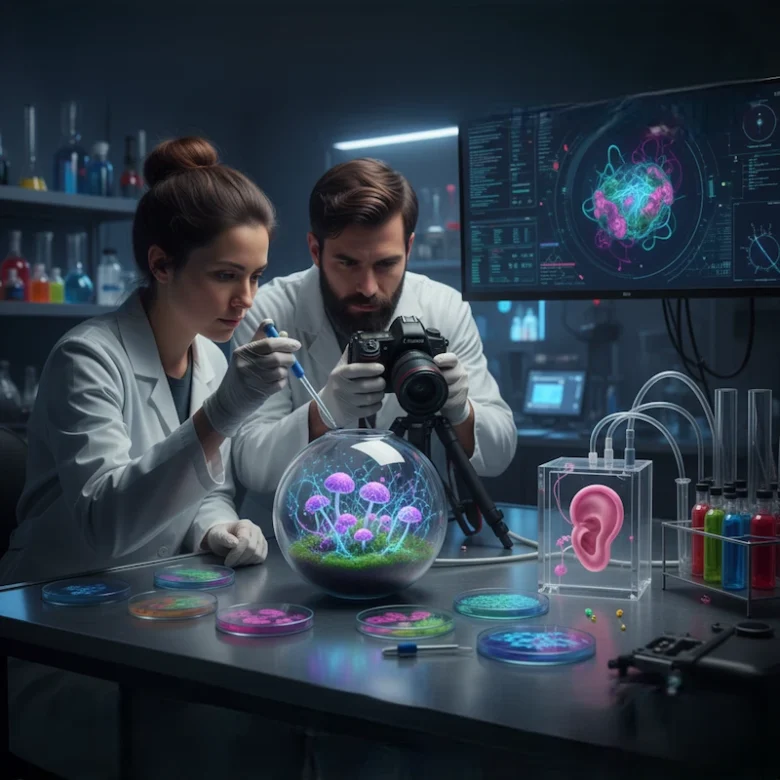
Working with life introduces variables—and challenges—that are unique to this art form. The logistics of the lab become inextricably linked to the meaning of the work.
Ephemeral beauty: the inevitable death and decomposition of the artwork
A critical element of Bio-Art is its ephemeral nature. Since the medium is living, it is mortal. The perfect microbial landscape eventually consumes its nutrient base; the tissue culture must die or be preserved.
- Conceptual weight: This ephemerality is often the central conceptual point. The artwork serves as a powerful metaphor for life itself—beautiful, process-driven, and finite. Unlike a bronze statue designed to last millennia, Bio-Art forces the viewer to confront mortality and the fleeting nature of existence.
- Documentation: Due to this impermanence, documentation (photography, video, and scientific data logging) becomes essential. The final piece of the artwork is often not the living organism itself, but the record of its existence, growth, and death.
The role of the scientist-collaborator: art as interdisciplinary research
Few artists are also trained geneticists. Bio-Art necessitates deep interdisciplinary collaboration. The artist provides the conceptual framework and the ethical provocation; the scientist provides the technical expertise and access to the lab.
This relationship is a crucial component of the art. It challenges the traditional separation of the “two cultures”—the sciences and the humanities—by proving that their most profound questions are often the same.
The process itself becomes a performance of shared inquiry, where the tools of empirical research are appropriated for aesthetic and philosophical ends.
Scales of existence: from DNA encoding to large-scale ecosystems
Bio-Art operates across the entire spectrum of life’s scale:
- Micro-Scale (DNA): Artists like Joe Davis have experimented with encoding information into the DNA of bacteria, turning the biological code into a microscopic message board. The smallest unit of life becomes a medium for literature or history.
- Meso-Scale (Tissue/Organs): The growth of small, organ-like structures (e.g., the ear sculpture by Stelarc or Oron Catts) focuses on the concept of the body, challenging the integrity and the boundaries of the human form.
- Macro-Scale (Ecosystems): Other artists create self-sustaining miniature ecosystems (like Fargas’s Biosphere), addressing macro-level concerns about global sustainability, climate, and the balance of nature.
Bio-art’s future: the symbiotic horizon
As synthetic biology moves from the theoretical to the commercial, Bio-Art is evolving to remain a relevant and necessary critic.
Synthetic biology and ‘living’ architecture: designing life for function and form
The future of Bio-Art is deeply entwined with Synthetic Biology (SynBio). If SynBio seeks to engineer life for industrial purposes (biofuels, materials, new drugs), Bio-Art aims to use that same engineering to ask why and how we are doing it.
- Future materials: Artists are experimenting with growing functional, aesthetic materials. Imagine architecture that is grown, not built—structures made from self-repairing mycelium or “living concrete” developed by bacteria. The art object could become a utility that cleans the air, processes waste, or provides sustenance.
- Designing for the sixth extinction (Alexandra Daisy Ginsberg): This conceptual work explored the possibility of designing novel, artificial species using synthetic biology to support endangered ecosystems, questioning the human hubris involved in both causing and attempting to fix mass extinction.
The public’s role: Bio-Art as a catalyst for scientific literacy and policy debate
In an era where scientific literacy is crucial for civic participation, Bio-Art serves as a public interface for complex science.
- Democratization of the lab: By taking lab equipment and processes out of sterile isolation and placing them in public view, Bio-Art makes science accessible and debatable. It encourages a deeper scientific literacy, allowing people to move past fear and truly engage with the biotechnology shaping their future.
- Guiding policy: The provocative nature of Bio-Art often preempts ethical debates that will eventually become public policy. By forcing society to confront “what if” scenarios (e.g., creating edible organs, genetically modified pets), artists prepare the ground for responsible regulation and ethical consensus.
A new humanism: reconnecting with our biological reality in a digital age
In the end, Bio-Art is a call for a new humanism in the digital age. As we spend more time in virtual realities and abstract digital spaces, Bio-Art reminds us that our essence is material, biological, and vulnerable.
The artwork, whether a glowing rabbit, a landscape of bacteria, or a piece of cultivated tissue, forces us to confront the fact that we are all part of the same biological tapestry.
By working with life, Bio-Art is not just showing us the future of art; it is showing us the future of us—a future where the lines between the natural and the artificial are perpetually blurred, and where our biological reality is the most powerful and demanding medium of all.
If the convergence of advanced biology, ethical inquiry, and cutting-edge culture is what drives your curiosity, you are ready for the level of insight offered by Neomania Magazine.
Neomania is your essential source for exploring the trends that are redefining the future of art, technology, design, and science in the globalized world.
We cover the stories of the innovators who, like the Bio-Artists, are using the tools of tomorrow to pose the most urgent questions of today.
Don’t let the crucial ethical and aesthetic debates happen without you. Dive deeper into the culture that is transforming our very existence.