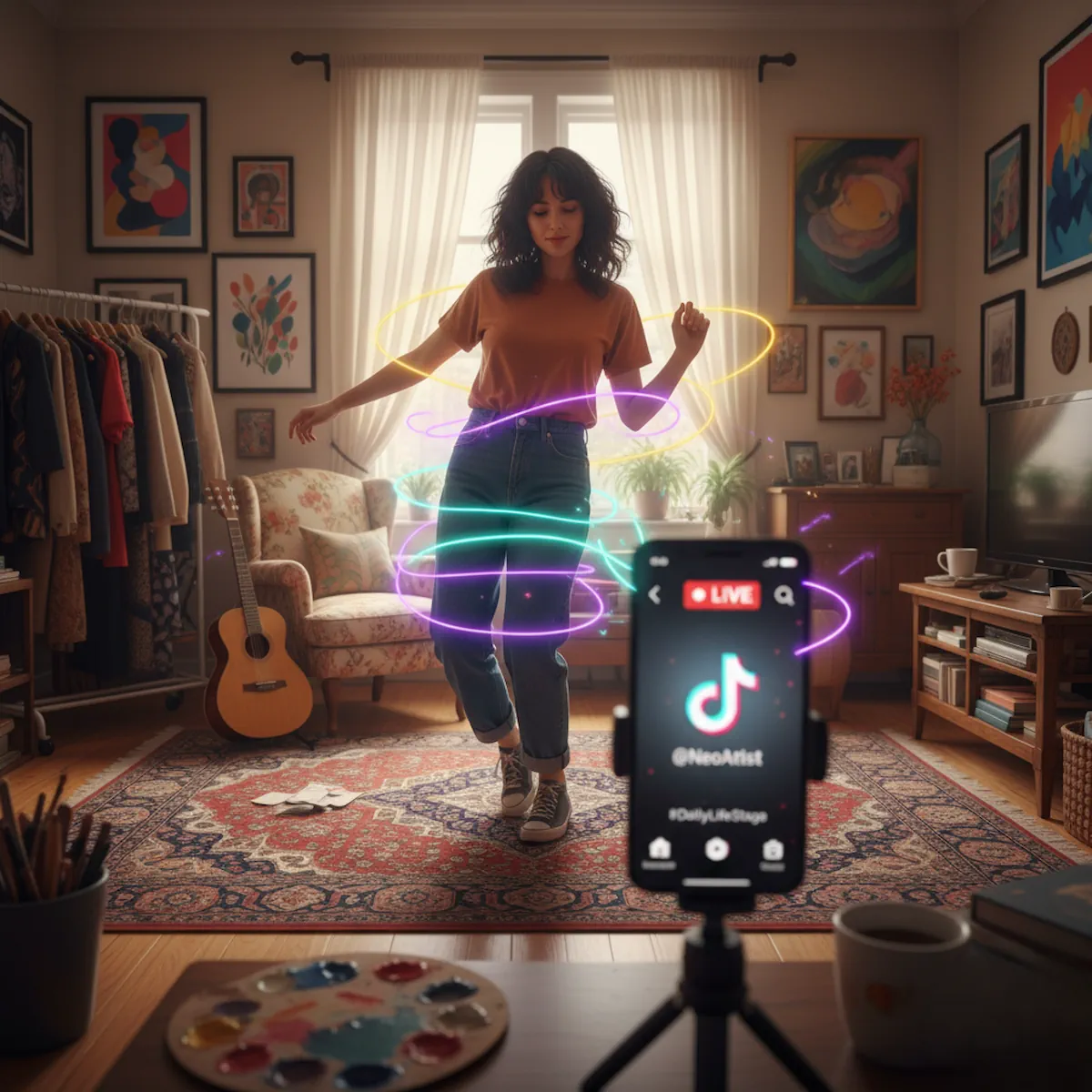
In a world where screens have replaced stages and every smartphone is a camera, the very nature of performance art is undergoing a radical, democratic transformation.
The rigid, often inaccessible gallery space has been deconstructed, and in its place, we find the boundless, ephemeral digital scroll of TikTok.
This is not a degradation of the form but a profound evolution, an invitation to a new kind of dialogue where everyday life is a choreographed statement, and every user is a potential performer.
This isn’t just about dance challenges; it’s a philosophical inquiry into what it means to perform, to be seen, and to create in the hyper-mediated now.
For decades, performance art was a niche discipline, relegated to the white walls of galleries or the fringe of experimental theater. It was a form defined by its ephemerality, its intentional friction with commercialism, and its direct confrontation with a live, in-person audience.
But with the rise of platforms like TikTok, these defining characteristics have been shattered and reconfigured. The art form has escaped the confines of its institutional home and burst into the mainstream, becoming a part of the daily rhythm of millions.
It’s a revolution that is simultaneously celebrated for its accessibility and derided for its perceived triviality. To truly understand this shift, we must look beyond the surface-level trends and examine how the platform is fundamentally rewriting the grammar of performance.
The deconstruction of performance
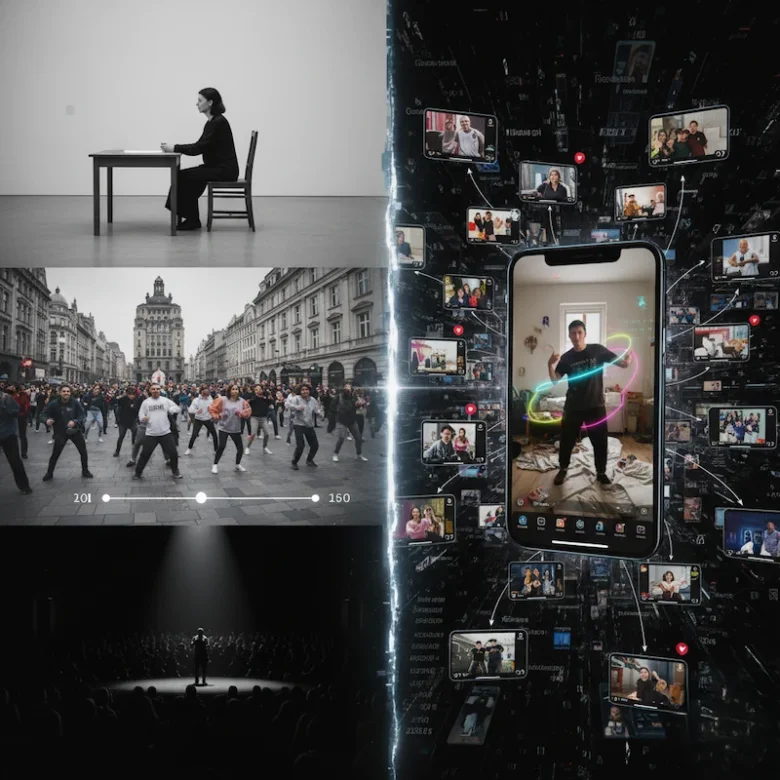
Just as conceptual fashion challenged the idea of clothing, TikTok is deconstructing the foundational elements of performance art—time, space, and audience—and reassembling them into a new, potent form.
This is not an act of simple reproduction but of radical re-contextualization, forcing us to re-evaluate our long-held assumptions about what constitutes art and who can be an artist.
From curated event to continuous feed:
Performance art traditionally existed in a fixed time and place, a singular event for a select audience. Think of Marina Abramović sitting motionless in a gallery for hours or a flash mob erupting in a public square.
The art was defined by its beginning, middle, and end. On TikTok, this is completely inverted. The performance is a constant, flowing stream. It’s an endless, looping present.
The content is no longer a one-time spectacle but a fragment in an endless, algorithmically curated feed, where a fleeting, 15-second action can hold as much meaning as a long-form gallery piece.
A carefully choreographed dance, a comedic skit, or a vulnerable monologue can be experienced as a small, potent burst of energy that then disappears into the scroll, only to be resurrected by the algorithm for another user.
This lack of a fixed, linear narrative challenges the artist to compress their idea into a powerful, bite-sized punch, making the medium a master of brevity and conceptual economy.
The audience as a participant:
In the traditional gallery, the audience is a passive observer. They are there to witness, to receive, and to reflect, but not to intervene in the act itself. The TikTok audience, by contrast, is an active participant.
Through likes, comments, stitches, and duets, the viewer becomes a co-creator, a collaborator, and sometimes a critic. The art piece is not complete until the community engages with it, fundamentally blurring the line between performer and spectator.
A creator’s performance can become a prompt for a thousand different interpretations as other users perform a “duet” with the original video, layering their own performance on top of it.
This isn’t just a feature; it’s a core tenet of the art form itself. The single, auteur-driven performance is replaced by a collective, decentralized act of creation, where the meaning of the work is shaped by a global, networked community.
The medium is the act: a new language
TikTok has given rise to its own unique aesthetic and a new set of visual and intellectual cues. The value system is inverted, prioritizing authenticity over polished perfection and personal narrative over grand abstraction.
The platform’s unique features and constraints have forced creators to invent a new visual and aural language to express their ideas.
The aesthetics of the unfiltered:
Unlike a carefully lit and rehearsed theatrical performance, TikTok thrives on the raw and the unscripted. The use of shaky camera footage, raw audio, and imperfectly edited cuts isn’t a flaw; it’s a deliberate aesthetic choice that signals authenticity and intimacy.
The design is in service to the provocation, inviting the viewer into a vulnerable, unmediated moment. The creator’s bedroom becomes a stage, their kitchen a set.
There is no proscenium arch, no formal distance between the performer and the audience. The art is integrated into the mundane reality of the creator’s life, and that very integration becomes part of the performance’s conceptual weight.
This “anti-perfection” aesthetic is a direct rebellion against the highly curated and filtered world of platforms like Instagram, signaling a shift in what is considered valuable and relatable.
Sound as the central narrative:
While traditional performance art often uses sound as a backdrop, on TikTok, the audio is the seed, the skeleton, and the soul of the performance.
A sound clip can become the prompt for thousands of interpretations, transforming a simple meme into a collective, spontaneous choreography.
The platform’s language is a conversation between image and sound, where a fleeting gesture or expression becomes a universal statement simply by being paired with a specific track.
The audio, which is often a repurposed clip from a movie, a song, or a voice-over, carries a powerful narrative subtext. The visual performance is often a reaction to or an interpretation of this sound, making the audio the primary text and the visual a kind of poetic commentary.
A user might not know the exact meaning of a video, but the sound tells them everything they need to know—it’s a call to action, a moment of vulnerability, or a comedic punchline, all communicated in a split second.
The roots in avant-garde thought
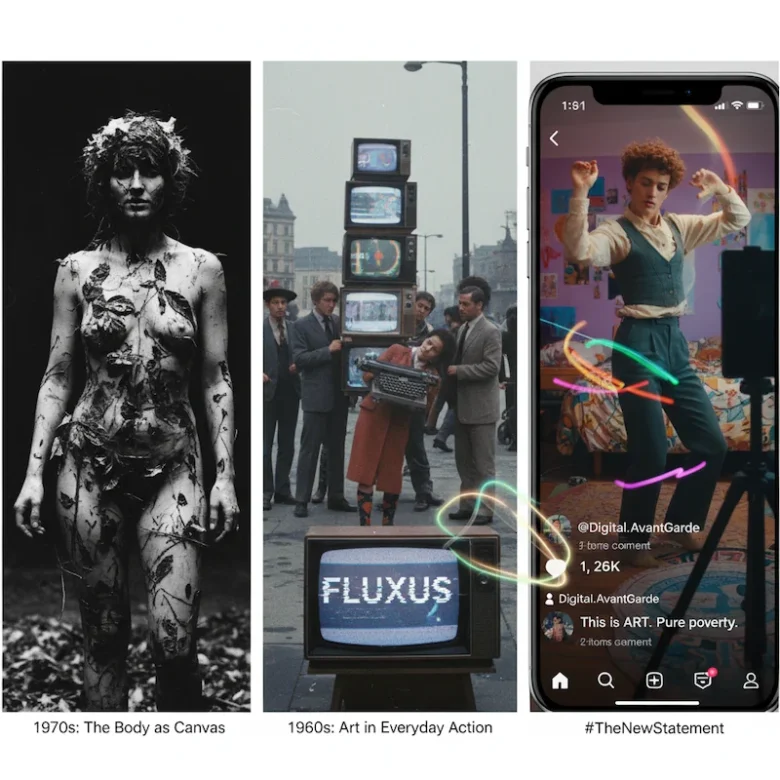
TikTok’s most compelling creators did not emerge from a vacuum. Their work is a modern-day tributary of a larger river of 20th-century thought, deeply intertwined with avant-garde movements that sought to dismantle old certainties about art and identity. The philosophical foundations of this digital art form are surprisingly deep.
Echoes of fluxus and conceptual art:
Just as artists in the Fluxus movement (1960s-70s) focused on the ephemeral and the ordinary, creating art from everyday actions, TikTok creators transform mundane tasks—getting dressed, cooking a meal, or simply reacting to a sound—into a staged performance.
This “anti-art” stance is a rebellion against the formal, institutionalized art world, just as Duchamp’s readymades questioned what constitutes a work of art. Nam June Paik, a founding member of Fluxus, used televisions to create video sculptures that challenged our relationship with media.
Today, a TikTok creator uses their phone to create a performance that challenges our relationship with their daily life. The art is found not in a precious object but in an action, a gesture, a fleeting moment of self-expression. The art is the process, not the product.
The body as a philosophical statement:
Many TikTok creators use their bodies as a canvas to explore themes of identity, gender, and personal expression. This directly connects to performance artists from the 1970s and 80s who used their bodies to make powerful political and social statements.
Think of the work of Carolee Schneemann, who used her body to challenge ideas of female objectification, or Ana Mendieta, who used her body to explore themes of nature and identity.
On TikTok, the body is a vehicle for a thousand different performances—from gender-bending fashion videos to powerful choreographies that address mental health—deconstructing the idealized, sanitized body that social media has so often sought to create.
The body is no longer a passive object to be dressed or adorned; it is an active medium, a living sculpture, a site of protest and celebration, all captured in a 15-second loop.
The intentional awkwardness of a dance, the raw emotion of a confessional video, or the simple act of a person showing their body unapologetically becomes a powerful philosophical statement about vulnerability and authenticity.
The critique: elitist or essential?
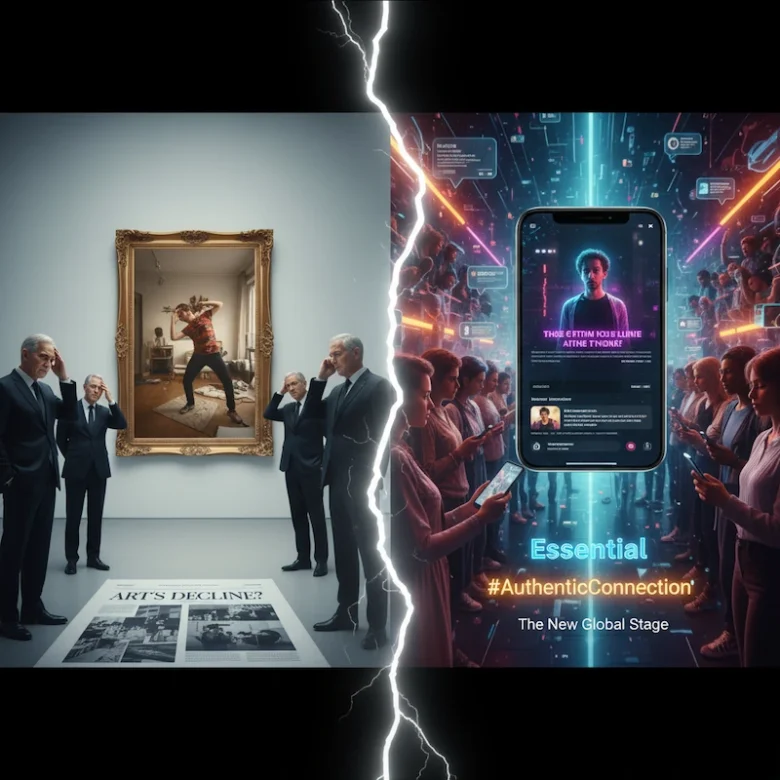
The most common criticism leveled against TikTok as an artistic medium is that it is trivial and ephemeral, a space for fleeting trends rather than profound statements. This is the same criticism that has been leveled against every new art form, from photography to street art.
The art world’s discomfort:
Critics argue that TikTok’s content is too intellectual, too abstract, and too far removed from the solemnity of a gallery. They see it as an inside joke for a small, self-congratulatory online crowd.
The art world, with its long-standing traditions and gatekeepers, often struggles to accept new forms of expression that do not fit into its established framework.
They see the democratic nature of the platform as a dilution of artistic rigor. However, its defenders argue that this critique misses the point.
The platform is an essential laboratory where the foundational assumptions of performance—what is a stage? who is a performer?—can be questioned and dismantled in real-time.
It’s the critical research and development wing of a creative industry that has become too slow and too rigid. Without this space for radical thought, the art world would do nothing but repeat itself, endlessly churning out new versions of the same old ideas.
From mass spectacle to authentic connection:
The most successful TikTok artists are those who walk this tightrope with integrity. Their most outrageous or experimental creations are always underpinned by a coherent and deeply considered philosophical idea.
The challenge for both the creator and the viewer is to distinguish between a performative act that is a shallow pursuit of viral fame and one that carries a genuine intellectual weight.
The best TikTok art is not just a spectacle; it is a conversation. It’s the creator who uses a popular sound to make a statement about a social issue, or the one who uses a simple gesture to convey a complex emotion.
They are the ones who understand that the real power of the platform lies not in its ability to create a mass spectacle, but in its ability to forge an authentic, vulnerable connection between a person and a global audience.
The future of the stage
Performance art in the age of TikTok is a bold invitation to wear ideas—to let our daily lives complicate, challenge, and converse. In this space, the act of performing ceases to decorate and begins to debate.
If you’re the kind of person who sees more than just trends—who wants to understand the meaning behind the movement—you’re in the right place.
Neomania Magazine explores the currents of thought shaping art, design, and culture, always seeking the question behind the form.
Don’t just watch the show. Join the conversation and subscribe to Neomania Magazine.