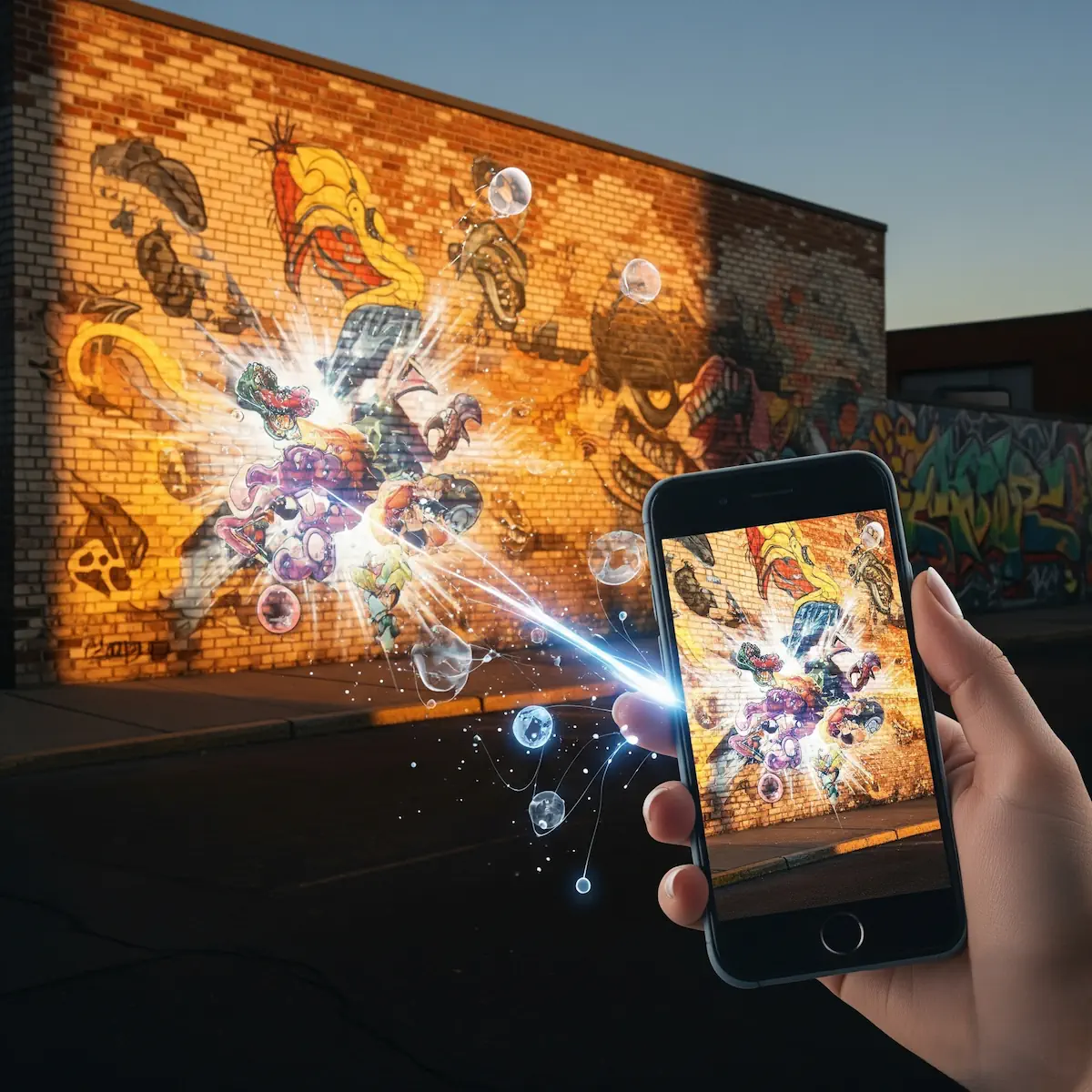
Street art has always made bold statements. It’s the raw pulse of the city rendered in spray paint and wheatpaste—a visual rebellion sprawling across brick and concrete.
From the political stencils of Banksy to the poetic murals of Faith47, its power lies in its public, unavoidable presence. It’s a declaration, a territory claim, a fleeting masterpiece on a borrowed wall. But now, the wall has changed.
In fact, the wall is no longer the final frontier. With the seismic rise of augmented reality (AR), street art no longer just exists—it activates.
It has broken free from the surface, becoming interactive, kinetic, and entirely unseen to the naked eye, a secret world accessible only to those who know how to look.
This isn’t an upgrade; it’s a paradigm shift. The concrete canvas is becoming a digital portal. The spray can is being joined by the smartphone.
We are witnessing the birth of a new artistic movement where the most provocative work isn’t on the wall, but layered over it in a dimension of light and code.
This is the new underground, a clandestine gallery that exists everywhere and nowhere at once. The message is no longer just written on the wall; it’s broadcasted through it.
What is augmented street art?
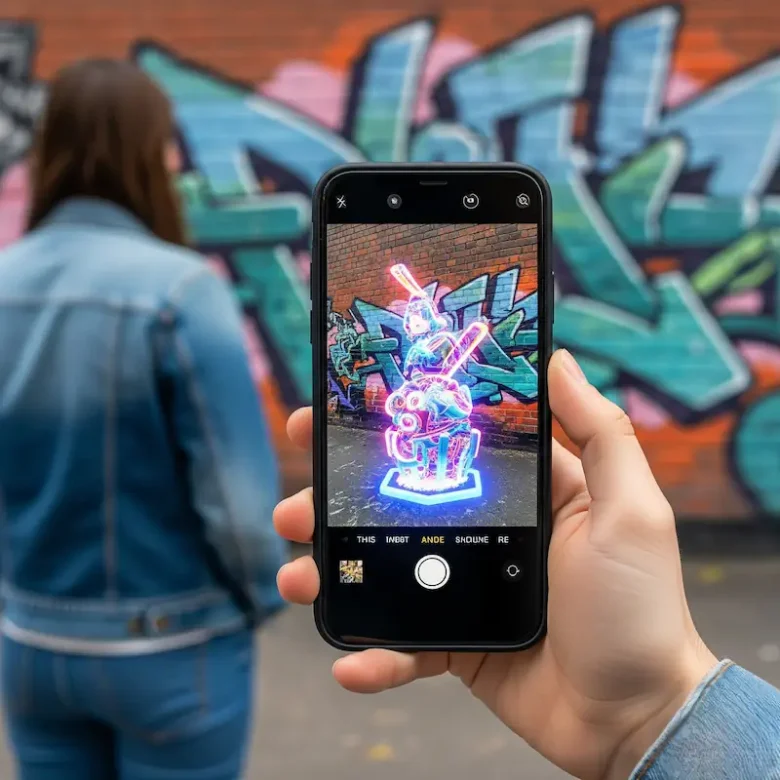
At its core, augmented street art is a hybrid reality, a mind-bending fusion of the gritty, tangible world of urban art and the boundless, ethereal realm of digital information.
It’s a creative insurgency that hacks our perception of public space, layering animations, soundscapes, 3D objects, and interactive narratives onto physical artworks or, more radically, onto empty, geo-located coordinates.
The trigger can be anything: pointing your phone’s camera at a mural, scanning a cleverly hidden QR code, or simply walking into a specific zone in the city.
Suddenly, the static image on a wall shatters its 2D prison. A painted bird takes flight, a geometric pattern pulses to a hidden beat, or an entire sculptural form materializes in the thin air of a public square.
A fusion of physical and digital space
Think of it as a magic lens. You see a mural of a stoic figure on a decaying industrial building. To the average passerby, it’s a beautiful but silent piece.
But you, the initiated viewer, pull out your phone. Through your screen, the figure’s eyes blink and begin to follow you. Text appears, floating in the air, telling the story of the neighborhood.
A haunting soundtrack, composed for the piece, begins to play, changing as you move closer or farther away. The physical art is the anchor, the key that unlocks a deeper, multi-sensory experience.
The artist’s vision is no longer confined to the limitations of paint; it expands into the dimensions of time, sound, and interaction. This isn’t just art you look at; it’s a world you step into.
From graffiti tags to geo-tagged codes
The evolution of the artist’s “tag” is perhaps the most potent symbol of this new movement. For decades, a graffiti writer’s tag was their identity, a stylized signature sprayed on a train car or scrawled on a mailbox to claim space and prove presence.
It was an act of physical defiance. Today, artists are leaving marks not only on brick walls but also on digital coordinates. They are tagging GPS locations, creating “digital graffiti” that exists as a piece of code assigned to a specific latitude and longitude.
Point your phone at an unassuming street corner in Lisbon, and a shimmering, impossible sculpture by the artist Zien might unfold before your eyes.
It has no mass, no physical structure, yet it dominates the space. This is geo-tagged art—a digital occupation of public space. The act of creation is no longer about conquering a physical surface but about colonizing a virtual one. The new tag is a geo-pin, and the new wall is the global positioning system itself.
Why merge street art with AR?
The impulse to fuse these two worlds isn’t just a technological gimmick. It’s a response to fundamental artistic desires: the drive for deeper expression, the thrill of subversion, and the need to speak in a language that resonates with a digitally native generation.
AR offers solutions to some of street art’s oldest limitations while opening up entirely new frontiers for creative rebellion.
Expanding the sensory experience
Traditional street art is a powerful, but primarily visual and static, medium. You see it. You interpret it. You walk away. AR shatters this passivity.
It transforms a static image into a kinetic moment, a silent mural into a symphony. The art becomes something you don’t just view—you explore it, you hear it, you follow its narrative, or you directly interact with it.
An AR mural might ask you a question, with your answer changing the animation. A digital sculpture might react to the sounds of the city around it, morphing in response to a passing siren or a crowd’s applause.
This turns the viewer into a participant, a co-creator in a living, breathing artwork. The sensory palette expands from color and form to include motion, sound, and time, making the artistic statement exponentially more immersive and unforgettable.
Creating without permission (or damage)
Herein lies the revolutionary spark. Street art has always danced on the knife’s edge of legality. The act of unsanctioned public art is often labeled as vandalism, carrying the risk of fines and arrest. The artwork itself is ephemeral, vulnerable to being power-washed into oblivion by municipal cleanup crews. AR art elegantly circumvents this entire conflict.
Because augmented reality doesn’t physically alter any surfaces, artists can stage clandestine digital interventions in the most heavily policed and symbolically charged public spaces without breaking a single law or damaging property.
Imagine projecting a digital protest slogan onto the facade of the White House, or placing a critical animated sculpture inside the headquarters of a multinational corporation, visible only to those with the right app.
It’s the ultimate form of “clean graffiti.” It’s untraceable, non-destructive, and deeply subversive. The act of rebellion is democratized, requiring not a crowbar and a can of paint, but a laptop and a brilliant idea.
Key technologies behind AR street art
This creative explosion is fueled by an increasingly accessible ecosystem of software and hardware. While the concepts are complex, the tools for creating AR experiences have become remarkably intuitive, empowering a global cohort of artists to bend reality without needing a degree in computer science.
Apps and platforms artists use
A handful of key platforms have emerged as the digital spray cans for this new generation:
Artivive:
Often described as the “Photoshop for AR,” Artivive is a user-friendly platform that excels at bringing existing 2D artworks to life. Artists upload a static image (the “trigger”) and a digital layer (like an animation or video).
The app then uses image recognition to overlay the digital content when a viewer points their phone at the physical piece. It’s widely used by galleries, museums, and street artists looking to add a hidden dimension to their murals.
Adobe Aero:
Backed by the creative software giant, Aero is a powerful, code-free tool for creating and sharing immersive 3D experiences. Its strength lies in its intuitive interface and seamless integration with other Adobe products like Photoshop and Dimension.
Artists can build complex, interactive scenes with sophisticated animations and anchor them to the real world, making it ideal for crafting standalone AR installations.
8th Wall:
This platform is a game-changer because it’s entirely web-based (WebAR). This means users don’t need to download a specific app to view the experience; they can simply access it through a web browser on their smartphone.
This removes a significant barrier to entry, making AR art as easy to share as a hyperlink. For artists focused on reaching the widest possible audience, 8th Wall’s frictionless approach is invaluable.
Snapchat Lens Studio & Meta Spark AR:
By tapping into the massive, built-in audiences of Snapchat and Instagram/Facebook, these platforms democratize AR creation and distribution.
While often associated with novelty face filters, their technology is incredibly powerful. Street artists can create and publish AR “lenses” or “effects” that can be triggered by specific locations or images, effectively turning social media users into a massive, decentralized distribution network for their work.
Geolocation and mixed reality
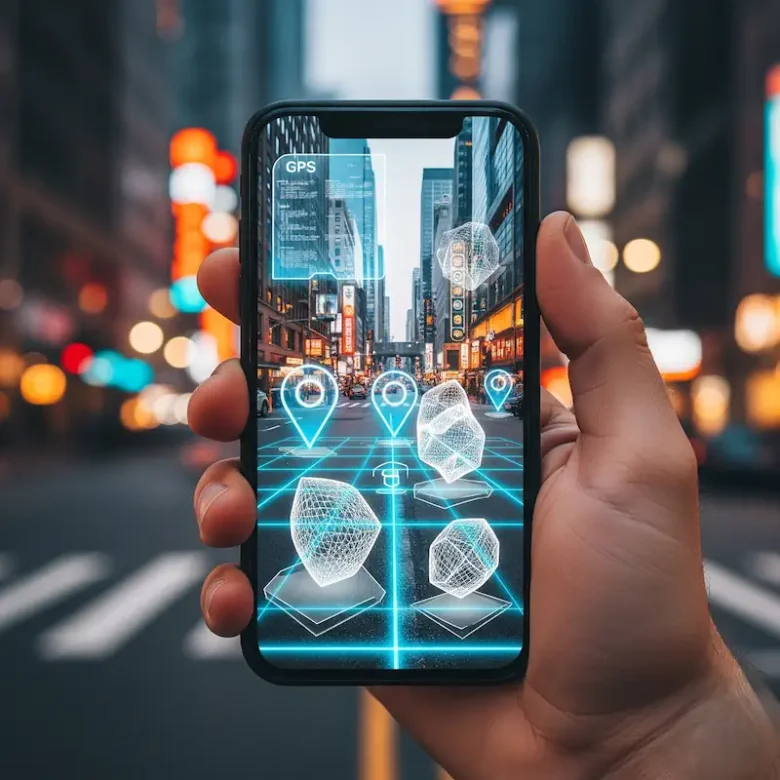
Beyond image-based triggers, the true paradigm shift is geolocation. Using the GPS, accelerometer, and compass in every smartphone, artists can now anchor digital content to precise physical coordinates.
This is the foundation of mixed reality, where the digital and physical worlds are not just layered but are aware of each other. An AR mural in this context might change depending on where you are standing, revealing different elements as you walk around it.
An entire city can be mapped with a sequence of AR artworks, creating a narrative walking tour where each stop is triggered simply by your presence.
This technology transforms the entire urban grid into a potential canvas, every park, plaza, and alley a potential stage for a digital intervention.
Artists redefining public space with AR
A global vanguard of artists is pioneering this new medium, each using the technology to push their unique aesthetic and conceptual boundaries. They are not just creating art; they are architects of a new, layered reality.
Names shaping the digital street art landscape
César Figueiredo (Brazil):
Working in the urban landscapes of Brazil, Figueiredo uses AR to transform forgotten walls and neglected public spaces into vibrant, virtual portals.
His work often features fantastical creatures and surreal architectures that seem to erupt from the mundane, inviting viewers to see the hidden potential and magic in their everyday surroundings.
He doesn’t just augment reality; he reveals a more vibrant one hiding just beneath the surface.
Yiying Lu (China/Australia):
Globally recognized for creating iconic visuals like the Twitter “Fail Whale” and the dumplings emoji, Lu has seamlessly transitioned her whimsical and powerful illustrative style into the AR space.
Her work often merges traditional Chinese art forms, like calligraphy, with fluid, playful animations. An AR piece might see calligraphic characters leap off the wall and dance in the air, deconstructing language and image into a pure, joyous experience.
Zien (Spain):
Operating with the anonymity characteristic of traditional graffiti legends, the Spanish artist Zien creates ephemeral, floating AR sculptures in prominent public squares.
These digital objects often mimic the form of classical monuments but are rendered in glitchy, futuristic textures. They pose a profound question about the nature of public monuments and memory.
Is an invisible, digital sculpture less real than a bronze statue? Zien’s work exists in the provocative space between presence and absence.
Diana Sinclair (USA):
A young, multidisciplinary artist, Sinclair has gained international acclaim for her work exploring Black identity and Afrofuturism.
She uses AR to create interactive digital murals that tell nuanced stories of Black history and culture. Her pieces are not just to be viewed but to be experienced; they often incorporate audio narratives and interactive elements that invite the viewer into a dialogue.
For Sinclair, AR is a tool to reclaim public space and insert narratives that have been historically marginalized or erased.
Street art as digital protest
From its inception, street art has been a vehicle for dissent—a way for the voiceless to speak truth to power in the most public forum possible.
AR supercharges this potential, creating a new, potent form of activism that is nimble, resilient, and perfectly suited to the digital age.
Rebellion that can’t be erased
The greatest vulnerability of physical graffiti is its physicality. A protest mural can be painted over in hours, its message silenced by a coat of beige paint.
But how do you erase a ghost? AR protest art cannot be painted over, scrubbed away, or sandblasted into silence. It is intangible, censorship-resistant, and instantly shareable on a global scale.
An activist artist can launch a digital protest in Moscow, and seconds later, people in New York, London, and Tokyo can view it, share it, and amplify its message.
The protest becomes a piece of data, a viral entity that lives in the cloud, untouchable by the authorities it seeks to critique. It is rebellion with digital permanence.
Encrypted messages in public space
AR enables a modern form of steganography—hiding messages in plain sight. An artist can create a seemingly innocuous public mural, one that is aesthetically pleasing and politically neutral enough to be officially sanctioned or at least tolerated.
However, this physical mural is merely a key. When viewed through an AR app, it unlocks a hidden layer of explosive content: a defiant political statement, data visualizations of corporate malfeasance, links to banned journalism, or immersive stories from marginalized communities.
A simple QR code embedded in a piece of street art can act as a digital rabbit hole, leading viewers to an encrypted website or a private server.
This is the modern-day dead drop, a method for communicating encrypted, subversive messages in the open, turning any wall into a potential node in a network of dissent.
The impact of AR street art on cities
This technological and artistic shift is not just changing art; it’s actively reshaping our relationship with the urban environment itself. Cities are beginning to recognize AR as a powerful tool for cultural engagement, tourism, and civic identity.
A new kind of cultural tourism
Forward-thinking cities are embracing AR street art as a new cultural asset. Official walking tours in cities like Berlin, Tokyo, and Mexico City are being designed around augmented reality experiences.
Tourists and locals alike are guided through neighborhoods not just to see historical landmarks, but to unlock the hidden digital stories layered on top of them.
This gamifies urban exploration, turning a simple walk into an interactive treasure hunt. It drives foot traffic to different districts, supports local artists, and offers a unique, tech-forward image that attracts a new generation of travelers.
Reclaiming public space through invisibility
On a deeper level, AR empowers citizens to reclaim a sense of ownership over their environment. The modern city is often a highly regulated and commercialized space, with every surface an opportunity for advertising.
AR provides a way to digitally annotate, comment on, and re-contextualize this environment. Streets, bridges, parks, and corporate plazas are no longer just spaces to transit through.
With AR, they become layered environments, part canvas, part interface. A boring bank building can be digitally re-skinned with art that critiques the financial system.
An empty lot can become home to a beautiful, community-created virtual garden. It is a quiet, invisible revolution in urban design, where the public writes back.
Is this the future of street art?
Is AR a fleeting trend, or is it a fundamental evolution of the form? As digital creativity becomes more deeply woven into the fabric of our lives, the evidence points toward a permanent shift in what artists demand from a canvas.
The wall is no longer enough
For a generation of artists who grew up with the internet, video games, and interactive media, a static, silent wall can feel profoundly limiting.
Their creative language is one of motion, interaction, and data. They think in layers and timelines. For these artists, AR is not a gimmick; it’s a native tool.
It allows their imagination to spill out beyond the physical constraints of paint and surface. Why paint a bird when you can make it fly? Why write a word when you can make it speak? The physical wall is becoming a foundation, not a destination.
Art as algorithm in motion
The most advanced forms of AR street art are becoming living, responsive systems. We are beginning to see works that are not pre-rendered animations but generative pieces of code that react to real-time data.
Imagine a digital mural whose colors shift with the weather, or an AR sculpture whose form contorts based on local air quality data.
Picture a sound installation that is triggered by GPS, but whose music is algorithmically composed based on the speed at which you walk through the space.
This is art as an algorithm in motion, a dynamic system tailored by and to the viewer and their environment. The artwork is no longer a finished object but an ever-changing, living code.
Tensions and critiques of digital street art
No revolution is without its critics, and the rise of AR street art sparks crucial debates about authenticity, access, and control. This new digital frontier is not a utopia; it is contested territory.
Evolution or erasure of authenticity?
Purists of the graffiti movement argue that AR loses the raw, visceral authenticity that defines street art. For them, the medium’s power comes from its grit: the physical risk, the smell of spray paint at 3 AM, the texture of a crumbling wall, the adrenaline of the illicit act.
They argue that mediating this experience through the cold, sterile glass of a phone screen sanitizes the art, stripping it of its soul and its connection to the street.
However, proponents see this as a classic case of an older generation resisting a new tool. The aerosol can was once a new technology that was likely decried by traditional sign painters.
They argue that AR is simply an evolution, a new tool in the artist’s arsenal that expands the possibilities for expression without replacing the foundational roots of graffiti and muralism.
Who controls augmented space?
This is perhaps the most critical and unsettling question for the future. As AR technology moves from the fringes to the mainstream, it becomes increasingly commercialized.
Who gets to decide what is visible in the augmented layer of reality? Right now, that power lies with the platforms—the tech giants like Meta, Google, and Apple who are building the AR clouds of the future. What happens when they control the digital sky?
Will activist art that critiques a platform’s corporate partner be algorithmically suppressed or simply banned? Will brands be able to buy the exclusive AR rights to Times Square or the Eiffel Tower, cluttering our view with digital advertisements?
There is a real danger that public augmented space, instead of being a new frontier for free expression, could become the most privatized and filtered space of all.
The marriage of street art and augmented reality doesn’t erase graffiti—it evolves it into a new state of being. It transforms public space from a single surface into a layered universe of hidden messages, spectral sculptures, and dynamic activism.
The revolution will not be televised; it will be augmented. Today, the street is not just what we walk on—it’s also the cloud we see through. And in that cloud, every wall is infinite.
At Neomania, we don’t report on the future: we live in it. We believe innovation isn’t an event; it’s a mindset. It’s the relentless pursuit of the next frontier, a celebration of disruption, and the conviction that the only tradition worth honoring is the one you break. We are the pulse of what’s next, the fever for the new.
Don’t just watch the change. Be the one who ignites it. Subscribe to Neomania Magazine and stop following the future—start defining it.
[mailerlite_form form_id=3]