You’ve seen the headlines. You’ve scrolled past the multi-million dollar pixelated apes on your feed. You’ve heard friends, tech gurus, and maybe even your bewildered uncle mention them in a mix of awe and confusion. NFTs.
The three-letter acronym that crash-landed into our digital lives and rewired our understanding of art, ownership, and value. One minute, art was something you hung on a wall; the next, it was a string of code on a digital ledger, sparking bidding wars that rivaled a Christie’s auction.
If you’ve felt a step behind, wondering what in the world NFT art really is, you’re not alone. It’s a universe that seems to have its own language, its own currency, and its own culture.
But beneath the hype and the dizzying price tags lies a technological and creative revolution that’s genuinely reshaping our world.
This isn’t just about JPEGs. It’s about the future of creativity, the democratization of art, and a fundamental shift in how we define what is real and what is valuable in an increasingly digital existence.
So, buckle up. We’re about to demystify the craze, cut through the noise, and give you the ultimate guide to the wild, weird, and wonderful world of NFT art.
So what exactly is this NFT art everyone is talking about?
Let’s get the jargon out of the way first, because “non-fungible token” sounds more like a complex financial instrument than a piece of art. But the concept is simpler than it seems.
Think about money. A dollar bill is fungible. You can trade your dollar for someone else’s dollar, and you both still have the exact same value.
It’s interchangeable. Now, think about the Mona Lisa. There’s only one original. You can’t swap it for another painting and have the same thing. It’s unique, irreplaceable. It’s non-fungible.
Breaking down the basics of non-fungible tokens
At its core, an NFT is just that: a one-of-a-kind digital asset. It’s a certificate of authenticity and ownership for a digital item, securely recorded on a blockchain.
While the most famous examples are digital art, an NFT can be linked to almost anything: a piece of music, a video clip, a tweet (yes, really), a ticket to an exclusive event, or even a piece of virtual real estate in the metaverse.
The NFT itself isn’t the art; it’s the proof of ownership. Imagine you buy a rare photograph. You get the print, but you also get a signed certificate from the photographer verifying its authenticity.
The NFT is that digital certificate. It’s a permanent, unforgeable record that says, “This person owns the original version of this specific digital file.”
It’s public, it’s transparent, and it’s cryptographically secured, making it virtually impossible to fake or duplicate the ownership claim.
Understanding what makes digital art unique
This is where most people get tripped up. “But I can just right-click and save the image!” you might be thinking. And you’re right.
You can download a picture of the Mona Lisa, too, but you don’t own the original. You have a copy, a souvenir. The same logic applies to NFT art.
Anyone can have a copy of Beeple’s “Everydays: The First 5000 Days,” but only one person (or wallet address) can own the NFT that authenticates it as the original, the one the artist himself designated.
This concept of verified digital scarcity is the game-changer. Before NFTs, digital art was infinitely reproducible. An artist could create a stunning digital masterpiece, but once it was online, it could be copied and shared endlessly, stripping it of any monetary value.
There was no way to prove which file was the “original.” NFTs solved this problem. By attaching a unique token to the artwork, artists can now create provably scarce digital items, giving them the same potential for value appreciation as physical art.
Why a JPEG can be worth millions
So why would someone pay millions for what amounts to a digital receipt for a JPEG? It’s a cocktail of factors: culture, technology, and community.
Part of it is pure speculation—investors betting that a piece will become more valuable over time. But a huge part of it is about cultural status and belonging.
Owning a CryptoPunk or a Bored Ape Yacht Club NFT is like owning a Warhol or a Basquiat in the traditional art world. It’s a status symbol within a specific, highly influential digital community.
It’s also about supporting the artist directly and being part of a movement. Buying an NFT is often seen as a direct investment in a creator’s career, cutting out the galleries, agents, and auction houses that have traditionally controlled the art market.
It’s a vote for a new system, a new way of valuing creativity. The price tag isn’t just for the pixels; it’s for the story, the community, and the authenticated place in digital history.
How does this whole NFT thing actually work?
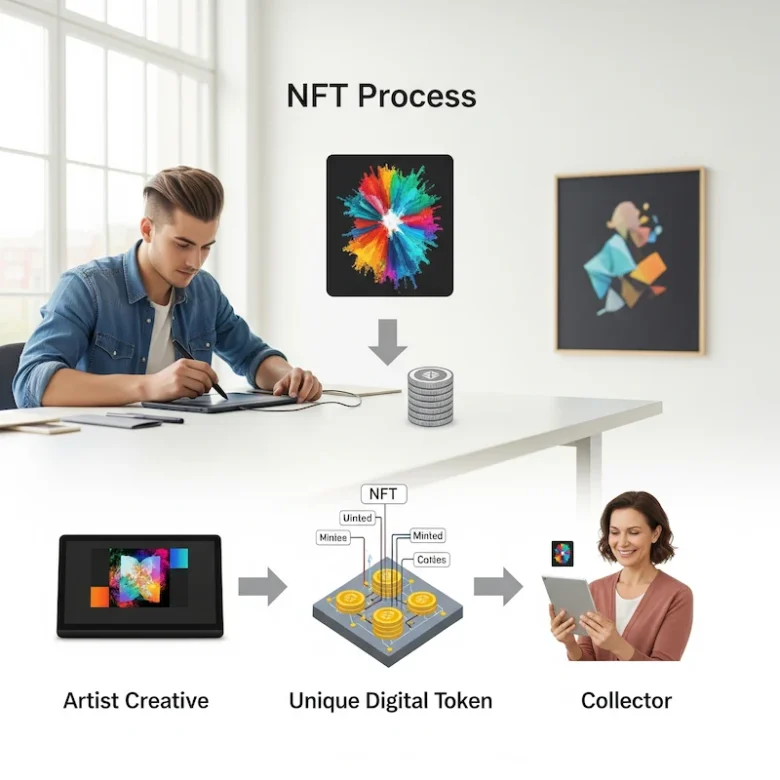
Alright, so we’ve wrapped our heads around the “what.” Now for the “how.” Behind every NFT is a powerful, decentralized technology that acts as the backbone for this entire ecosystem.
It sounds complex, but at its heart, it’s about creating a system of trust without needing a central authority like a bank or a government to oversee things. It’s all powered by the magic of blockchain.
A simple guide to the blockchain technology behind NFTs
If you’ve heard of Bitcoin or other cryptocurrencies, you’ve heard of blockchain. Think of a blockchain as a massive, shared, digital public ledger.
It’s like a global Google Doc that everyone can see but no one can control. When a transaction happens—like someone buying an NFT—it gets recorded as a “block” of data.
This block contains information like who paid whom, how much, and a timestamp.
Once the block is created, it’s cryptographically linked to the block before it, forming a “chain.” This chain is then distributed across thousands of computers worldwide.
To alter a single transaction, a hacker would need to change that block and every single block that came after it on thousands of different computers simultaneously, which is practically impossible.
This decentralized and linked structure is what makes the blockchain so incredibly secure and transparent. It’s a permanent, unchangeable record of every transaction, and it’s the source of truth for who owns what in the digital world.
The magic of smart contracts and digital ownership
This is where it gets really cool. NFTs are more than just entries in a ledger; they are powered by “smart contracts.” A smart contract is a piece of code that lives on the blockchain and automatically executes a set of rules when certain conditions are met.
Think of it as a digital vending machine. You put in your money (cryptocurrency), select your item (the NFT), and the machine automatically dispenses the product and records the sale. No cashier needed.
When an artist “mints” an NFT, they are deploying a smart contract on the blockchain. This contract contains all the essential information: the artist’s identity, a link to the artwork file, and any rules the artist wants to embed.
For example, the smart contract can be programmed to automatically pay the artist a royalty percentage every single time the NFT is resold in the future.
This is a revolutionary concept that we’ll explore more later, but it’s all made possible by these self-executing contracts that operate without middlemen.
Minting your own NFT explained
“Minting” is the process of turning a digital file into a unique crypto asset on the blockchain. It’s the moment the artwork officially becomes an NFT. The process sounds technical, but NFT marketplaces have made it surprisingly user-friendly.
First, an artist chooses a blockchain to mint on, with Ethereum being the most popular, though others like Solana and Polygon are gaining traction due to lower fees.
Next, they upload their digital file—be it an image, GIF, or video—to an NFT marketplace like OpenSea, Rarible, or Foundation.
They then fill out the details: a title, a description, and any special traits. The most important step is setting the rules of the smart contract, such as the royalty percentage for secondary sales.
Finally, they pay a “gas fee.” This is a transaction fee required by the blockchain network to compensate the computers that validate the transaction and add it to the blockchain.
Once the fee is paid, the smart contract is deployed, the NFT is created, and it’s officially “minted.” The digital file is now a unique, ownable, and sellable asset forever recorded on the blockchain.
Is NFT art the new frontier for creative expression?
For decades, the art world has been governed by an exclusive club of gatekeepers. Galleries, critics, auction houses, and wealthy collectors decided who got seen, who got famous, and who got paid.
It was a system that worked for a select few but left countless talented artists on the outside looking in. NFT art didn’t just knock on the door of this exclusive club; it blew the door off its hinges, creating a new, radically open frontier for creativity.
How artists are using NFTs to change the game
The most profound impact of NFTs is the unprecedented level of control and autonomy it gives back to artists. For the first time, a digital artist in any corner of the world can create a piece of work, mint it as an NFT, and present it to a global audience of millions without needing anyone’s permission.
There are no gallery submissions, no agent fees, no waiting for a big break. The connection between the creator and the collector is direct, immediate, and transparent.
This has unleashed a tidal wave of artistic innovation. Artists are no longer confined to static images. They are creating generative art that evolves over time, interactive pieces that respond to real-world data, and entire narrative universes built around their NFT collections.
Digital tools that were once seen as mere commercial instruments are now being celebrated as legitimate mediums for fine art. This technology hasn’t just provided a new way to sell art; it has provided a new canvas for creating it.
The impact on the traditional art world
The initial reaction from the traditional art world was a mix of skepticism and outright dismissal. To many, NFTs seemed like a fleeting digital fad.
But when Christie’s, one of the most prestigious auction houses in the world, sold Beeple’s NFT for a staggering $69 million in 2021, the art world was forced to pay attention.
The sale legitimized NFTs in a way no other event had, proving they could command prices once reserved for masters like Picasso and Monet.
Since then, the lines have blurred. Major galleries are now opening metaverse locations, established physical artists are experimenting with NFTs, and art fairs feature dedicated digital art sections.
Rather than replacing the traditional art world, NFTs are expanding it, forcing it to evolve. It’s challenging old notions of what constitutes “real” art and pushing institutions to embrace digital innovation.
The dialogue is no longer about if digital art is valuable, but how it will be integrated into the broader art historical canon.
Royalties and what they mean for creators
Perhaps the most revolutionary feature enabled by NFT smart contracts is the ability to program automatic, perpetual royalties for artists. In the traditional art world, an artist typically makes money only on the initial sale of their work.
If a painting they sold for $1,000 is later resold for $1 million, they see none of that profit. It’s a system that has long been criticized as deeply unfair to creators.
NFTs flip this model on its head. An artist can code a smart contract to, for example, receive a 10% royalty every time their NFT is sold to a new owner.
This happens automatically, in perpetuity, without any need for lawyers or intermediaries. The payment is executed by the code on the blockchain the moment the secondary sale occurs.
For creators, this is more than just a feature; it’s a lifeline. It provides a sustainable income stream, allowing them to benefit from the growing value of their work over their entire lifetime and beyond.
This single innovation has the power to create a more equitable and sustainable ecosystem for artists everywhere.
Ready to dive into the NFT Craze?
Feeling the pull of the digital art revolution? Whether you’re an aspiring collector, a curious investor, or just want to own a piece of this cultural moment, getting started in the NFT space is more accessible than you might think.
The community is vibrant, the platforms are becoming more user-friendly, and the thrill of discovering a new artist is undeniable. Here’s your no-nonsense guide to making your first move in the NFT craze.
Your first steps to buying NFT art
Before you can buy an NFT, you need two key things: a cryptocurrency wallet and some crypto to fund it. Think of the wallet as your personal digital bank account and gallery rolled into one.
It’s where you’ll store your cryptocurrency and where your purchased NFTs will live. The most popular choice for beginners is MetaMask, a browser extension and mobile app that’s easy to set up and integrates seamlessly with most NFT marketplaces.
Once your wallet is set up, you’ll need to buy some cryptocurrency. The vast majority of NFTs are built on the Ethereum blockchain, so you’ll likely need to purchase some Ether (ETH).
You can buy ETH on centralized crypto exchanges like Coinbase or Binance using your debit card or a bank transfer. After purchasing, you’ll transfer the ETH from the exchange to your personal MetaMask wallet address.
With your wallet funded, you are now officially ready to go shopping.
The top marketplaces to explore
NFT marketplaces are the digital storefronts where art is listed, discovered, and traded. They are the equivalents of eBay or Amazon for the NFT world. Each has a slightly different vibe and focus, so it’s worth exploring a few.
- OpenSea: This is the behemoth, the largest and most diverse NFT marketplace. You can find everything here, from high-profile art collections to photography, music, and collectibles. Its sheer size makes it a great place to start, but it can also be overwhelming.
- Rarible: Another large and popular platform, Rarible is known for its strong community focus and for pioneering many of the features now common in the space. It’s a great place to discover both established and emerging artists.
- Foundation: This marketplace is more curated and tends to focus on higher-end, single-edition art pieces. It originally operated on an invite-only basis for creators, giving it an air of exclusivity. It’s where you go to find unique, “1-of-1” artworks.
- Solana Art & Magic Eden: For those looking to avoid Ethereum’s sometimes-high gas fees, marketplaces on the Solana blockchain like these have become incredibly popular. They offer a faster, cheaper alternative for buying and minting NFTs.
Setting up your own digital wallet
Let’s quickly walk through the wallet setup, as it’s the most crucial step. Go to the official MetaMask website (beware of fake sites!) and download the extension for your browser.
During setup, you will be given a “secret recovery phrase” or “seed phrase”—a list of 12 words. This is the most important piece of information you will receive.
Write it down on a piece of paper and store it somewhere incredibly safe and offline. Never share it with anyone, and never store it on your computer or in a cloud service.
This phrase is the master key to your wallet; if you lose it, you lose access to all your assets forever. There is no “forgot password” option in the world of crypto.
Once your wallet is secured, you’re ready to connect it to a marketplace with a single click and begin your journey as an NFT collector.
What are the hidden risks in the NFT universe?
The world of NFTs is electrifying, but it’s also the Wild West of the digital age. The potential for high rewards comes with equally high risks, and diving in without understanding the pitfalls is a recipe for disaster.
The same technology that makes NFTs revolutionary also creates new avenues for problems, from environmental debates to financial volatility and outright scams.
A smart participant is an informed one, so let’s pull back the curtain on the darker side of the craze.
The environmental concerns you should know about
One of the loudest and most valid criticisms leveled against NFTs has been their environmental impact. Most NFTs are built on the Ethereum blockchain, which has historically used a system called “Proof of Work” to validate transactions.
This system requires a massive network of powerful computers to solve complex mathematical problems, consuming an enormous amount of electricity—in some estimates, as much as a small country.
Minting a single NFT could have a carbon footprint equivalent to a long-haul flight.
This has been a major ethical dilemma for many artists and collectors. However, the landscape is changing rapidly. The Ethereum network recently completed a monumental upgrade known as “The Merge,” switching to a new system called “Proof of Stake.”
This new method is drastically more energy-efficient, cutting Ethereum’s energy consumption by over 99%. Furthermore, many new NFTs are being minted on inherently eco-friendly blockchains like Solana and Polygon, which were designed from the ground up to be less energy-intensive.
While the environmental concern is still part of the conversation, the industry is actively and successfully addressing it.
Navigating the volatility of the NFT market
The NFT market is not for the faint of heart. It is incredibly speculative and prone to wild price swings. The value of an NFT is driven by demand, hype, and sentiment—all of which can change in an instant.
A collection that is the talk of the town one week can see its value plummet the next. This is not the stock market; there are no quarterly earnings reports or fundamental metrics to ground an asset’s price.
This volatility means you should never invest more than you are willing to lose. It’s easy to get caught up in “FOMO” (fear of missing out) when you see headlines about multi-million dollar sales, but for every success story, there are countless NFTs that have lost most of their value.
Treat your first purchases as an educational expense or a way to support an artist you admire, not as a guaranteed get-rich-quick scheme. The market is maturing, but it remains a high-risk, high-reward environment.
Scams and how to avoid them
Where there’s money, there are scammers, and the NFT space is no exception. The anonymity and decentralized nature of crypto make it a fertile ground for bad actors.
Common scams include “rug pulls,” where the anonymous developers of a new project hype it up, sell a large number of NFTs, and then disappear with the money, leaving buyers with worthless assets.
Phishing is also rampant. Scammers will create fake versions of popular marketplace websites or send you direct messages on social media with malicious links, trying to trick you into connecting your wallet and signing a transaction that drains your funds.
The golden rule is simple: be skeptical. Never click on suspicious links. Never share your seed phrase. Always double-check the URL of the website you’re on.
Use a “burner” wallet with only small amounts of crypto for new mints, and always verify the authenticity of a collection on multiple sources before making a purchase. A healthy dose of caution is your best defense.
Where is the world of NFT art heading next?
After the initial explosion of hype and the subsequent market corrections, the enduring question is: what’s next? Are NFTs a revolutionary technology destined to become a part of our daily lives, or a speculative bubble that has already popped? The reality is likely somewhere in between.
While the days of random JPEGs selling for millions may be waning, the underlying technology is quietly being integrated into the fabric of the next-generation internet, expanding far beyond the realm of fine art.
The future of digital collectibles and beyond
The first wave of NFTs was dominated by profile picture (PFP) projects and digital art. The next wave is poised to encompass so much more.
Think of NFTs not just as art, but as digital keys that unlock entire ecosystems. Your NFT could serve as your ticket to an exclusive concert or festival, your membership card for a decentralized autonomous organization (DAO), or your playable character and unique in-game assets in a blockchain-based video game.
This concept of “utility” is becoming the driving force of the market. Collectors are now looking for NFTs that do something. They want assets that grant them access, give them voting rights, or provide them with tangible benefits in both the digital and physical worlds.
This evolution from static collectibles to dynamic, functional assets is a crucial step in the maturation of the technology, proving its value beyond pure speculation.
How NFTs could reshape music and fashion
The art world was just the first creative industry to be disrupted. Music and fashion are next. For musicians, NFTs offer a way to sell limited-edition digital albums directly to fans, bundling them with exclusive content, backstage passes, or even a share of the song’s streaming royalties.
This model allows artists to bypass traditional record labels and build a deeper, more direct financial relationship with their supporters.
In fashion, luxury brands are already experimenting with NFT “digital twins.” When you buy a high-end physical handbag, you might also receive an NFT that authenticates it and serves as its digital counterpart for your avatar in the metaverse.
Digital-native fashion brands are designing and selling clothing that exists only in the digital realm, allowing people to express their style in online spaces. NFTs are set to become the foundation of ownership for a whole new generation of virtual goods.
Will NFT art still be a big deal in five years?
Predicting the future is always a fool’s errand, especially in a space that moves at the speed of light. However, it seems likely that in five years, we won’t be talking about “NFT art” as a separate category. It will simply be “art.”
The technology will become so seamlessly integrated that owning a digital asset will be as normal as having a social media profile.
The term “NFT” itself might even fade into the background, much like we don’t say “I’m going to browse the TCP/IP protocol” when we go online.
The market will be more stable, the user experience will be more intuitive, and the focus will be squarely on the quality of the art and the utility of the token.
The wild speculation will have cooled, leaving behind a robust and permanent infrastructure for authenticating and trading digital value.
NFT art was the Trojan horse that introduced the world to the power of true digital ownership. What comes next will build upon that foundation, reshaping not just how we see art, but how we interact, transact, and identify ourselves in the digital century.
The takeaway: beyond the hype
So, what is NFT art? At the end of the day, it’s a paradox. It’s a complex piece of technology wrapped in culture, a speculative financial asset that doubles as a profound artistic statement, and a digital key to a future that’s still being built.
We’ve journeyed from the basics of non-fungible tokens to the decentralized bedrock of the blockchain, navigated the risks, and peeked into the future.
The one clear takeaway is this: the conversation is no longer about whether digital ownership is real, but how it will redefine everything.
The initial chaotic gold rush may be settling, but the revolution it started—empowering creators, challenging institutions, and building a new layer of the internet—is just getting started. This isn’t the end of the story; it’s the end of the beginning.
Stay Ahead of What’s Next with Neomania
The world of NFTs, crypto, and Web3 moves at warp speed, and today’s cutting-edge is tomorrow’s history. If you’re driven by a need to understand the forces shaping our future, you’re in the right place.
Neomania Magazine is your front-row seat to the cultural and technological shifts that matter. We cut through the noise to bring you the signal.
Don’t just follow the trend. Understand it. Subscribe to our newsletter and join the Neomania community to stay plugged into the future, today.
[mailerlite_form form_id=3]