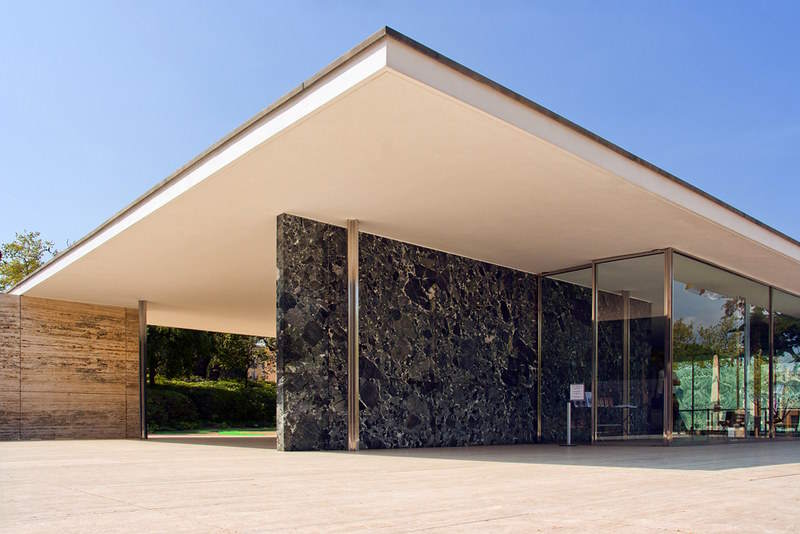
In a world saturated with noise, architecture can be a form of whisper. Amid the visual cacophony of the modern landscape—the relentless branding, the chaotic urban sprawl, the digital interfaces screaming for our attention—a quieter language of design persists.
The minimalist architectural style is that language. It is not a statement about lack or emptiness, but a profound argument for clarity, restraint, and the enduring elegance of intention. It doesn’t demand attention; it invites reflection. It offers not a void, but a clearing—a space to breathe, to feel, and to think.
What is a minimalist architectural style?
At its core, minimalist architecture is the pursuit of essence. It is a discipline dedicated to reducing form, space, and material to their most elemental and powerful expressions.
While its visual identity solidified in the mid-20th century, its philosophical roots run deeper, drawing from the cool, industrial rationalism of the Bauhaus movement, the profound spiritual tranquility of Japanese Zen philosophy, and the radical, almost audacious, idea that space itself—like silence in a symphony—can be the most significant element of a composition.
This is not design by subtraction for its own sake. It is a meticulous process of inquiry, asking what is truly essential. It strips away the ornamental, the superfluous, and the sentimental to reveal an honest and direct relationship between a structure, its inhabitants, and its environment.
In minimalism, a wall is not just a barrier but a plane that catches light; a window is not merely an opening but a deliberate frame for the world outside. The building becomes less of an object and more of a vessel for human experience.
The philosophy of “less is more”
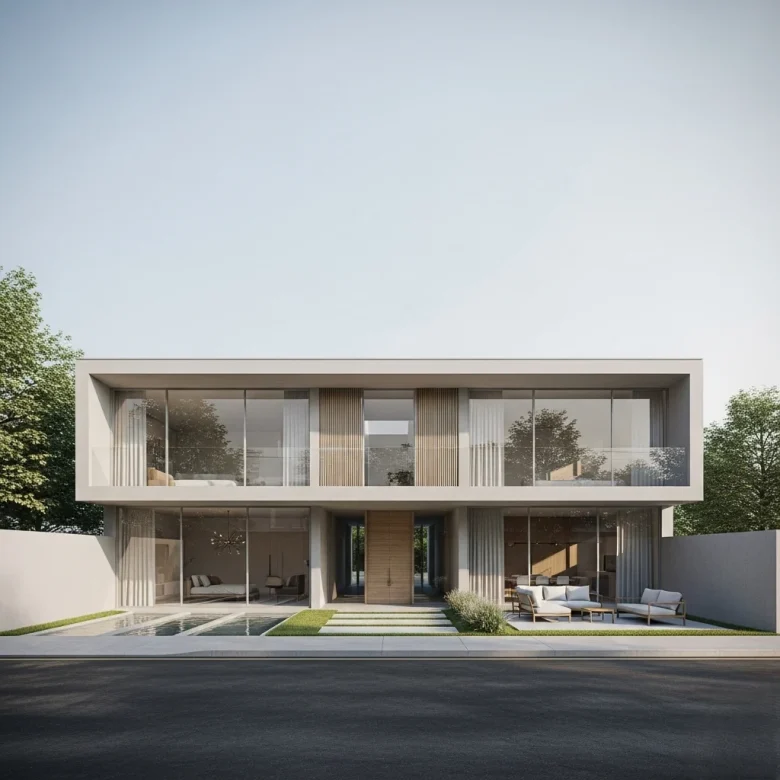
The phrase has become so ubiquitous that it risks becoming a cliché, yet Ludwig Mies van der Rohe’s declaration, “less is more,” remains the definitive mantra of the movement.
For Mies, and the generations of architects he inspired, this was not a stylistic preference but a moral and intellectual position. It was a call to champion the purity of form over the decadence of excess, to find beauty not in addition but in potent, deliberate subtraction.
In minimalist architecture, every line, every material, and every junction is intentional. There is nowhere to hide poor craftsmanship or muddled thinking.
The integrity of the structure lies exposed, celebrated in its own honesty. This approach demands a formidable level of discipline from the designer, but it also offers a unique form of liberation.
By shedding the non-essential, a building is free to express its core purpose with uncompromised clarity. Beauty emerges from the inherent qualities of the materials, the masterful handling of proportion, and the serene dance of light and shadow. It is an architecture of quiet confidence, asserting that the most powerful statement can be one of profound simplicity.
Key features of minimalist architectural design
The philosophy of minimalism manifests through a disciplined and highly curated grammar of design. These are not merely aesthetic choices but components of a holistic system designed to foster tranquility and focus.
The first and most vital feature is the dominance of clean lines and open spaces. Forms are simplified to their geometric essence—unbroken planes, sharp right angles, and graceful curves that guide the eye without distraction.
Walls are often liberated from their traditional role as rigid dividers, allowing for fluid, open-plan interiors where one space flows seamlessly into the next, creating a feeling of boundless calm.
This spatial clarity is enhanced by a strictly controlled neutral color palette. Whites, beiges, grays, and blacks form the foundation, not out of a fear of color, but out of a reverence for light.
These tones turn surfaces into canvases, allowing the subtle shifts in natural light throughout the day to become a primary design element. Color, when used, is deployed with surgical precision—a single, perfectly saturated surface or a piece of furniture becomes an anchor in a sea of tranquility.
There is also a profound respect for honest materials. Minimalism celebrates substances for what they are, exposing their raw texture and inherent character.
You see the rough, sculptural quality of poured concrete, the cool transparency of glass that dissolves boundaries, the organic warmth of raw, unstained wood, and the slender, skeletal strength of steel.
There is no attempt to disguise one material as another. This material honesty grounds the architecture in reality, creating a tactile, sensory experience.
Finally, all these elements serve a master principle: functional forms devoid of ornamentation. Every element must justify its existence through its purpose.
If a feature does not serve a function—be it structural, spatial, or programmatic—it is deemed superfluous and eliminated. This results in an architecture of profound integrity, where beauty is not applied but is intrinsic to the function and form of the building itself.
Minimalism vs. Modernism: are they the same?
It is a common point of confusion, as minimalism grew from the fertile soil of modernism. They are close relatives, but they are not twins; perhaps it is better to see them as a parent and a child, sharing DNA but possessing distinct personalities.
Modernism, born in the early 20th century, was a revolutionary and often utopian movement. It was a bold, declarative shout for a new world, championing progress, mass production, and the power of technology to reshape society. Its forms could be audacious and heroic, driven by a faith in the future.
Minimalism, which flourished later, is the more introspective child. It inherited modernism’s clean lines and rejection of historical ornament, but it turned the volume down. If modernism was a public proclamation, minimalism is a private meditation.
Its emphasis shifts from universal progress to individual purpose and sensory experience. While a modernist building might make a bold statement on the skyline, a minimalist one often seeks a quieter, more harmonious dialogue with its immediate surroundings. The focus is less on revolution and more on clarification; less on what is new and more on what is essential and timeless.
The influence of japanese minimalism on global architecture
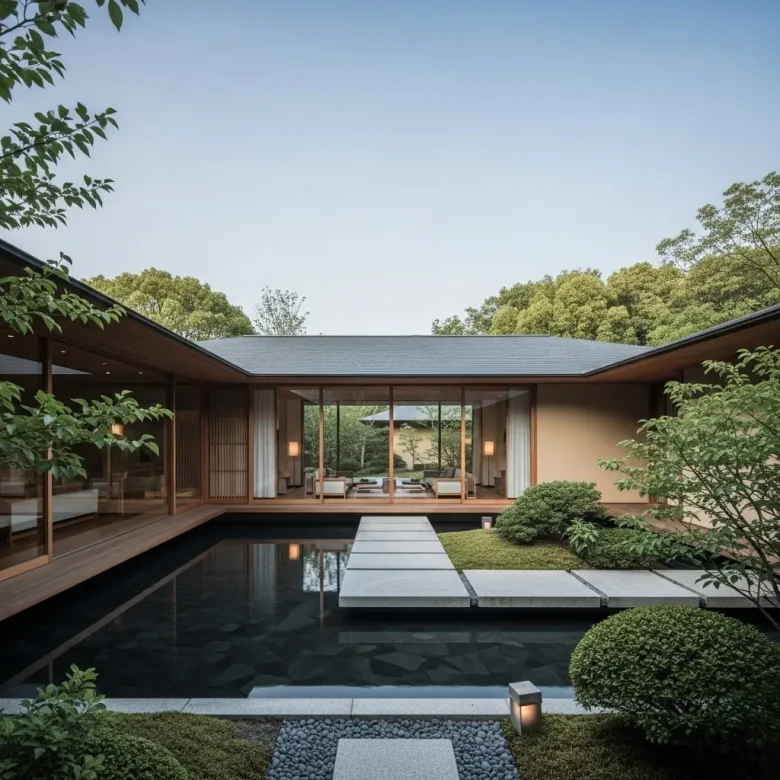
While modernism provided the structural grammar, the soul of minimalism arguably comes from Japan. Long before the West conceived of “less is more,” traditional Japanese aesthetics were cultivating a deep appreciation for simplicity, nature, and the spiritual potential of space. This worldview, heavily influenced by Zen Buddhism, is not about emptiness but about “purposeful void.”
Central to this is the concept of Ma (間), which recognizes the power of negative space. Ma is the interval, the pause, the silent space between objects that gives them meaning and relationship.
In architecture, it is the unmarked wall, the open floor, the quiet courtyard—these are not empty, but full of potential and energy. Another key principle is Wabi-sabi (侘寂), the acceptance and celebration of transience and imperfection.
It finds beauty in the natural, the weathered, and the unadorned, valuing the patina of age on wood or the subtle irregularities in a plastered wall.
Architects like Tadao Ando became global ambassadors for this philosophy, translating its poetry into the language of concrete, light, and water. His iconic structures, such as the Church of the Light, demonstrate how a simple, powerful void—a cruciform of pure light—can be more spiritually resonant than any amount of religious ornamentation.
This profound Japanese influence elevated minimalism from a mere style to a potential pathway for contemplation, grounding its clean aesthetics in a rich, centuries-old spiritual tradition.
Common materials in minimalist architecture
The minimalist ethos demands a truthfulness that extends directly to its material palette. The goal is not to decorate a form but to let the form emerge from the inherent character of its components.
Concrete is perhaps the most emblematic material of the movement. Often dismissed as cold or brutal, in the hands of a minimalist architect, it becomes sculptural and monolithic, possessing a raw, tactile honesty. Its surface tells the story of its creation, bearing the subtle imperfections of its liquid origins.
Glass is used not just for windows but as a tool for dematerialization. Large, frameless panes dissolve the barrier between interior and exterior, inviting the landscape inside and creating a sense of boundless space.
Counterbalancing these cooler elements, natural wood introduces warmth and an organic connection to nature. It is typically used in its rawest state—unstained, unadorned—celebrating its grain, texture, and natural color. It grounds the abstract purity of the design with a familiar, human touch.
Finally, steel provides the structural framework, often expressed with a graphic, skeletal elegance. Its slender profiles and tensile strength allow for the creation of vast, open spaces and sharp, precise lines that would be impossible with other materials.
Together, these four materials form a balanced quartet—earthy, ethereal, organic, and industrial—that speaks the minimalist language with clarity and grace.
How lighting defines minimalist space
In minimalist design, light is not an accessory; it is a primary building material, as fundamental as concrete or steel. It is the active element that sculpts space, reveals texture, and imbues a structure with emotional resonance.
Architects do not simply illuminate a room; they curate light and shadow with artistic precision. Openings are not placed arbitrarily but are carefully calibrated apertures designed to capture the sun’s movement.
A narrow, strategically placed skylight can wash a wall with a dynamic slash of light that changes with the hours, turning the passage of time into a visible spectacle.
The interplay between light and shadow creates depth, drama, and a sense of profound tranquility. Smooth surfaces become canvases for soft gradations, while textured materials like raw concrete or rough-hewn wood come alive as light rakes across them, revealing their tactile depth.
The quality of the space is thus defined not by what it contains, but by how it receives and manipulates light. It is an architecture that understands that the most powerful moments are often the most ephemeral—the quiet glow of dawn on a polished floor, the sharp silhouette of a window frame in the afternoon sun.
Iconic examples of minimalist architecture
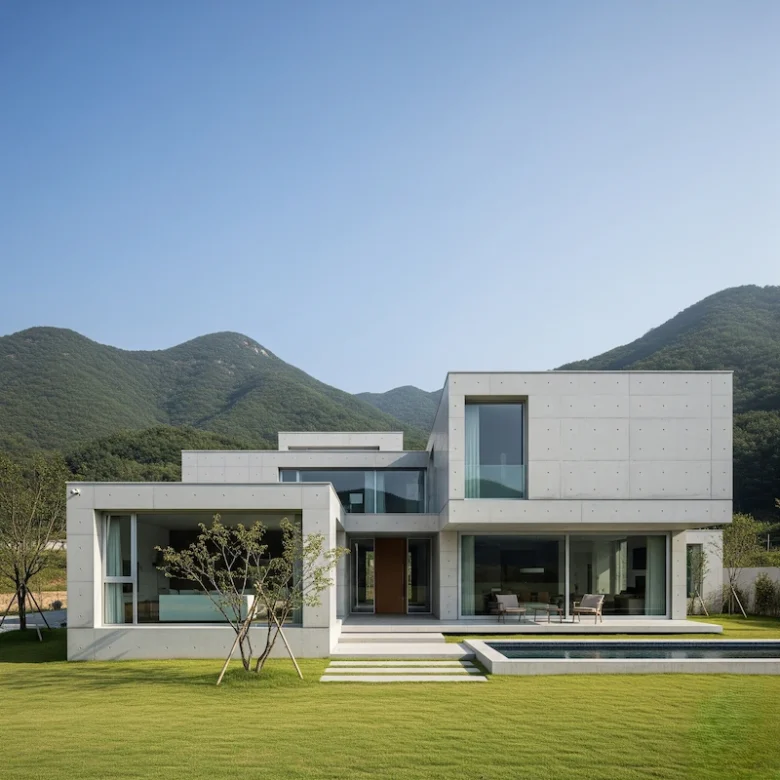
Certain buildings stand as manifestos of the minimalist ideal, structures where philosophy and form achieve perfect synthesis. Key examples include:
Barcelona Pavilion (Mies van der Rohe, Spain):
An early, seminal text for the movement. Composed of little more than intersecting planes of travertine, marble, and glass, it is a masterclass in fluid space and material purity that redefined architectural possibility.
Church of the Light (Tadao Ando, Japan):
A powerful demonstration of spiritual minimalism. The building is a simple, dark box of exposed concrete, where the sole focal point is a void cut into the wall—a cruciform of pure light that proves divinity can be found in profound simplicity.
Therme Vals (Peter Zumthor, Switzerland):
A complete sensory journey through minimalism. It features cavernous spaces carved from local stone, where the architectural experience is shaped not just by form, but by the primal interplay of light, shadow, water, and sound.
Casa Wabi (Tadao Ando, Mexico):
A stunning example of minimalist principles meeting a rustic, coastal landscape. It combines sharp concrete walls with traditional thatched palapa roofs, creating a dialogue between modern geometry and local vernacular.
Famous minimalist architects
While the movement is broad, its narrative has been shaped by a few singular voices whose work continues to define the field:
- Tadao Ando (Japan): A poet of concrete who uses the material to create serene, contemplative spaces that feel simultaneously ancient and modern, often integrating nature and light in dramatic ways.
- John Pawson (United Kingdom): The undisputed master of domestic and sacred minimalism, who refines spaces down to their spiritual essence with an unwavering focus on perfect proportions, rich materiality, and the effects of light.
- SANAA (Kazuyo Sejima & Ryue Nishizawa, Japan): A duo renowned for creating an ethereal, almost weightless architecture. Their work uses light, glass, and slender structures to design buildings that seem to dissolve into atmosphere.
- Álvaro Siza Vieira (Portugal): A creator of a softer, more sculptural minimalism. His work is imbued with a poetic, humanistic grace, connecting clean, modern lines to sensual, organic forms that respond deeply to their context.
The role of minimalism in sustainable architecture
The ethos of “less is more” naturally aligns with the core principles of sustainability. By focusing on the essential, minimalist architecture inherently champions resource efficiency. Using fewer construction materials not only reduces the embodied energy of a building but also minimizes waste.
The emphasis on high-quality, durable materials like stone and wood promotes longevity over the fleeting trendiness of disposable culture, resulting in buildings that are meant to last for generations.
Furthermore, the minimalist focus on light and space often leads to passive design strategies. Large, strategically oriented windows can maximize natural light and reduce the need for artificial lighting, while open-plan layouts can facilitate natural ventilation.
In this sense, minimalism is not just an aesthetic choice; it is an ethical one. It is a responsible approach to building that respects not only the visual environment but the ecological one as well.
Minimalist interior architecture & how to apply it at home
The principles of minimalism translate seamlessly to the interior. The goal is to create a sanctuary of calm and order. This begins with an intentional and often difficult process: decluttering. It is about keeping only those objects that are beautiful, functional, or deeply meaningful.
Spaces are defined by clean surfaces and a lack of visual noise. A monochrome or neutral color palette creates a cohesive, peaceful backdrop.
To apply this at home, prioritize quality over quantity. It is better to have one perfectly crafted chair than five mediocre ones. Invest in storage solutions that hide away life’s necessary clutter, allowing the main living spaces to remain serene.
Maximize light and spatial flow by using sheer curtains or none at all, and arranging furniture to create clear, unimpeded pathways. Every object matters, and the “negative space” around them becomes a design element in its own right, giving each chosen piece room to breathe.
Digital minimalism: architecture for virtual spaces
As our lives become increasingly digital, the minimalist ethos has logically extended into the virtual realm. From the clean, intuitive interfaces of our favorite apps to the design of websites that prioritize content over distracting ads and pop-ups, digital minimalism is a response to information overload.
In the emerging world of the metaverse and virtual reality, architects are designing virtual spaces—galleries, homes, and public squares—that follow these same principles, proving that the human need for clarity and focus thrives even when rendered in pixels.
Ultimately, minimalist architecture is more than an aesthetic; it is an answer. In a world that constantly shouts for more, it offers a radical whisper of enough. It is a philosophy that trades ornamentation for intention, clutter for clarity, and noise for a resonant silence.
By stripping design down to its essential components, it creates not an absence, but a presence—of light, of space, of purpose, and of ourselves within it. As our lives accelerate and our planet calls for more considered solutions, the principles of minimalism have never been more vital.
This is the kind of critical dialogue we champion at Neomania Magazine. To continue exploring the ideas, forms, and philosophies that define our built world, subscribe today and join a community that believes architecture is not just to be seen, but to be understood.
[mailerlite_form form_id=3]