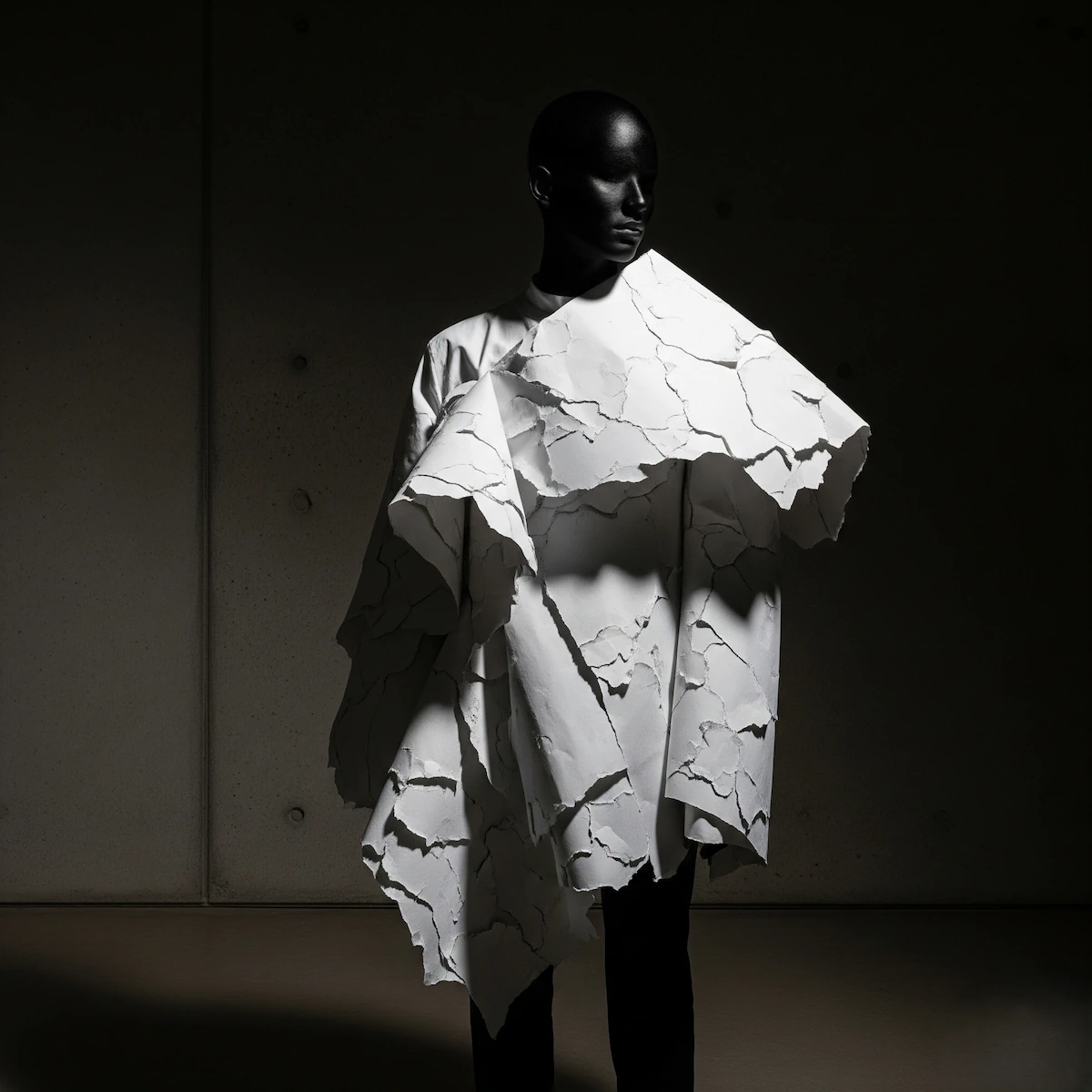
In a world where fashion often serves commerce or aesthetics, conceptual fashion philosophy offers something radically different: thought. It asks not how we look, but what we mean. This is fashion as critique, architecture, metaphor — clothing as a philosophical statement. Sometimes unwearable. Always unforgettable.
What is conceptual fashion philosophy?
Imagine a garment that asks a question instead of providing an answer. A piece of clothing whose primary function is not to adorn or protect, but to provoke a conversation.
This is the realm of the conceptual fashion philosophy, a space where textiles become texts and silhouettes become arguments.
It is a quiet, radical departure from the clamor of trends and seasons, an invitation to a deeper engagement with the objects we place on our bodies.
It operates on the premise that a garment can be a vessel for an idea, as potent and complex as a sculpture or a poem.
Beyond trends, into thought
Conceptual fashion is less about the cyclical nature of style and more about the enduring power of discourse. It deliberately steps off the fast-moving carousel of “what’s next” to ask, “what now?” and, more importantly, “why?”.
It uses the language of clothing—cut, material, form, context—to express cultural anxieties, political critiques, existential queries, or deeply personal emotional states.
In this paradigm, a dress might be designed not to flatter the body, but to question the very notion of a body. A coat may be intentionally impractical, subverting the function of protection to make a statement about vulnerability or exposure.
It is fashion as a textile essay, where each seam and fold is a carefully chosen word in a larger intellectual argument.
Philosophy as foundation, not influence
It is a crucial distinction: this is not fashion merely “inspired by” philosophy. One does not simply create a mood board with a picture of Simone de Beauvoir and call it a day. Instead, conceptual fashion is a form of philosophy in practice.
It employs the methods of philosophical inquiry—deconstruction, phenomenology, questioning of systems, exploration of identity—but uses fabric, silhouette, and the human form as its medium.
A designer might deconstruct a blazer not just for aesthetic effect, but to philosophically dissect the uniform of power it represents.
Another might create a garment that slowly disintegrates with wear, forcing a confrontation with our ideas about permanence, decay, and time.
The idea is not an afterthought or a decorative theme; it is the seed, the skeleton, and the soul of the garment itself.
Key characteristics of conceptual fashion
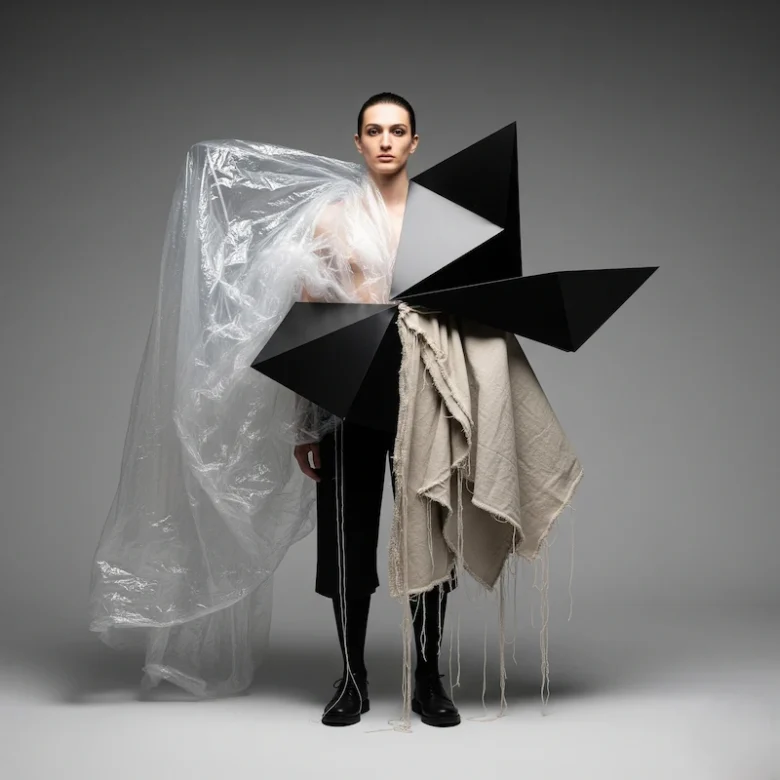
To navigate this landscape is to learn a new set of visual and intellectual cues. The value system is inverted: practicality may be irrelevant, beauty redefined, and materials chosen for their meaning rather than their comfort. These characteristics are not arbitrary; they are the tools with which these designers articulate their ideas.
Narrative over practicality
In conceptual fashion, the story is the primary function. A garment is successful not if it is comfortable or easy to wear, but if it effectively communicates its narrative.
A dress might be constructed with such extreme, sculptural proportions that sitting is impossible, forcing the wearer and the viewer to contemplate ideas of restriction, spectacle, or the body as an architectural space.
A piece might be intentionally unfinished, with raw seams and dangling threads, telling a story about process, becoming, and the illusion of perfection.
The design is in service to the provocation, not the person. It asks the body to adapt to the idea, rather than the other way around.
Materials as message
The choice of material in conceptual design is never accidental; it is a critical part of the philosophical statement. Designers may reject traditional textiles in favor of unconventional media, not for the shock value, but to dismantle our preconceived notions of clothing, value, and wearability.
A garment made of paper might speak to the fragility of memory or the disposability of modern culture. A piece constructed from plastic bags could be a sharp critique of consumerism and waste.
Metal might be used to explore themes of armor, industry, or confinement. These materials are chosen for their symbolic weight, transforming the garment from a simple object into a piece of material culture that demands interpretation.
Aesthetic minimalism or maximalism
To achieve their conceptual goals, designers often push aesthetics to their absolute limits, swinging between two powerful extremes. Some employ a radical minimalism, stripping the garment down to its most essential form, removing color, ornament, and any distracting detail.
This is an act of creating silence, of forcing the viewer to focus on a single, potent idea—the curve of a seam, the weight of a fold. Conversely, other designers embrace an overwhelming maximalism.
They flood the garment with an exaggeration of form, texture, and volume, creating a piece that is visually loud and complex. Both strategies serve the same purpose: to create a conceptual friction that disrupts our passive consumption of fashion and forces us to actively engage with what we are seeing.
The intellectual roots of conceptual fashion
Conceptual fashion did not emerge from a vacuum. It is a tributary of a larger river of 20th-century thought, deeply intertwined with avant-garde art movements and postmodern philosophy that sought to dismantle old certainties and question the very nature of reality, art, and identity.
Art and anti-fashion movements
Emerging with force in the 1960s and 70s, conceptual fashion found its philosophical bedrock in the anti-establishment spirit of movements like Dada, Fluxus, and conceptual art.
Just as Marcel Duchamp’s readymades questioned what constitutes a work of art by placing a urinal in a gallery, conceptual designers began to question what constitutes a garment.
They shared a deep skepticism of authorship, form, and purpose. If art didn’t have to be a beautiful painting, then fashion didn’t have to be a beautiful dress.
It could be an idea, a process, a performance. This “anti-fashion” stance was a rebellion against the commercialism and prescriptive beauty standards of the mainstream industry.
Postmodernism and deconstruction
As postmodern thought, particularly the deconstructionist philosophy of Jacques Derrida, permeated intellectual circles, designers found a powerful new tool.
Deconstruction taught that meaning is not fixed or inherent, but is constructed through language and systems. Conceptual designers applied this idea to the “language” of fashion.
They began to literally and figuratively tear apart the grammar of clothing. They exposed seams, linings, and darts, not to show how a garment was made, but to question the illusion of a seamless, finished product.
They challenged the binary of gender by creating ambiguous silhouettes. They disrupted the timeline of fashion by referencing historical garments in fragmented, anachronistic ways.
They questioned the very idea of a “perfect fit” by creating clothes that were intentionally oversized, distorted, or ill-fitting, thus deconstructing the idealized body that fashion had for so long sought to create.
Influential voices in conceptual fashion
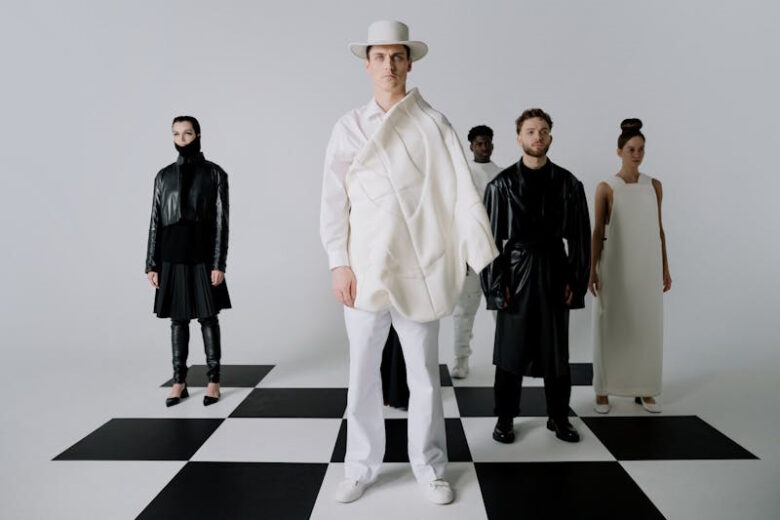
This philosophical movement is not anonymous; it is defined by a handful of visionary designers who have consistently prioritized the idea over the item, the question over the answer. They are the architects of this intellectual space, and their work forms its foundational texts.
Rei Kawakubo (Comme des Garçons)
For decades, Rei Kawakubo has been fashion’s foremost philosopher-queen. With Comme des Garçons, she has waged a relentless war on convention.
Her work is a profound and ongoing investigation into the nature of identity, the body, and the space in between. She doesn’t design clothes; she designs forms that challenge our perception of the human silhouette.
Her seminal 1997 collection, “Body Meets Dress, Dress Meets Body” (informally known as “Lumps and Bumps”), featured garments with grotesque, tumor-like padding that distorted the body into alien shapes.
It was a direct assault on the industry’s obsession with a sleek, idealized female form. Kawakubo’s creations are often asymmetrical, voluminous, and seemingly chaotic, evoking the fluidity and instability of our own identities. To wear her clothing is to wear a question about the very definition of a body.
Martin Margiela
The enigmatic Belgian designer Martin Margiela built a career on the concepts of anonymity, deconstruction, and ephemerality.
By refusing to be photographed and replacing the designer label with four simple white stitches, he questioned the cult of personality and authorship that dominates the fashion world.
His genius lay in his ability to dissect garments, to reveal their inner workings and hidden histories. He would turn jackets inside out, construct sweaters from old army socks, and create vests from broken porcelain.
His famous Tabi boot, a subtle but persistent cleft in the traditional form of a shoe, is a perfect example of his ability to insert a small, disruptive question into an everyday object. Margiela’s work is a meditation on the ghost of clothing—its memory, its construction, and its decay.
Hussein Chalayan
A true multi-disciplinary artist, Hussein Chalayan operates at the intersection of fashion, technology, architecture, and political commentary.
His work is a testament to the idea that clothing can be a medium for complex narratives about our contemporary world. He is famous for his transformative garments: a coffee table that unfolds into a wooden skirt, a dress that retracts into the collar of a 1950s-style frock, or clothing made from the same materials as an airplane’s interior.
His collections have addressed themes of migration, exile, and the relationship between nature and technology, with pieces like remote-controlled dresses that morph on the runway or textiles that react to climate data.
Chalayan proves that fashion can be a form of critical inquiry, a way to process and respond to the most urgent issues of our time.
Philosophy in the studio: how designers think
The creative process in conceptual fashion is fundamentally different from that of its commercial counterpart. It is not a linear path from sketch to sample. It is an intellectual and artistic investigation, a laboratory where ideas are tested and hypotheses are formed using fabric and thread.
The question becomes the design
The starting point for a conceptual garment is rarely a trend, a color palette, or even a particular silhouette. It is, almost always, a question. Instead of asking, “What will a beautiful dress for next season look like?” the conceptual designer asks, “What is the meaning of a dress?” or “Can a garment express the feeling of loss?” or “What if clothing had no front or back?”.
The entire design process becomes an attempt to answer, or more accurately, to explore, that initial question. The form the garment ultimately takes—its shape, its material, its construction—is a direct result of that philosophical inquiry. The design is the thesis.
Process over product
In this world, the journey is often more significant than the destination. The act of making the piece, the research, the experimentation, and the performance of the idea can hold as much, if not more, meaning than the final, static object.
A designer might bury a collection of white garments in the earth for a season, allowing soil and microbes to become co-creators, leaving unpredictable stains and decay.
The resulting “product” is not just the stained clothing, but the entire narrative of its burial and resurrection. Some conceptual pieces are never intended to be worn in the traditional sense at all; they exist only for a single performance or a photograph, their purpose fulfilled in that fleeting, conceptual moment.
Conceptual fashion in exhibitions and performance
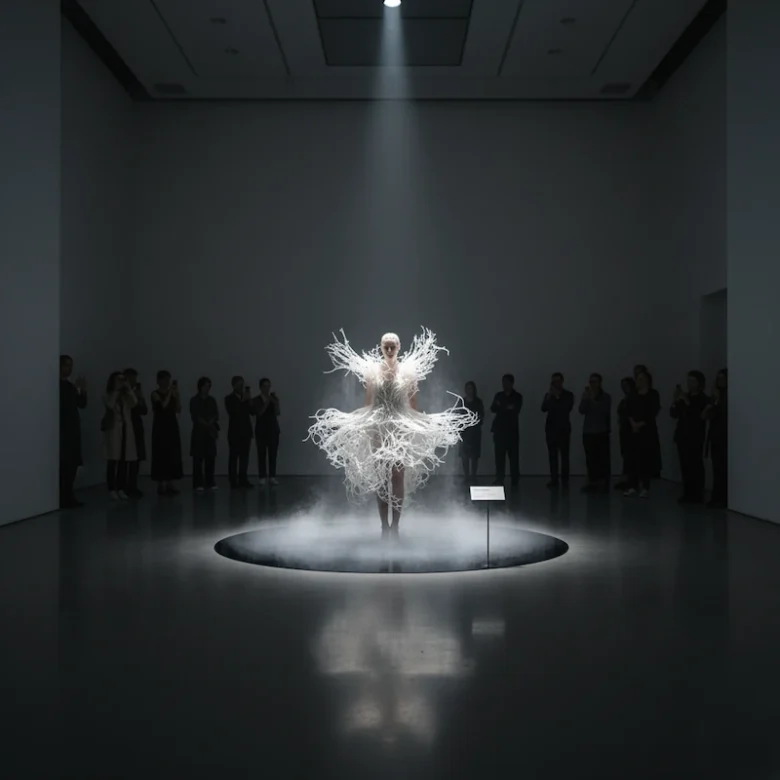
Given its emphasis on ideas over wearability, it is no surprise that conceptual fashion often finds its most natural home outside the boutique and inside the spaces of high art—the gallery, the museum, and the performance stage.
Runway as gallery
For conceptual designers, the fashion show is not a commercial presentation of a new collection. It is a choreographed performance, a temporary installation, a piece of theatre.
The traditional linear catwalk is often rejected in favor of immersive or disruptive experiences that challenge the audience’s role as passive consumers.
Alexander McQueen famously staged a show in a glass box designed to look like a psychiatric ward, culminating in a model breathing against the glass with moths flying around her.
Martin Margiela held shows in derelict subway stations or gritty urban lots, forcing the fashion elite out of their comfort zones. These are not just showcases for clothes; they are carefully constructed environments designed to amplify the conceptual message of the collection.
Garments as installations
Increasingly, conceptual garments are being recognized as legitimate works of art and are exhibited in major museums and international art biennials.
In the gallery context, freed from the need to be worn, these pieces can be appreciated as pure sculpture. The viewer can walk around them, examine their construction, and contemplate their meaning without the distraction of a moving body.
The work of designers like Iris van Herpen, who uses 3D printing and scientific collaboration to create breathtakingly complex forms, often blurs the line between haute couture and contemporary sculpture.
In the museum, the garment becomes a cultural artifact, a physical manifestation of an idea that can be studied and debated long after its season has passed.
Public reception and criticism
Conceptual fashion, by its very nature, is provocative and often divisive. It does not seek easy acceptance. Its relationship with the public and the media is a constant push-and-pull between accusations of irrelevance and praise for its intellectual rigor.
Elitist or essential?
The most common criticism leveled against conceptual fashion is that it is inaccessible and elitist. Critics argue that it is too intellectual, too abstract, and too far removed from the everyday reality of what people actually wear.
They see it as an inside joke for a small, self-congratulatory art-world crowd. However, its defenders argue that this critique misses the point entirely.
They contend that conceptual fashion serves an essential function as the research and development department of the industry.
It is a critical laboratory where the foundational assumptions of fashion can be questioned and dismantled. Without this space for radical thought, they argue, fashion would do nothing but repeat itself, endlessly churning out new versions of the same old ideas.
Wearable philosophy vs visual spectacle
Within the world of conceptual fashion itself, there is a constant tension: where is the line between a profound statement and a hollow provocation?
When does a challenging garment become a mere visual spectacle, designed for Instagram likes rather than genuine intellectual engagement? The most successful conceptual designers are those who walk this tightrope with integrity.
Their most outrageous creations are always underpinned by a coherent and deeply considered philosophical idea. The challenge for both the creator and the viewer is to distinguish between wearable philosophy—no matter how abstract—and empty shock value.
Digital conceptualism: fashion in virtual space
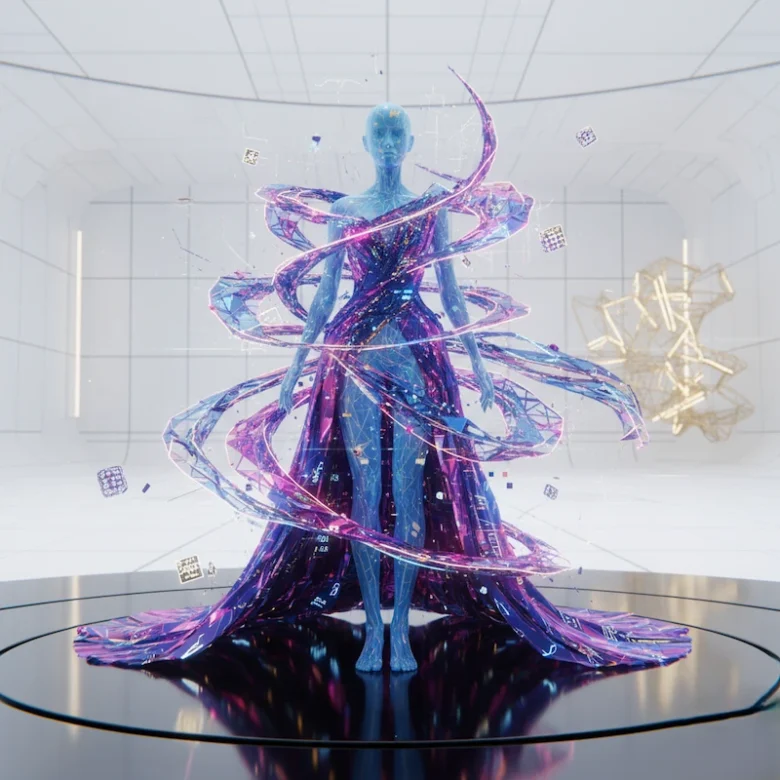
As our lives become increasingly digitized, so too does the frontier of conceptual fashion. The virtual world offers a new, dematerialized space for designers to explore their ideas, freed from the constraints of physics, commerce, and even the human body itself.
3D garments and meta-meaning
Conceptual fashion is thriving on digital platforms, where designers create 3D garments for avatars in virtual worlds. In this meta-space, clothing can defy gravity, change form based on algorithmic data, or be made of impossible materials like liquid light or pure data.
This is the ultimate subversion of function. Digital garments challenge our ideas about physicality, consumption, and the very nature of a self-image that is no longer tied to a physical body. It allows for the exploration of pure form and idea in a way that physical textiles never could.
NFTs and fashion artifacts
The rise of NFTs (Non-Fungible Tokens) has provided a new mechanism for owning and collecting conceptual fashion. A virtual garment can now be sold as a unique, verifiable digital artifact.
The “object” being purchased is not a physical thing, but the idea itself, represented by an image and a block of code. This is, in many ways, the logical conclusion of the conceptual art movement.
It returns fashion to its absolute conceptual core, where the value lies not in the material or the craftsmanship, but in the singularity and provenance of the idea.
Conceptual fashion philosophy invites us to wear ideas — to let clothing complicate, challenge, and converse. In this space, fashion ceases to decorate and begins to debate.
It asks not what we wear, but why we wear anything at all. And in that question lies a future where style and substance are the same thread.
If you believe the deepest style is to wear an idea, you’ve found your home. Neomania Magazine explores the currents of thought shaping art, design, and culture—always seeking the question behind the form.