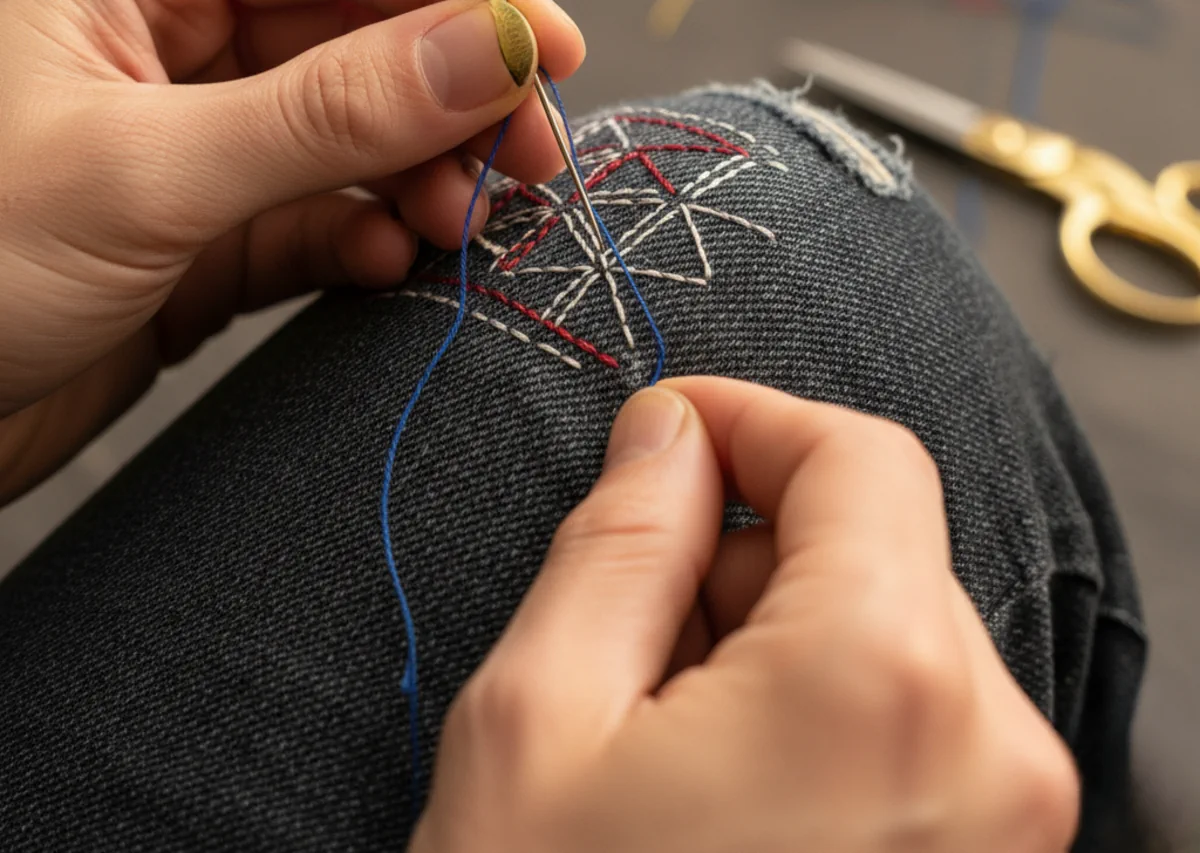
Circular fashion is a regenerative system where clothing, textiles, and accessories are designed, sourced, produced, and provided with the intent to be used and circulated responsibly and effectively for as long as possible.
Unlike the traditional ‘linear’ model (take-make-dispose), it focuses on keeping items out of landfills through repair, reuse, resale, and, finally, recycling.
This guide explains the core principles, the key differences from ‘sustainable fashion‘, and how both brands and consumers can participate.
So, why is my closet full of ‘linear’ fast fashion?
Let’s be real. You’re standing in front of a closet packed with clothes, yet you have that all-too-familiar feeling of having nothing to wear. That’s not a personal failing; it’s the direct result of a business model that’s dominated the last two decades: Fast Fashion.
This model is purely linear. Think of it as a one-way street that ends at a cliff. Its entire philosophy is built on “Take-Make-Dispose.”
- TAKE: This is the resource extraction. We take raw materials like cotton (which is incredibly water-intensive), petroleum (for polyester), and wood pulp (for viscose). This step is often destructive, depleting natural resources and polluting water sources.
- MAKE: This is the manufacturing phase. We use those materials, treat them with chemical dyes, and power factories (often with coal) to churn out billions of garments at lightning speed. This phase is notorious for both its massive carbon footprint and its human rights issues.
- DISPOSE: This is the cliff. Because the clothes are cheap and trend-focused, we wear them just a few times before getting rid of them. And “getting rid of” almost always means the trash.
How bad is it? The statistics are staggering.
- Massive production: The world produces over 100 billion garments every single year.
- Massive waste: A shocking 92 million tons of textile waste is created annually. That’s the equivalent of a garbage truck full of clothes being dumped in a landfill every single second.
- Short lifespan: The average person buys 60% more clothing than they did 15 years ago but keeps each item for half as long.
- No second life: Worst of all, less than 1% of all clothing is ever recycled back into new clothing.
This linear system is broken. It’s draining our planet, exploiting workers, and, ironically, leaving us with closets full of clothes we don’t even love. Circular fashion isn’t just a nice idea; it’s the only logical way forward.
The blueprint: what are the core principles of a circular fashion system?
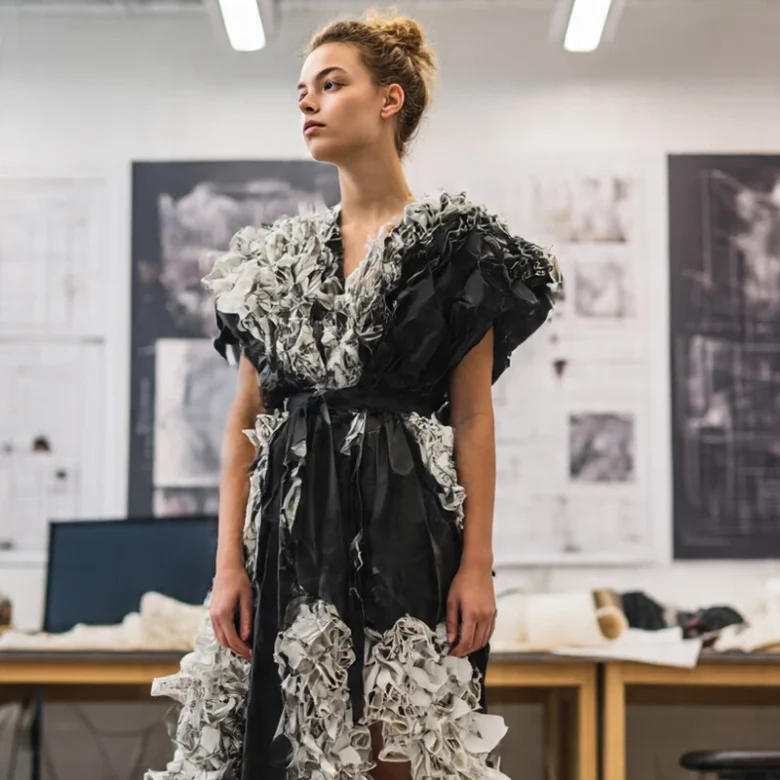
Circular fashion is the answer to the linear model’s “take-make-dispose” problem. It’s a complete redesign of the system, guided by a few core principles. Think of it as a loop, where nothing is ever waste—it’s just a “nutrient” for the next cycle.
Here is the blueprint that visionary brands and designers are using right now:
1. Design for longevity & disassembly
This is the most important step, and it happens before the garment is even made.
- Longevity: This is the anti-fast-fashion. It means creating clothes that last. We’re talking about using high-quality fabrics, stronger stitching (like French seams), and timeless designs that you’ll want to wear for years, not just for one season. The most sustainable garment is the one you already own.
- Disassembly: This is the secret genius of circular design. How can you recycle a garment if it’s made of 12 different materials glued and sewn together? You can’t. Designing for disassembly means thinking about the end of the product at the beginning. This includes:
- Using mono-materials: Sticking to 100% cotton or 100% recycled polyester (not a 50/50 blend, which is a recycling nightmare).
- Smarter trims: Using buttons that can be easily unscrewed or cut off, rather than heat-fused sequins or toxic glues.
- Smart patterns: Designing patterns that are easy to recut into new items.
2. Source safe & renewable materials
You can’t have a healthy loop if you start with poison. This principle is about the ingredients.
- Safe: This means non-toxic. It means eliminating hazardous chemicals and dyes that harm factory workers, the soil, and you, the wearer.
- Renewable: This means using materials that can be regrown or regenerated. Think organic cotton (which avoids toxic pesticides), linen, and hemp. It also includes next-generation materials like Tencel™ Lyocell (made from sustainably sourced wood pulp in a closed-loop system) or even Piñatex (leather alternative from pineapple leaves).
- Recycled: This includes using materials already in existence, like recycled polyester (often from plastic bottles) or recycled cotton (from factory scraps).
3. Implement models of reuse
This is where the loop really starts to spin. The goal is to keep the product itself in use for as long as possible, before we even think about recycling the material.
- Resale: This is the boom of “re-commerce.” Think platforms like The RealReal, Poshmark, and Depop, or brands’ own take-back programs that resell their pre-loved items.
- Rental: This is the “access over ownership” model, and it’s perfect for our modern lives. Why buy a $1,000 gown for a single wedding? Rental services like Rent the Runway or Nuuly let you wear beautiful, high-end fashion for an event (or even for your daily work-drobe) and then send it back to be cleaned and worn by someone else.
- Swapping: The original social fashion! This is the simple, community-based act of trading clothes with friends or at organized events.
4. Repair & remanufacture
This is my favorite part. It’s about building a relationship with your clothes.
- Repair: Fast fashion taught us that a small hole or a broken zipper means the item is trash. Circular fashion says, “No, that’s just a moment for it to get better.” Brands like Nudie Jeans offer free repairs for life. It’s about bringing back the art of mending, darning, and tailoring.
- Remanufacture (or Upcycling): This is where creativity explodes. This is taking a product that’s “done” and using its components to make something new and of equal or greater value. Think of brands like RE/DONE, which takes vintage Levi’s apart at the seams and reconstructs them into modern, coveted fits.
5. Recycle
This is the absolute last resort. When the T-shirt has been worn, resold, repaired, and finally turned into a cleaning rag, it’s time to return its materials to the cycle.
- Mechanical recycling: This is the most common form. It shreds the fabric (like cotton) and respins it into new yarn. The fibers get shorter each time, so it’s often “downcycled” into insulation or mattress stuffing.
- Chemical recycling: This is the holy grail, especially for synthetics like polyester. This process uses chemicals to break the polymer back down to its original molecular building blocks, allowing it to be reformed into new, “virgin-quality” fiber over and over again. This technology is new, expensive, and energy-intensive, but it’s the key to a truly closed loop.
The big question: circular vs. sustainable vs. ethical fashion… what’s the real difference?
You’ve seen all the buzzwords. They get thrown around so much they start to lose their meaning. Is “circular” just a new, sexier word for “sustainable”?
No. They are not the same thing, but they are deeply related. Think of them as three different lenses to look at the same industry. A brand can be one without being the others—but the “holy grail” is to be all three.
Let’s break it down.
| Term | Main focus | The core question it answers | Example |
|---|---|---|---|
| Sustainable | Environmental impact (Planet) | “How was this made, and what materials were used?” | A T-shirt made from 100% organic cotton, which uses less water and no pesticides. The focus is on the eco-footprint of the materials. |
| Ethical | Human impact (People) | “Who made this, and were they treated fairly?” | A brand that is Fair Trade Certified, guaranteeing its garment workers in Bangladesh are paid a living wage and have safe working conditions. |
| Circular | Product lifecycle (System) | “Where does this go when I’m done with it?” | A brand that will buy back your old jeans, repair them, and resell them (like Patagonia’s Worn Wear) or recycle them into new jeans. |
Why this matters
It’s crucial to know the difference so you can spot greenwashing.
A brand can release a “sustainable” collection using organic cotton. But if they pay their workers poverty wages, they are not ethical. And if they have no plan for that T-shirt after you’re done with it (other than a landfill), they are not circular.
A brand can be “ethical” by paying fair wages, but if they are mass-producing virgin polyester (a fossil fuel product) and encouraging you to throw it away after a season, they are not sustainable or circular.
Circularity is the system that allows sustainable materials and ethical practices to thrive in a regenerative loop. It’s the “how” that brings it all together.
Behind the scenes: how are brands actually making this work?
This all sounds great in theory, but how does it work as a business? How do you make money if you’re telling people to buy less?
You change the business model. You stop focusing on just “selling new units” and start focusing on “providing a service.” The Ellen MacArthur Foundation, the leading authority on the circular economy, has identified several key models that are already proving successful.
1. The resale model (recommerce)
This is the most explosive trend. Brands are finally realizing that they are losing a fortune to the secondhand market (like Poshmark and The RealReal). So, why not get in on the action themselves?
- How it works: A brand encourages you to bring back or mail in your old items from their label. In exchange, you get cash or store credit. The brand then cleans, repairs, and “certifies” the item and sells it on their own “Pre-Loved” or “Worn Wear” platform.
- Who’s doing it: Patagonia (Worn Wear), Eileen Fisher (Renew), and Madewell (denim trade-in program) are pioneers. They create a new revenue stream from old products and build immense customer loyalty.
2. The rental model (access)
This is the “Netflix for your closet” model. It fundamentally shifts the business from ownership to access.
- How it works: Customers pay a subscription fee (like at Rent the Runway or Nuuly) to “rent” a rotating selection of clothes. It’s perfect for trend-chasers and event-goers. For the brand, one single dress can now generate revenue 10, 20, or 30 times before it’s retired.
- The circular benefit: This model demands that clothes be well-made. A cheap fast-fashion dress would fall apart after two rentals. This forces brands to invest in quality, durability, and repairability—all core circular principles.
3. The repair & remake model (longevity)
This is the “relationship” model. It’s about a brand taking responsibility for its products for their entire life.
- Repair: Nudie Jeans is the classic example. They offer free repairs for life. You bring in your ripped jeans, they fix them, and you walk out. This builds a bond that no 50% off sale could ever create. Barbour does the same with their iconic wax jackets, offering re-waxing and repair services for decades-old coats.
- Remake (Upcycling): This is about using “waste” as a raw material. The brand RE/DONE built its entire business on taking apart vintage jeans and “remaking” them into new, luxury fits. This is the ultimate expression of circular creativity.
I tried a 100% circular wardrobe for 6 months. Here’s what really happened.
From my experience writing about fashion, I know the statistics, the models, and the circular fashion. But I had one question that kept nagging at me: could a real person, a fashion lover living in the real world, actually do it?
So, I set some rules for a six-month experiment:
- No new clothes. Period. Unless the brand was demonstrably circular (i.e., had a take-back program and used recycled/renewable materials).
- Prioritize the 3 R’s: My first stop for anything I “needed” had to be Rental, Resale (thrifting), or Repair.
- Mindful disposal: I had to find a responsible “end-of-life” for any clothes I was done with.
Here’s the unfiltered truth of what I learned.
Months 1-2: the shock and the “wedding” test
The first few weeks were a shock. I realized how much I used online shopping as a 10-minute stress reliever. Breaking the “add to cart” habit was the hardest part.
Then came the first test: a black-tie wedding in New York. My old gowns felt stale. My first instinct was to panic-buy. Instead, I turned to Rent the Runway. I spent an hour browsing, added a stunning Jason Wu gown (retail $2,200) to my cart, and rented it for $150.
The good: I felt like a million bucks. I wore a high-fashion, high-quality garment that I could never have afforded to buy. I got my compliments, danced all night, and felt zero buyer’s remorse.
The bad: The logistics. It arrived two days before (phew), but I was paranoid about spilling wine on it. The “return by 12 PM Monday” deadline meant a stressful trip to UPS with a hangover. It was incredibly convenient but also felt very transactional.
Months 3-4: the joy of repair
This is where the magic happened. My favorite pair of high-waisted, “perfect-fit” jeans—the ones that cost too much but were worth every penny—blew out at the knee. Pre-experiment, I would have mourned them and started a depressing, multi-week search for a replacement.
Instead, I took them to a local tailor. He said, “Oh, this is an easy fix.” For $15.
I got them back, and the patch was fine, but it sparked something. I went down a YouTube rabbit hole and discovered Sashiko, the Japanese art of visible mending. I bought a small kit. On a Sunday afternoon, I sat and added blue-and-white stitching around the repair and on another thinning spot on the pocket.
It wasn’t just “fixing a hole.” It was an act of creation. I was adding my own story to the garment. Those jeans are now, without question, my favorite thing in my closet. They are 100% unique. I learned that repair isn’t a chore; it’s a form of self-care and customization.
Months 5-6: the closet clean-out and the “resale” hustle
The final challenge was disposal. I did a massive closet edit and sorted everything into four piles:
- To sell: Good brands, great condition. I listed these on Poshmark. (Learned: It’s work. Taking good photos, writing descriptions, and shipping is a side-hustle. But I made $280.)
- To consign: High-end items (a designer bag I never used). I sent these to The RealReal. (Learned: It’s slow, and their commission is high, but it’s zero-effort.)
- To donate: Good, basic items. These went to a local women’s shelter, not a big-box thrift store (which often just landfills or ships donations overseas).
- To recycle: The truly “dead” pile—holey socks, stained white tees, old underwear. This was the hardest. I found a textile recycling bin at my local farmer’s market. For my old jeans, I used the Blue Jeans Go Green program, which turns them into housing insulation.
My 6-month verdict
Did I miss the thrill of a new, shiny thing? Sometimes. But what I gained was so much more.
- My “style” got better. Because I couldn’t just buy anything, I had to really think about what I wanted. I saved up and bought one perfect, secondhand cashmere sweater instead of three cheap acrylic ones.
- I have more money. This one’s obvious. I spent a fraction of what I normally would.
- I’m not a “consumer” anymore. This was the biggest mental shift. I stopped being a passive consumer of fashion and became an active participant. I’m a renter, a repairer, a reseller, and a curator. My closet is smaller, but it’s 100% me. It’s a 10/10 recommendation.
Your turn: how you can join the circular fashion movement (without giving up your style)
Okay, so you don’t have to go 100% cold-turkey like I did. The best way to start is with small, powerful changes. This isn’t about giving up your love for fashion; it’s about deepening it.
Step 1: buy less, buy better
The most circular act is to buy less. Before you buy anything, ask yourself the “30 Wears Test”: Will I wear this at least 30 times? If the answer is no, it’s not for you. When you do buy, prioritize quality. Look at the seams. Touch the fabric. Choose natural or recycled fibers. Invest in pieces that you’ll love in three years, not just three weeks.
Step 2: prioritize secondhand & rental
Make secondhand your first stop. We have to kill the stigma of “used.” It’s not “used”; it’s “pre-loved,” “archival,” or “vintage.”
- For trends & basics: Hit up Poshmark, Depop, or your local thrift store.
- For high-end investment pieces: Browse The RealReal or Vestiaire Collective.
- For events: Use a rental service like Nuuly (for fun, everyday style) or Rent the Runway (for big events).
Step 3: care & repair your clothes
You can double the life of your clothes just by treating them right. This is the real sustainable act.
- Wash less: Your jeans do not need to be washed after every wear. Spot-clean and air them out.
- Wash cold: Switch to cold water and hang your clothes to dry. The dryer is a fiber-destroying monster.
- Learn to mend: You don’t need to be a Sashiko master. Just learn to sew on a button. Find a great local tailor for the bigger stuff. Cherish your clothes, and they will last.
Step 4: Dispose responsibly
When you are truly, finally done with a garment, your trash can is not an option.
- Can it be sold? Use Poshmark or Depop.
- Is it in good condition? Donate it to a local shelter or charity that you trust.
- Is it at the end of its life? Do not throw it in the trash. Find a textile recycling program. Many brands like Madewell, H&M, and Patagonia have in-store take-back bins.
Your burning questions, answered
We get a lot of questions about this. Here are the most common ones, answered.
1. Can polyester or other synthetic materials be part of circular fashion?
Yes, but it’s complicated. Virgin polyester is a fossil-fuel product. However, recycled polyester (rPET), usually from plastic bottles, is a key part of the circular model right now because it diverts waste.
The true circular goal is chemical recycling: a process that can take an old polyester T-shirt, break it down to its molecular level, and turn it back into new, “virgin-quality” polyester fiber. This technology is still new and energy-intensive, but it’s the key to a true loop for synthetics.
2. Is “circular fashion” just a form of greenwashing by big brands?
It absolutely can be. Here’s how to spot it: Look for systems, not just products.
Greenwashing: A brand launches one “circular” T-shirt line made from 50% recycled cotton but the other 99% of their business is still linear fast fashion. They are just trying to get eco-points without changing their destructive model.
Real circularity: A brand has a public commitment (e.g., they’re a signatory to the Ellen MacArthur Foundation’s “New Plastics Economy”). They have in-place programs for you to send back old clothes. They have repair services. They are investing in new materials. True circularity is a C-suite, top-to-bottom business model, not a tiny capsule collectionc
3. What’s the difference between upcycling and downcycling in textiles?
This is a great question. Both are forms of recycling, but the destination is different.
Upcycling: This is when you recycle a material into something of equal or greater value. The best example is turning old jeans into a new pair of jeans, or into a cool denim jacket.
Downcycling: This is when you recycle a material into something of lesser value. This is far more common. It’s when old T-shirts are shredded and turned into housing insulation or mattress stuffing. The material is kept out of a landfill (which is good!), but it has “left” the fashion loop and can’t be made back into a T-shirt.
4. This is overwhelming. Where is the one place I can recycle my old, unwearable clothes?
I know, it’s frustrating. The infrastructure is still being built. There is no one perfect answer.
Brand Take-Backs: Your best bet. Levi’s, Patagonia, Madewell, and even H&M have bins in-store. They have the supply chains to sort and (hopefully) recycle them properly.
Specialty Programs: For denim, Blue Jeans Go Green.
Community Recycling: Check your local farmer’s market or city’s recycling website. More and more communities are adding textile bins.
The most important takeaway? Circularity is a journey, not a destination. It’s not about being perfect. It’s about being conscious. It’s about falling back in love with the clothes we own and demanding a better, more beautiful, and less wasteful system from the brands that want our business. And frankly, that’s a trend we can all get behind.
Join the Neomania Movement
Loved this deep dive into circular fashion? This is just the beginning.
At Neomania Magazine, we are your daily guide to the future of style, culture, art, and conscious living. We’re a community of enthusiasts and experts who believe that a passionate, modern life can also be a mindful one.
- Get inspired daily: discover emerging designers, groundbreaking architecture, and sustainable travel.
- Stay ahead of the curve: get our expert take on the trends that actually matter.
- Live beautifully: From gastronomy to design, we explore how to live a more creative and connected life.
Subscribe to our newsletter for exclusive content, expert interviews, and your weekly dose of inspiration delivered straight to your inbox. Be the first to know.