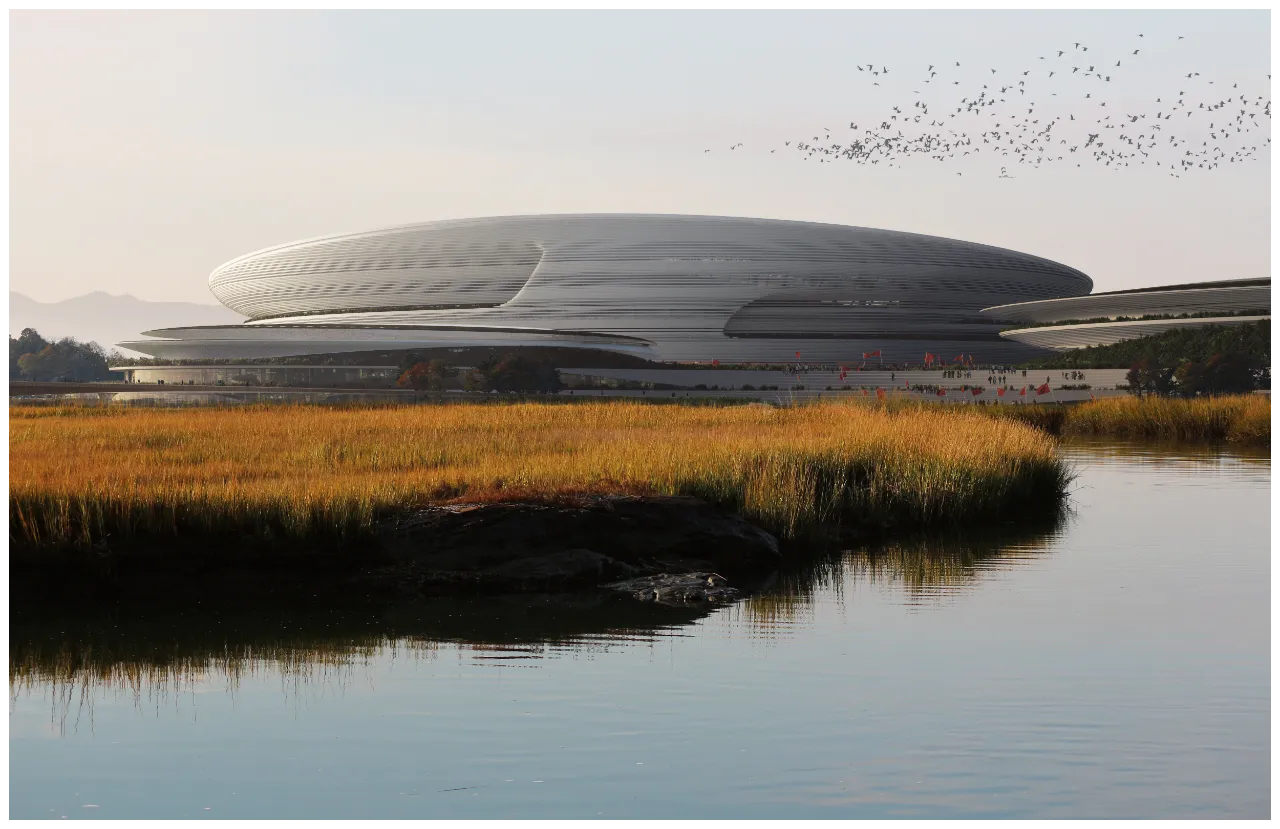
Guangzhou Sports Centre
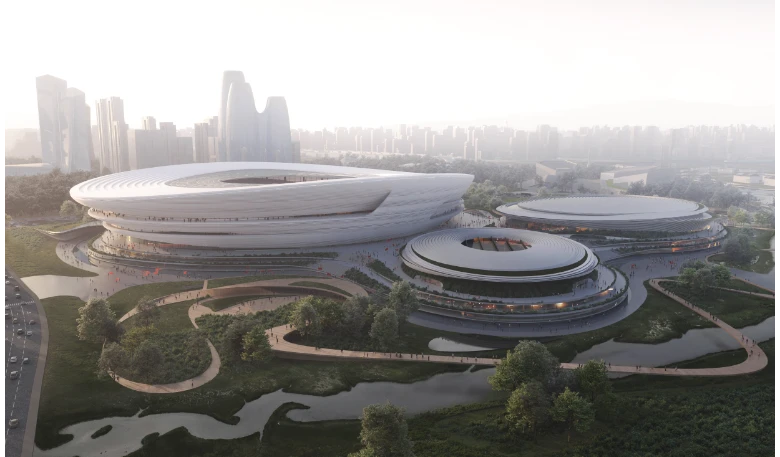
This immense sports complex on the Pearl River features an open-air field with a capacity of 60,000 seats, an indoor arena for basketball and other events seating 20,000 and an aquatic center with a pool and diving boards for 4,000 people.
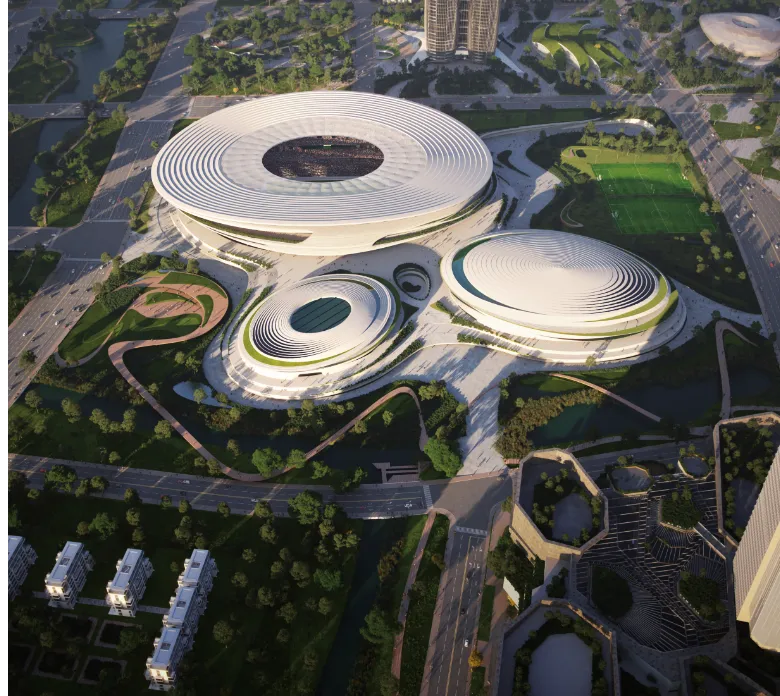
Designed by ZHA (Zaha Hadid Architects), the Guangzhou Sports Centre is located in a 70 hectares park on the riverbank in Greater Bay, a new waterfront area in the Nansha District. It sits at the intersection of the tides and pedestrian traffic, where architecture attempts to capture the essence of water in form.
The grand opening celebrations in December 2025 consist of a series of concerts that transform the sports stadium into a stage for music.
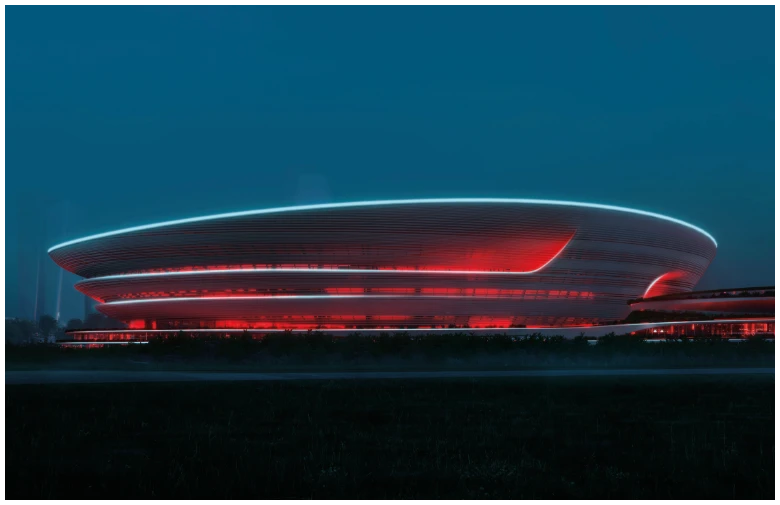
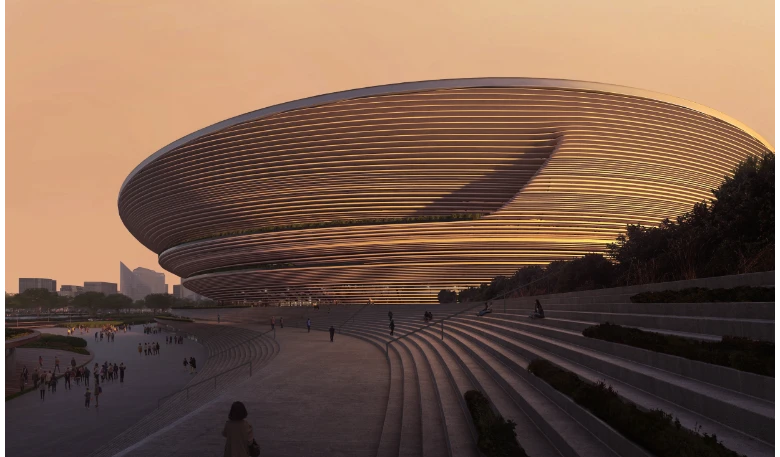
ZHA‘s geometries evoke a maritime memory. Vertical lams and curvilinear facades reflect ancient environmental wisdom.
They are inspired by the sails of ancient Song Dynasty boats.
An original layered wooden roof surrounds the enormous stadium, evoking the pleated silk structures of traditional Chinese fans.
It also draws on the traditional architecture of Lingnan, perfectly suited to the subtropical climate.
Long strips of wood provide shade and cool the interior, promoting natural ventilation.
The architects have sculpted a smooth roof with concave and convex volumes.
An arch frames the river and a large skylight frames the views as if capturing a photograph.
From the distance, the complex appears as a constellation of curves, a choreography of roofs that open and fold like sails caught between two winds.
The stadium features an adjustable seating area that can be modified to accommodate different events.
Its curved exterior rises, forming an arched opening on the side, allowing cool air from the Pearl River estuary to enter the stadium and offering views of the water.
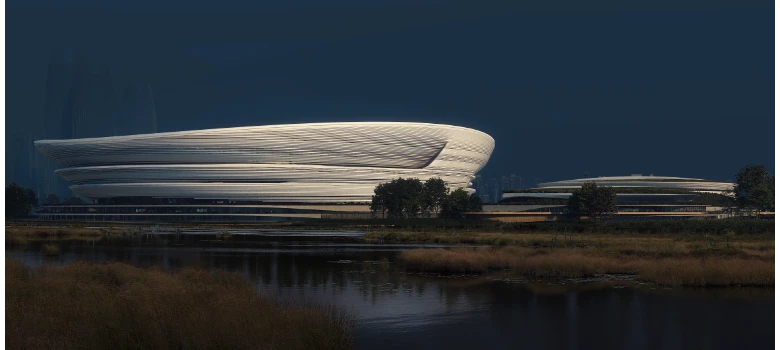
The wetlands surrounding the complex were designed to prevent flooding and help manage excess water caused by rising sea levels.
Islands connected by walkways, terraces and rooftops covered in plants seem to blur the boundary between the city and the river. These are not mere structures, but spaces tailored to human needs. Their design aims to accommodate the rituals of professional, amateur athletes, swimmers, players and spectators.
Entering the complex is like stepping into a tidal wave.
The pathways curve like currents, the plazas converge like estuaries and circulation flows intentionally within an urban choreography that guides people like a river guides boats.
Inside the stadium, the seats are sculpted into tiers that offer grand scale intimacy. A cathedral of 60,000 voices where sound folds, resonates and dissipates in carefully calculated volumes.
Another indoor stadium and the aquatic area are smaller siblings, calibrated for different spectacles, but sharing the same fluid style.
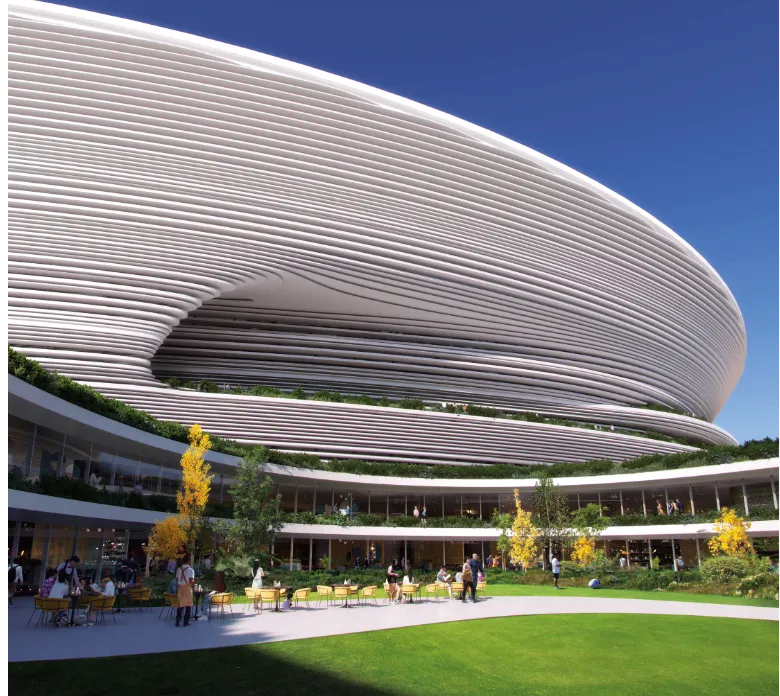
But it is not a complex exclusively for entertainment. ZHA offers a civic center focused on programs that promote sport and theenvironment. Athlete accommodations, training fields, running tracks and public recreation spaces are integrated into the park.
The center becomes not just an isolated monument but a living part of daily life. Bridges and subway connections integrate the center, making it accessible not only from Guangzhou but also from the entire interconnected metropolis, from Shenzhen to Hong Kong and Macau.
The complex signifies a port, a nerve center for the movement of people, economies and cultural exchange.
The materials evoke local craftsmanship: imposing concrete, layered steel and vertical louvers that play with the wind and natural light.
Bathed in the setting sun, the structure reveals its shell, oscillating between shadow and radiance.
At night, the facades become an urban lantern, a riverside beacon visible from the opposite bank.
There is also poetry in the choice of the site. The Pearl River is a long-standing pivotal center of Chinese trade and history.
Guangzhou has long been an important port city, a threshold between inland life and ocean routes.
This new Sports Center, with its riverside park weaves a new chapter, combining physical culture and public life.
The architectural arch frames the river and represents a continuation of the city: history, commerce and a new sports amphitheater for the contemporary era.
It is an impeccably finished complex, a response designed for the climate and culture, a perfect space to host both global events and leisurely afternoons surrounded by nature.
Guangzhou Sports Centre is an invitation to experience how architecture shapes ritual and how rituals, in turn, shape architecture.
The city unveils this new, dynamic coastal cathedral: a place where the harmony of water and the geometry of crowds meet, where sails become roofs and the rhythm of the river.
The new stadium, with its swimming pool facing the Guangzhou Sea, is a completed masterpiece and a symbol of light.
It pays homage to ancestral traditions and offers a vision for the future.
It is a reminder that great stadiums are not just meeting places, but instruments for imagining how we will gather in the future.
Innovative Iraqui-British architect Zaha Hadid was the first female winner of Pritzker Prize (2004). Her concepts perdure after her death (2016) with her studio ZHA, mainly her biomorphic, fluid, dynamic and curved forms inspired by natural shapes.
ZHA integrates buildings into landscapes by mimicking natural topography and forces, leading to structures that appear to grow organically, melting into their surroundings.
Zaha’s biomorphic architecture projects
- Vitra Fire Station, 1993, Germany
- Rosenthal Center for Contemporary Art, 2003, Cincinnati, USA
- BMW Central Building, 2005, Germany
- Phaeno Science Center, 2005, Germany
- MAXXI Museum, 2010, Rome
- Guangzhou Opera House, 2010, China
- Galaxy SOHO, 2012, Beijing, China
- Heydar Aliyev Center, 2012, Baku, Azerbaijan
- Riverside Transport Museum, 2011, Glasgow, Scotland
- Dongdaemun Design Plaza, 2014, Seoul, South Korea
- Port House, 2016, Antwerp, Belgium
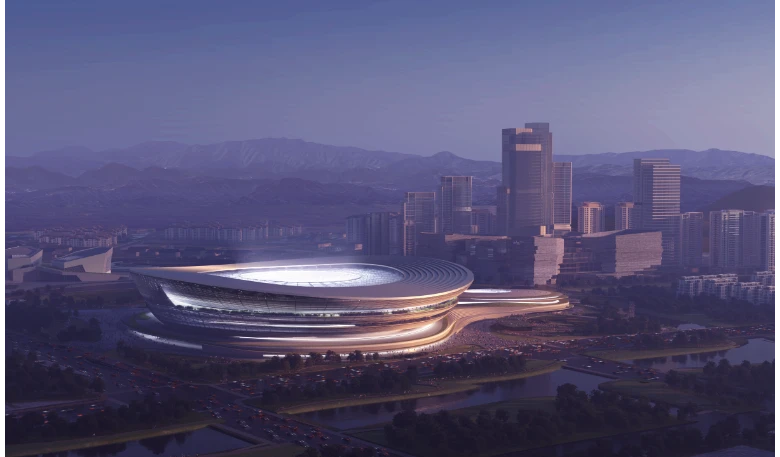
In Guangzhou, biomorphic geometries, climate adaptation, fluid interplay with nature, environment fusion with public life… are all Zaha Hadid’s concepts that whisper prophetic dreams.
The stadiums of the future will not stand out as individual monuments, but will be integrated into cities, merging with the landscape.
They will breathe with the climate, evolve with the community and create experiences far beyond the simple sporting spectacle.