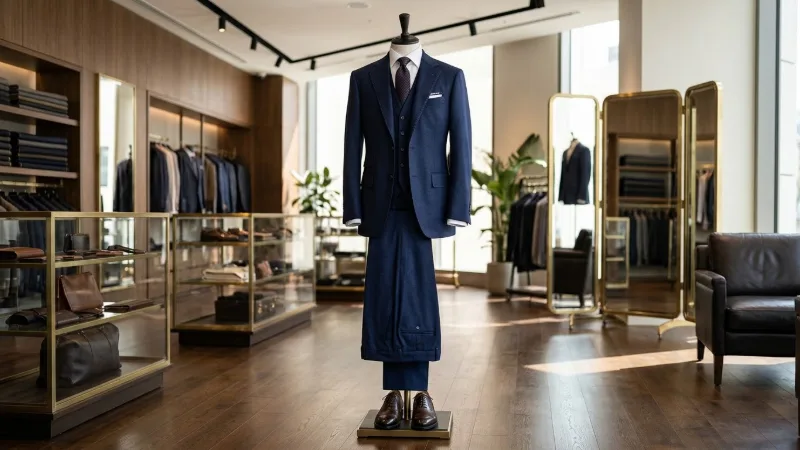
The usual story goes like this. Bespoke is the expensive suit with the long wait, and made to measure is its quicker, more affordable sibling. A cutter tells a different story, and it begins on a sheet of brown paper.
Either a pattern is drafted for your body and nobody else’s, or a standard pattern already exists and is adjusted until it sits close to you. The hours, the fittings, the hand stitches and the months of waiting all follow from that first decision.
That is why the bespoke vs made to measure question is more interesting than a price tag suggests. Shops use both words loosely and advertisers use them generously. Both routes can produce a beautiful garment.
Both can disappoint if you expect one and receive the other. The real difference is authorship: who draws the lines of the suit, and how much of you goes into them. A good suit is a portrait in cloth, and every portrait starts with a sketch.
Stage one: know what each word promises
Settle the vocabulary before you compare hours or fittings. Most confusion in a fitting room starts with two people using the same word for different things. One of them is thinking of a process. The other is thinking of a result.
Bespoke tailoring, explained in Savile Row terms
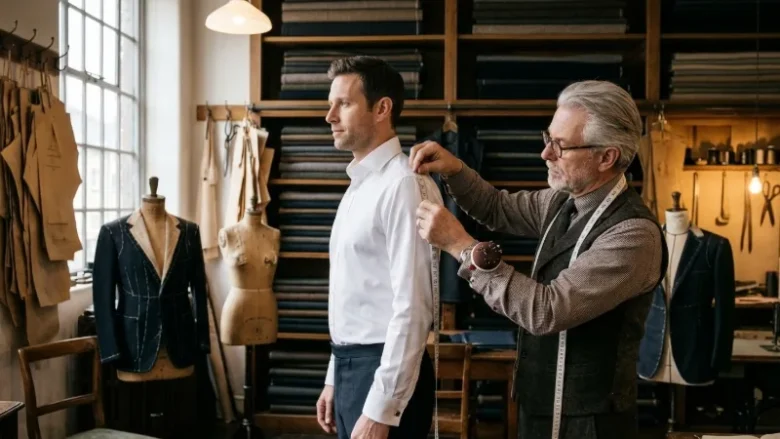
The most demanding definition comes from the London street that turned the word into a global reference. The Savile Row Bespoke Association was formed in 2004 by five houses: Anderson & Sheppard, Dege & Skinner, Gieves & Hawkes, H. Huntsman & Sons and Henry Poole & Co. Its method starts with about thirty body measurements. These are drafted into an individual paper pattern, and your chosen cloth is cut from that pattern.
The averages are generous with time. For Savile Row houses, the association gives fifty man-hours, three intermediate fittings and around three months between commission and finished garment. By its own account, the process has changed little since the seventeenth century. Its tailoring glossary defines a bespoke suit as one whose pattern is made specifically for the customer. It is built with a minimum of fifty hours of hand work and a series of fittings.
Member houses also accept rules that read almost like a manifesto for slowness:
- A Master Cutter oversees every tailor.
- Every garment is constructed within a one-hundred-yard radius of Savile Row.
- Each house offers at least 2,000 cloths.
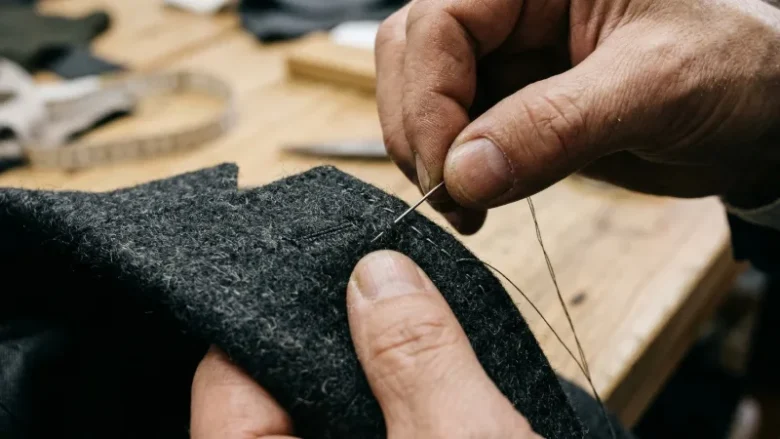
- Jacket foreparts are entirely hand canvassed. Buttonholes are sewn, sleeves attached and linings felled by hand.
Read those standards as a high benchmark, not a universal rule. They describe what one group of houses commits to. Workshops elsewhere may organize their work differently and still cut an original pattern for each client. In the strict sense, what makes a suit bespoke is a pattern drawn for one person. Handwork is the tradition that usually travels with it, but the pattern comes first.
Made to measure, as the trade uses it
Made to measure starts somewhere else. The common industry definition describes clothing cut and sewn from a standard-sized base pattern, often called a block, which is adjusted using a handful of body measurements. The garment is still cut for you. It simply begins life as a shape designed for many people and then bent toward one.
Construction typically mixes machine and hand sewing. Fewer fittings are needed, so the wait is shorter. Prices typically land above ready-to-wear and below bespoke, although the gap varies between houses.
One common misunderstanding deserves correcting. Made to measure is not the same as altering a finished suit. Alterations work on cloth that has already been cut and sewn. Made to measure changes the pattern before the scissors touch anything. That is why a good one can feel far more personal than a jacket taken in off the rail.
The block sets the limit of made to measure. If your shoulders, posture and proportions sit close to the standard shape, the adjustments can be subtle and the result excellent. If they drift far from it, every correction pulls against the original geometry. You start to see the strain in the collar, across the back and in the way the sleeves hang when your arms are at rest.
Why the label on the door is not enough
It would be convenient if the word bespoke guaranteed the Savile Row method. It does not. In the United Kingdom the term has no single legal definition, and a decision taken in 2008 made that plain to anyone shopping for a suit.
On 18 June 2008 the UK’s Advertising Standards Authority rejected a complaint about suits advertised as bespoke. Those suits were machine-cut and sewn to the customer’s measurements. The regulator found that customers expect a bespoke suit to be tailored to their measurements and specifications.
It also found that most people would not expect it to be fully hand-made, with a pattern cut from scratch. The word was read in its ordinary sense of “made to order.”
The ruling did not settle the argument inside the trade. A specialist menswear writer responded at the time that the heart of bespoke is a cut that is yours and yours alone, not an amended block sewn by machine.
He also called requirements such as hand sewing and a one-on-one interview arguable, and said they had eroded over the years. That tension still shapes how shops talk to customers. It also explains why two tailors on the same street can use the same word with complete sincerity and mean different things.
Across the Channel, the protected term is a different one altogether. In France, the designations haute couture, Couture Création and Grand Couturier require an annual accreditation from the Minister of Industry. That accreditation rests on a decree of 23 January 1945 and an order of 6 April 1945.
A fact sheet from the French Ministry of Culture says the haute couture list currently has thirteen houses, a figure that may have changed since the fact sheet was written. They are chosen by a commission within the Fédération de la Haute Couture et de la Mode, formerly the Chambre Syndicale de la Couture Parisienne. That accreditation belongs to couture. It does not extend to men’s tailoring or to the words “sur mesure” on a shop window.
The practical lesson is simple. Whatever word appears on the door, whether bespoke, sur mesure or a medida, ask how the pattern is made. No label answers that question for you, and the answer changes everything that follows.
Stage two: choose the route that suits your body and your calendar
Once the vocabulary is clear, the decision becomes personal. Neither route is better in the abstract. Each one fits a different person at a different moment in life.
Bespoke makes sense when your figure departs noticeably from standard proportions. Common examples are a dropped shoulder, a pronounced seat, a forward stance or one arm longer than the other. It also makes sense when you want a silhouette that no block offers, or when the suit should accompany you for decades.
You need to be able to give the process three months and several appointments without resenting them. A bespoke commission rewards presence. If travel or work keeps you away from fittings, the pattern loses the corrections that make it yours.
Made to measure is the sensible choice when your build sits close to standard sizing. It also fits when you need a suit sooner than a bespoke timeline allows, or when you want to test a cut, a cloth or a color before investing in an original pattern. For a first serious tailored suit on a fairly regular figure, we would start here.
A good made-to-measure house teaches you what you like in a lapel, a trouser rise or a shoulder line. That self-knowledge pays off later if you commission bespoke, because you arrive with opinions instead of vague wishes.
There is a third answer that people rarely hear in a tailor’s shop: sometimes neither. If a suit will leave the wardrobe twice a year, a well-chosen ready-to-wear jacket with careful alterations may be the more honest purchase. In that case, the budget could go toward a coat or a pair of shoes you will wear every week.
The comparison below sets the Savile Row standard against common made-to-measure practice. The specifics vary by house and by order, so read the right-hand column as typical rather than guaranteed.
| Aspect | Bespoke (Savile Row standard) | Made to measure (common practice) |
|---|---|---|
| Pattern | Drafted individually for the client | Standard base block, adjusted |
| Measurements | About thirty, plus the cutter’s observation of posture | A smaller set of key measurements |
| Construction | Minimum fifty hours of hand work; hand-canvassed foreparts | Machine and hand sewing combined |
| Fittings | Average of three intermediate fittings | Typically fewer |
| Lead time | Around three months on average | Typically shorter |
| Relative cost | Typically above made to measure | Typically above ready-to-wear, below bespoke |
| Cloth choice | At least 2,000 cloths at member houses | Depends on the house |
| Best for | Off-standard figures, long-term pieces, original silhouettes | Near-standard figures, tighter calendars, first tailored suits |
| Main limitation | Time and commitment to fittings | The block cannot absorb large corrections |
Stage three: the questions to ask before you commission
A good tailor welcomes precise questions, because they reveal a client who will notice good work. These are the questions worth asking at the first meeting, roughly in this order:
- Is my pattern drafted from scratch, or adjusted from a house block? This is the dividing line, so ask it plainly and expect a plain answer.
- Who cuts my suit, and will that person attend my fittings? A pattern improves through continuity between cutter and client.
- How many fittings are planned, and at what stages? A basted fitting shows that the house is willing to take the coat apart and correct it.
- Where is the suit made? In-house workrooms and outside factories can both produce good work, but you deserve to know which one is involved.
- How is the chest constructed? Ask whether the canvas is sewn or fused, and which parts are finished by hand, including the buttonholes.
- Will my pattern be kept for future orders? In bespoke it usually is, and it becomes the foundation of every suit that follows.
- Which cloths can I see, and in what weights? Weave and weight matter as much as color, especially for a suit you will wear in very different climates.
Listen to how the answers are given, too. Vague talk of “traditional methods” is less reassuring than a cutter who happily explains why your left shoulder needs a different line from your right. Confidence about the craft usually sounds specific.
Stage four: your first bespoke suit, fitting by fitting
The first commission teaches you the rhythm. Based on the Savile Row averages, expect roughly three months and three intermediate fittings. Some houses work faster, and others add a visit when the cloth or the figure asks for it.

The conversation and the measuring
The process starts with conversation rather than a tape measure. The cutter wants to know where and how you will wear the suit: city mornings, long dinners, frequent flights, a warm Andalusian summer or a gray Paris winter.
Then come the measurements, around thirty of them on the Row. The cutter also notes things no number captures: how you stand, how you hold your head, which shoulder drops when you relax.
Arrive in the shoes and the type of shirt you plan to wear with the suit, and stand as you normally do. If you straighten up for the tape, the cutter records a posture you will abandon by lunchtime.
Pattern, cloth and cutting
Your measurements and the cutter’s observations become a paper pattern drawn for you alone. This is the moment to choose cloth with care. A Savile Row Bespoke Association member house offers at least 2,000 options, and the swatch books can be overwhelming.
Narrow the field by use first, then by weight, and only at the end by pattern and color. A cloth that drapes beautifully in the hand may be too warm, too light or too lively for the life you described in the first conversation.
The baste fitting
The first fitting often surprises newcomers. The coat arrives loosely tacked together with white thread and covered in chalk marks. Sometimes the sleeves or collar are not finished. Nothing is wrong. This is a draft, built to be taken apart.
Pins, chalk marks and a close look at how the garment balances on your body come first, and parts of the pattern may be recut afterward. Speak up about anything that feels tight, loose or simply unlike you. Changes are easiest when the cloth is barely sewn, and silence here becomes a compromise later.
Forward fitting and finishing
At the next stage the suit looks more like itself. The canvas is shaped, the pockets are in place and the sleeves are set. The adjustments become finer: a quarter inch at the waist, the way the trousers break over the shoe, the roll of the lapel. Then the long handwork of finishing begins, and the final fitting is about confirmation rather than correction.
Try to keep your weight stable during these months. Avoid booking the last appointment the day before an important event, because a small final adjustment needs some breathing room.
Do not expect perfection the first time. Your pattern now exists on paper, and each future commission refines it. In practice, the second suit cut from the same pattern tends to sit better than the first, because the cutter has followed your body through a full cycle.
If you choose made to measure, make the process work for you
Made to measure rewards a prepared client. Any sensible made to measure suit guide starts with the same advice: the result depends on how well the starting block matches you before a single adjustment is made.
- Try on the house’s fitting garments, if they offer them, in more than one size. The starting block matters more than the list of changes.
- Ask to be measured by an experienced fitter, and ask to see the adjustments written down.
- Decide on your preferences before you arrive: lapel width, button position, pocket style, trouser finish. Indecision at the counter leads to compromises.
- Ask whether a fitting is included before the suit is finished, and use it.
- Ask which parts are sewn by hand. The mix of machine and hand work varies widely, and a hand-finished collar or hand-sewn buttonholes can change how a jacket feels.
Know the limits as well. A skilled fitter can lengthen sleeves, open a waist or lower a shoulder on a made-to-measure jacket. Marked asymmetry or posture is harder, and correcting it on a block rarely happens without visible strain. If the fitter keeps saying “we can’t quite get that,” your body is asking for a pattern of its own.
After delivery: living with a tailored suit
A suit cut for you begins a relationship with a workroom. It does not end a transaction. Let the suit rest for a day between wears so the cloth can recover, and hang it on a shaped hanger that fills the shoulders. Brush it rather than sending it to the dry cleaner at the first mark, because heavy pressing flattens the soft roll of a hand-shaped lapel.
If your body changes, take the suit back to the house that made it. Generous seam allowances, common in good tailoring, make it possible to let a suit out. A pattern the house has kept can also be updated, so your next commission starts closer to the body you have now. Made-to-measure suits deserve the same care, although how much they can be let out depends on how each house cuts its seams.
Why the old ledgers still matter
The insistence on paper patterns and handwork is not nostalgia for its own sake. It is a living archive. Henry Poole & Co dates itself to 1806, when the military tailor James Poole founded the firm. His son Henry inherited the business in 1846. The firm’s own history presents him as the first bespoke tailor to open grand premises with an entrance onto Savile Row.
The house’s ledgers also hold one of tailoring’s favorite stories. In 1865 the Prince of Wales, later Edward VII, asked for a short silk evening coat as an informal alternative to white tie, and that commission is recorded in the firm’s books.
The house is credited with the garment that evolved into the dinner jacket, though the origin of the dinner jacket is not settled. One request from one client, written into a ledger, ended up shaping evening dress for generations.
Learning the craft behind such stories takes years. Apprentice tailors in the association’s houses can train for up to six years to specialize in a single area, such as cutting patterns or making trousers. A bespoke suit brings several of those specialties together in one garment. That is its poetry: a coat built by many hands to fit one body, and recorded on paper so it can be built again.
That is also why the distinction is worth keeping in your own vocabulary, even where regulators are relaxed about it. Words are part of the cloth. When you know what you are asking for, the tailor can give it to you, and the suit becomes a conversation rather than a guess.
At NEOMANÍA Magazine, our Fashion section treats tailoring as culture as much as clothing, alongside architecture, design, art and living. We publish exclusive interviews with designers and news on exhibitions, books and trends. We also offer downloadable issues, in English and Spanish, so you can keep these stories close long after the season has turned.
If the difference between a drafted pattern and an adjusted block has changed how you look at your own wardrobe, subscribe to keep reading the magazine and its articles. If your brand would like to appear in our pages, get in touch with our team to request the media kit.