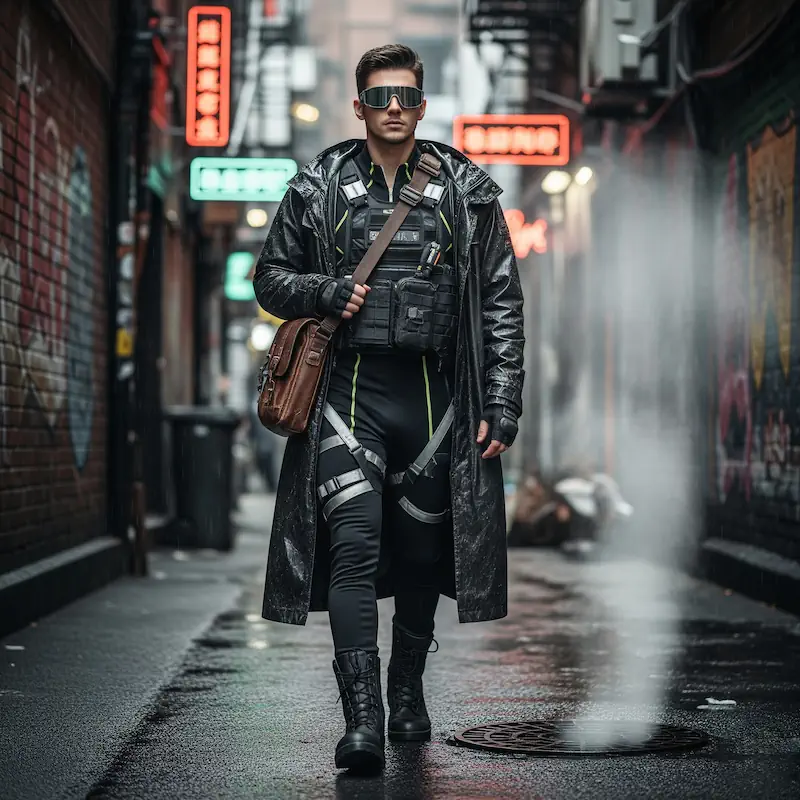
The rain outside is real, but the world you see through your window is curated by an algorithm. Your identity is a collection of data points, your location a commodity. This isn’t the opening scene of a sci-fi novel; this is Tuesday.
In a world that has seamlessly merged the digital and the physical, where corporations are the new empires and privacy is a fading luxury, cyberpunk fashion isn’t a nostalgic trend. It is a user manual.
It’s the only dress code that logs into our glitched present, a practical and philosophical response to a future that arrived unannounced.
Forget flying cars. The future we inherited is one of ubiquitous screens, surveillance capitalism, and a planet groaning under the weight of our progress.
Cyberpunk fashion, therefore, is not about cosplaying a fantasy. It is an acknowledgment of reality. It’s the armor we don for the concrete jungle and the data cloud, a style that asks the most pressing questions of our time: In an age of overwhelming information, how do we protect our signal?
When the body itself is a frontier for technology, where does the self begin and the system end? This isn’t about looking futuristic. It’s about being functional, resilient, and defiant in the face of it.
The ghost in the machine: decoding the cyberpunk DNA
To understand cyberpunk fashion, one must look past the surface-level signifiers. It is a visual language, an aesthetic born from the friction between technological advancement and societal decay.
Its DNA is a code written in shadow, function, and deliberate imperfection, a uniform for navigating the beautiful and terrifying paradoxes of modern life.
Beyond the neon-soaked rain
The city at night is the quintessential cyberpunk landscape, but its essence is not merely the glow of neon on wet pavement. It is the overwhelming darkness that makes that light so potent.
The core palette is a study in blacks and grays—the color of asphalt, server racks, polluted skies, and carbon fiber. This is not the passive black of minimalism; it is an active, functional black, chosen for its ability to absorb light, to move unseen.
Upon this canvas, the jarring slash of color—the acid green of a circuit board, the electric blue of a corrupted file, the warning-sign orange—is not decorative. It is information.
It is a biohazard symbol, a status indicator, a deliberate glitch in the monochrome uniformity. To wear these colors is to announce your presence on your own terms, a single, defiant pixel in a sea of grayscale data.
The supremacy of function
At the heart of cyberpunk beats the pulse of “techwear.” This is where the genre transcends aesthetics and becomes a design ethos. Function is not just a feature; it is the supreme virtue, the object of worship.
Garments are tools, systems, wearable architecture. They are crafted from materials engineered for performance: waterproof-breathable membranes like Gore-Tex to shield against acid rain, abrasion-resistant nylons like Cordura to withstand the urban grind, and four-way stretch fabrics for uninhibited movement.
The design language is one of explicit utility. Pockets are numerous, placed for ergonomic access. Straps and webbing systems (like the military-derived PALS/MOLLE) allow for modularity, letting the user attach or detach pouches and hardware as the mission dictates.
A jacket from a brand like Acronym is not just a piece of clothing; it’s a piece of gear, an interface between the user and their hostile environment.
Every sealed seam, waterproof zipper, and quick-release buckle is a testament to this philosophy: in a world of unpredictability, your clothing should be the one system you can always rely on.
The glitch in the silhouette
If techwear provides the “cyber,” punk provides the soul. It is the ghost in the machine, the human element that disrupts the cold logic of pure function.
Cyberpunk inherits punk’s love of deconstruction, its rage against the clean, symmetrical lines of conformity. The silhouette is often broken, asymmetrical, and layered in a way that defies easy categorization.
Hems are left raw, panels are mismatched, and straps hang loose, creating a sense of calculated chaos. This “glitch aesthetic” is a visual rebellion against mass-produced perfection.
It suggests a history of repair, modification, and adaptation. It says that the garment, like its wearer, has survived, has been taken apart and reassembled to be stronger, more unique. It is the antithesis of the pristine, off-the-rack look, a proud display of the scars and patches that form a unique identity.
More than human: the philosophy worn on our sleeves
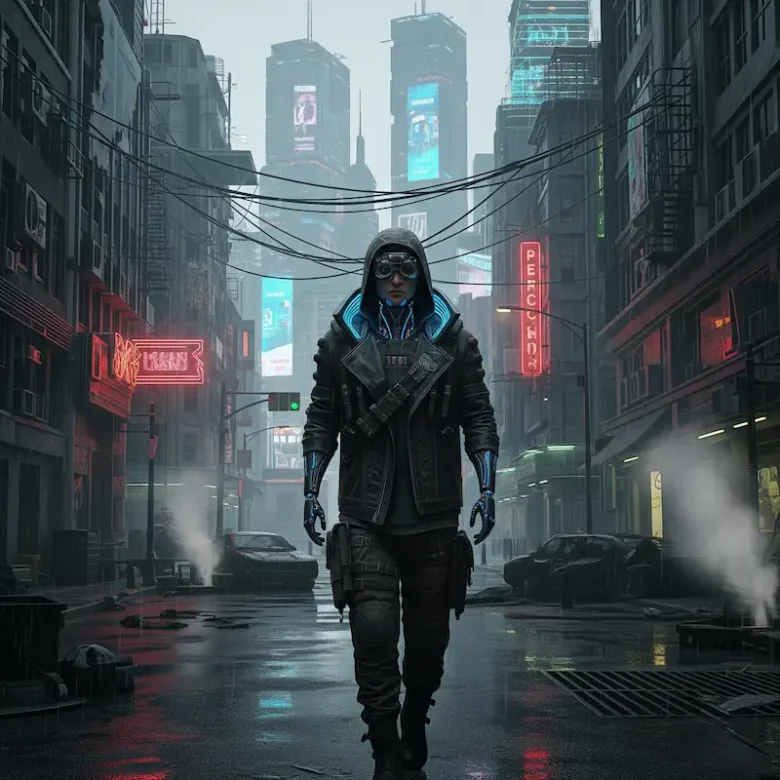
To wear cyberpunk is to make a statement. It is to engage in a philosophical discourse without saying a word. The clothing is a physical manifestation of a worldview shaped by the seminal works of the genre, a critical commentary on our increasingly complex relationship with technology, power, and the very definition of humanity.
“High tech, low life” as a design principle
The foundational cyberpunk motto, “High Tech, Low Life,” is the most crucial design principle of the entire movement. It embodies the core paradox: a world where incredible technological marvels coexist with social decay and marginalization.
Fashion translates this by clashing futuristic elements with worn, gritty textures. A sleek, carbon-fiber plate might be strapped over a frayed and patched hoodie.
A pair of technologically advanced cargo pants might be paired with scuffed, military-surplus boots. This aesthetic rejects the clean, utopian futures peddled by tech corporations.
It finds beauty in the makeshift, the repurposed, and the resilient. It tells a story of survival, of people using discarded and advanced technology alike to get by on the fringes of society.
It’s an honest reflection of a world where you can hold a supercomputer in your hand but still have to worry about the rent.
The body as a modifiable platform
Cyberpunk fashion relentlessly probes the boundaries of the human form. It operates from the premise that the body is no longer a sacred, static vessel, but a modifiable platform, a piece of hardware to be upgraded.
Garments often blur the line between clothing and prosthesis. Complex harnesses and strap systems redefine the body’s contours. Masks and face coverings obscure identity and suggest alternative sensory inputs, from air filtration to data overlays.
The clothing often features ports, panels, and integrated wiring that hint at a direct connection between the flesh and the machine.
This is fashion on the edge of transhumanism, exploring a future where our clothes become an inseparable part of our augmented selves. It’s less about dressing the body and more about interfacing with it.
Fashion as counter-surveillance
In an era of ubiquitous CCTV, facial recognition, and digital tracking, anonymity is the new rebellion. Cyberpunk fashion provides a toolkit for reclaiming it.
It is an act of “data-dazzle,” a form of personal encryption against the watchful eyes of the state and the corporation. Deep hoods, high collars, and face-obscuring masks are not just stylistic choices; they are practical measures to defeat algorithmic identification.
The complex, layered silhouettes break up the human form, making it harder for tracking software to follow. Materials that block RFID signals can be integrated into pockets to protect personal data.
In this context, getting dressed in the morning becomes a strategic act of defiance, a way of carving out a small zone of privacy in a world that wants to see and catalogue everything. It’s a silent protest for the right to be unreadable.
The 21st century upgrade: a style rebooted by the net
While its roots are in the 20th century, cyberpunk fashion’s current form has been forged in the fires of the internet. It has been remixed, reinterpreted, and distributed at the speed of light, evolving from a niche subculture into a global, digital-first phenomenon.
From niche forums to the instagram feed
For years, the aesthetic was cultivated in the deep corners of the internet—in Usenet groups, forums, and niche blogs. Today, it thrives in plain sight on visual platforms like Instagram, Pinterest, and TikTok.
This migration to the mainstream has had a dual effect. On one hand, it has flattened some of the genre’s deep-seated ideology into a more consumable “aesthetic.”
On the other, it has created an unprecedented global community. A teenager in Seoul can now share styling ideas with a designer in Berlin, creating a vibrant, cross-pollinating ecosystem of inspiration.
The feed has become a living mood board, accelerating the style’s evolution and creating countless new hybrid forms as cyberpunk collides with goth, streetwear, and haute couture.
Leveling Up: the influence of video game wardrobes
No single medium has had a more profound impact on modern cyberpunk fashion than video games. Titles like Deus Ex, Metal Gear Solid, and the monumental Cyberpunk 2077 have provided millions with interactive, deeply immersive experiences of living in a cyberpunk world.
In these games, customizing your character’s wardrobe is not just cosmetic; it’s a core part of the experience, affecting stats and abilities.
This has trained a generation to think of clothing in terms of systems, loadouts, and functionality. Consequently, fans are no longer content to just see the style on screen; they want to embody it.
The demand for real-world versions of in-game gear has pushed fashion forward, blurring the line between digital armor and physical apparel.
The rise of the urban ninja
A significant modern iteration of the cyberpunk aesthetic is the “urban ninja.” This style refines the often-bulky cyberpunk look into something more sleek, agile, and focused on movement.
It draws heavily from martial arts and traditional Japanese clothing, incorporating elements like hakama-style pants, tabi boots, and lightweight kimonos.
Combined with modern technical fabrics and a stark, monochrome palette, the result is a hyper-mobile, minimalist, and deeply enigmatic silhouette.
It speaks to a need for agility and stealth in the dense urban environment, representing a quieter, more precise form of the cyberpunk ethos—less overt rebellion, more covert operation.
Building your system: a practical design ethos
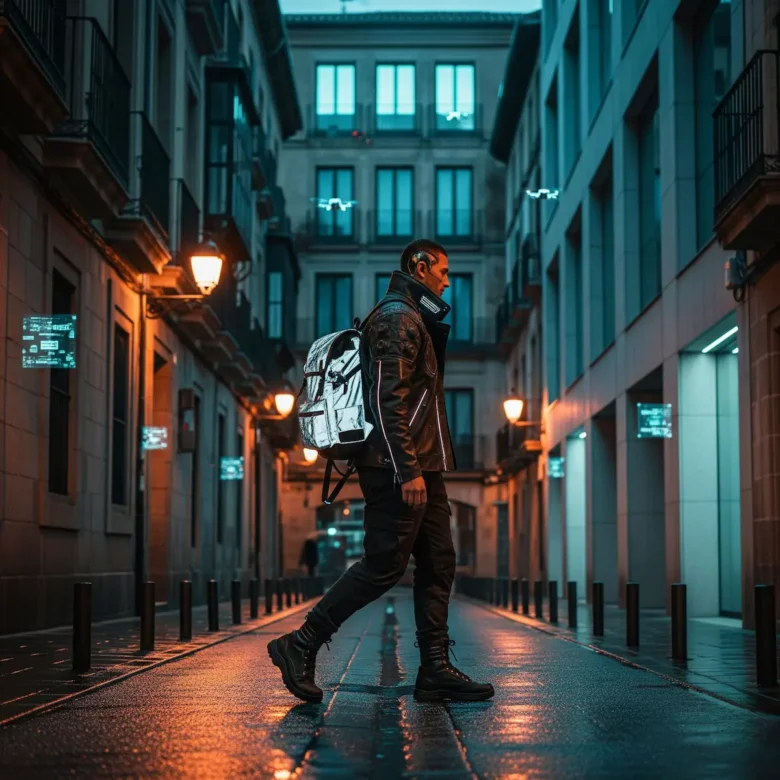
To adopt cyberpunk fashion is not to buy a costume. It is to build a personal system. It requires a shift in mindset, from thinking about “outfits” to thinking about “loadouts.”
It’s a conscious process of curating a small, highly functional, and deeply personal wardrobe designed for your life.
The logic of layering
Layering is the foundational grammar of the cyberpunk style. It is a practical response to unpredictable environments. The system typically consists of three parts.
The base layer sits next to the skin and is designed to manage moisture and provide comfort (e.g., a merino wool or technical polyester t-shirt).
The mid-layer provides insulation and can be added or removed as temperatures fluctuate (e.g., a fleece, a hoodie, or a light vest).
The shell layer is the outermost shield, protecting against wind, rain, and abrasion (e.g., a Gore-Tex jacket). The art lies in ensuring these layers work together, allowing for a full range of motion and easy adaptation to any situation, from a crowded subway to a sudden downpour.
A palette for urban camouflage
The color palette is your primary tool for blending in or standing out on your own terms. It is rooted in the spectrum of the urban environment. Start with a foundation of blacks, charcoals, and deep grays.
These are your camouflage. Introduce utilitarian colors like olive drab and navy blue, which speak to function and military heritage.
Finally, use color as a deliberate accent, a strategic highlight. A flash of safety orange on a zipper pull, a blood-red graphic on a t-shirt, or the electric blue of a strap. These accents should be used sparingly, like emergency signals, to draw the eye and make a specific statement against the muted background.
Hardware: the accessories that define you
In cyberpunk, accessories are not afterthoughts; they are critical hardware. They are what elevates a look from simple clothing to a functional system.
Think of a cross-body sling bag, designed to keep your essentials secure and accessible without impeding movement. Consider your eyewear as an interface—sleek, wraparound sunglasses or even blue-light filtering glasses that speak to a life lived in front of screens. Gloves, whether fingerless or tactical, suggest a hands-on interaction with the world.
And finally, footwear is your foundation. This means rugged combat boots, high-performance trail runners, or technical sneakers from lines like Nike’s ACG (All Conditions Gear). Your hardware should feel purposeful, as if each piece was chosen for a specific task.
The future is unwritten, but not undressed
Cyberpunk fashion is more than a collection of clothes. It is a mirror reflecting our most urgent contemporary anxieties and a toolkit for navigating them. It remains a potent and relevant language because the future it warned us about is now simply our present.
An evolving, open-source style
Unlike a fleeting trend, cyberpunk is an open-source ethos. It is constantly being forked, updated, and patched by its users around the world.
It absorbs new technologies, new ideas, and new influences, from sustainable materials to 3D-printed accessories. Its ability to evolve is what keeps it from becoming a relic.
It is not about preserving a past vision of the future, but about continuously adapting to the future as it unfolds.
Your wardrobe as a statement
Ultimately, the most powerful aspect of cyberpunk fashion is its invitation to be deliberate. In a world of fast fashion and mindless consumption, curating a cyberpunk wardrobe is an act of intention.
It forces you to think about what you wear, why you wear it, and what it says about you. It is a declaration that you are not a passive consumer of trends, but an active participant in the construction of your own identity.
It’s not a costume, It’s a conversation
To dress cyberpunk is to join a global conversation about our collective future. It’s an entry point into discussions about technology, privacy, corporate power, and human identity.
The clothes are just the interface for these ideas. They are a signifier to others that you are engaged, that you are thinking critically, and that you are ready for whatever comes next.
The real question the style asks is not “What will you wear?” but “What will you do?”
The world is complex. The signal is buried in the noise. Neomania Magazine is your filter. We don’t just report on the future; we decode its source code.