The very idea of “clothing” is becoming obsolete. For centuries, the word has signified a passive layer of fabric against skin, a second skin at best. But the garments now emerging from the world’s most forward-thinking labs and studios are anything but passive.
They are active systems, dynamic interfaces, and literal new skins woven from living cells and lines of code. The long-held distinction between the garment and the wearer is collapsing.
We are witnessing the birth of a new sartorial language, one that doesn’t just describe who we are but actively shapes who we can become. Its vocabulary is drawn from biotechnology and data streams; its syntax is sculpted by algorithms and augmented reality.
The designers of this new era are not mere tailors; they are the architects of our next evolution. To explore their work is to understand that the future of fashion isn’t about predicting what we’ll wear—it’s about programming what we will be.
This article, therefore, is not a trend report. Such a notion is antiquated. Instead, it is a primer for this emerging language, a guide to fashion’s next frontier.
We will explore the body as a living canvas, decode the grammar of our virtual identities, and examine the ecological imperative that provides the moral foundation for this new aesthetic.
This is a look at how we are, thread by thread, fashioning the future human.
The body as a living canvas
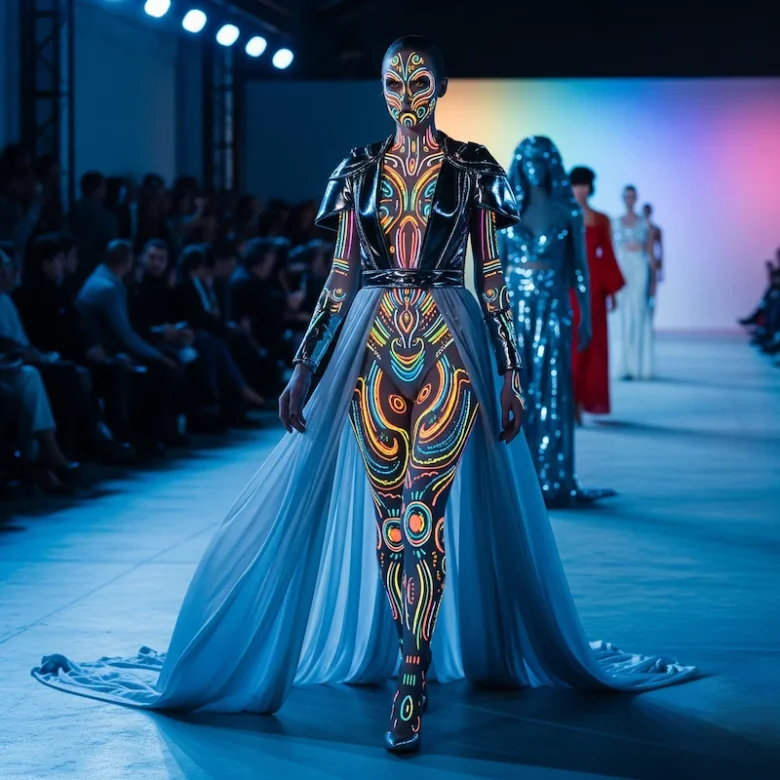
The most profound revolution in what we wear will not happen in the cut, but in the substance. For centuries, fashion has relied on a finite material lexicon: fibers from plants, animals, or petroleum-based synthetics.
This vocabulary is now being detonated by a new generation of creators who see themselves less as designers and more as material alchemists.
Fabric is ceasing to be a passive element and is instead becoming an active system—a biological and sensory extension of its wearer. The skin we choose to wear is merging with our own epidermis in an unprecedented dialogue.
Bio-couture beyond the seam
Imagine a dress cultivated from mycelium, the fungal network that acts as nature’s internet. A garment that, at the end of its life, isn’t discarded but planted, becoming nourishment for the soil.
This is not speculative fantasy; it is the active work of pioneers like Dutch designer Aniela Hoitink, who grows garments from mushroom roots, and the New York-based firm Modern Meadow, which bio-fabricates leather in a lab from living cells, without harming a single animal.
This bio-couture proposes a radical paradigm shift from an extractive industry to a regenerative one. Garments made of algae, kombucha, or specialized bacteria not only eliminate a carbon footprint but also introduce a new visual poetics.
Their organic textures, inherent imperfections, and ability to change over time defy the industrial obsession with uniformity. These are textiles that breathe, that remember their biological origins, and that force us to rethink our relationship with the life and death of the objects we wear.
Responsive skins that feel the world
The next material horizon is the integration of responsive capability. “E-textiles” or smart fabrics are materials that can see, hear, and feel.
They embed microelectronics, chromatic polymers, or conductive fibers that allow them to react to internal or external stimuli. While Google’s Project Jacquard weaves touch-sensitive connectivity into denim, the true vanguard lies beyond device control.
Consider a jacket whose very weave changes color to optimize for heat absorption based on the wearer’s body temperature, or a fabric that releases calming compounds in response to an elevated heart rate.
Artist and designer Ying Gao creates dresses that ripple and move when they detect a spectator’s gaze, a poetic exploration of voyeurism and intimacy.
This “living” fashion turns clothing into a feedback loop, an exo-nervous system that mediates our interaction with the world, translating unconscious biological functions into visible, aesthetic expression.
Sculpting a new human topography
Beyond new materials, futuristic design is fundamentally reconsidering the human silhouette, treating the body not as a mannequin to be draped, but as a landscape to be sculpted.
Drawing inspiration from parametric architecture and generative art, designers are creating “body architectures” that augment and redefine our physical forms.
Iris van Herpen remains a key figure, collaborating with scientists and architects to produce 3D-printed and laser-cut forms that are both skeletal and ethereal, evoking wings, soundwaves, or magnetic fields.
This isn’t about creating bulky, impractical costumes; it’s about using lightweight, advanced materials to craft new topographies.
These designs challenge our perception of the body’s boundaries, creating a silhouette that is not given by nature, but consciously chosen and intelligently designed.
Wearing the web: digital skins and virtual identities
As our lives increasingly migrate into non-physical spaces, the very act of getting dressed is becoming untethered from the physical body.
Our identity is now a fluid collage of data and representation, and digital fashion is emerging as its most potent and unbound form of expression.
It’s a realm where the laws of physics, material cost, and gravity simply dissolve, leaving a void filled by pure creativity. But this new freedom raises complex questions about value, ownership, and the very nature of self in a world of pixels.
The intangible currency of digital couture
What is a dress worth if it cannot be touched? This question, once nonsensical, now underpins a multi-million dollar industry. Purely digital fashion houses like The Fabricant and DressX are crafting haute couture that exists only as code, designed not for bodies of flesh and blood, but for avatars.
Often sold as NFTs, their value lies not in the craft of the needle and thread, but in the originality of the concept, the complexity of the render, and the scarcity certified by the blockchain.
To wear one of these creations in a virtual space is a status symbol, a signal of belonging to the digital vanguard. It is the act of clothing the intangible self, the digital soul that represents us in these new realms of social interaction.
Curating reality through an augmented lens
While metaverse fashion clothes our digital twins, Augmented Reality (AR) hacks our appearance in the physical world. The face has become the primary canvas for this ephemeral new art form.
AR filters on platforms like Instagram and Snapchat have evolved from playful novelties into sophisticated creative tools. Digital artists are designing iridescent masks, cybernetic makeup, and impossible textures that overlay our faces in real time.
This phenomenon challenges traditional cosmetics, offering a form of beauty that is activated rather than applied—an identity that can be changed, shared, and discarded with a single click.
Beauty becomes a performance, a temporary work of art existing only at the intersection of a face, a code, and the gaze of another through a screen.
The paradox of anonymity in a virtual world
This new digital wardrobe engenders a fascinating psychological paradox. On one hand, it offers unprecedented anonymity. An avatar can be anything—a being of light, a mythical creature, a geometric abstraction—freeing the individual from the constraints of their physical body, gender, or race.
On the other hand, it allows for a hyper-curated form of self-exposure. Every choice of “skin” or filter is a data point in a meticulously constructed personal brand.
This tension defines 21st-century identity: a fragmented self that seeks refuge in the anonymity of an avatar while simultaneously broadcasting its uniqueness through a carefully calibrated digital aesthetic.
Blueprints for a symbiotic future
For decades, fashion has operated with a willful blindness to its environmental cost, championing a linear “take-make-waste” system.
A future that ignores this reality is not a future; it is a shimmering, unsustainable mirage. The most critical vanguard, therefore, lies not in form or function, but in the ecological consciousness that is rebuilding the design process from the ground up.
Sustainability is ceasing to be a marketing footnote and is becoming the very heart of design, giving rise to a new aesthetic—a beauty derived from the intelligence of the system and the celebration of endurance.
Designing garments for disappearance
The concept of “waste” is a design flaw. The future of fashion addresses this by designing not just the garment, but its entire lifecycle and eventual reincarnation.
This is the logic of the circular economy, a model where every end is a new beginning. It manifests in modular clothing that can be easily disassembled for repair and upgrades, or in textiles engineered for programmed disassembly, safely dissolving back into base polymers to be spun into new thread.
The goal is a closed-loop, “Cradle to Cradle” system. The aesthetic value no longer resides merely in the object, but in the elegance and intelligence of its flow through time.
The clean alchemy of lab-grown textiles
The answer to the ecological crisis is not to halt production, but to radically reinvent it. The alchemy of the future happens in a clean, controlled laboratory.
Companies are using microbiology to grow and deposit dyes directly onto fabric, a process that can reduce water usage by up to 90%.
Others are developing textiles that actively capture carbon from the atmosphere, turning a garment into a tiny carbon sink. We are witnessing a monumental shift from “farm-to-fabric” to “lab-to-label,” where biotechnology and chemical innovation allow for the creation of materials and colors with a radically lower environmental impact.
Finding beauty in the mended scar
In a culture obsessed with the new and pristine, perhaps the most futuristic act is to repair. True sustainability is emotional as well as material; it is about forging a lasting bond with our possessions.
An “aesthetic of repair” is emerging, inspired by philosophies like the Japanese art of Kintsugi, where broken pottery is mended with gold, celebrating its scars as a mark of history and resilience.
In fashion, this translates to visible, artistic mending—a seam that is not hidden but highlighted. It is a quiet rebellion against planned obsolescence.
A garment that has been worn, loved, damaged, and carefully restored tells a story, possessing a soul that no new item can claim.
Weaving time with algorithm and craft
In the rush toward the future, there’s a temptation to erase the past. But the wisest vanguard seeks synthesis, not rupture. A truly human-centric futurism recognizes that tradition is not an anchor but a compass.
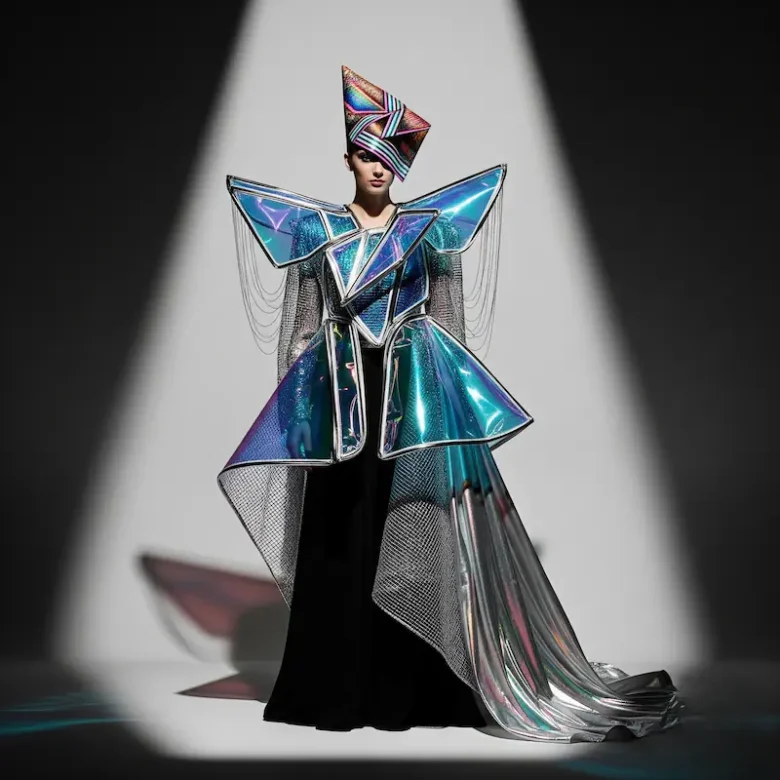
This is manifesting in a fascinating dialogue between time-honored artisanal techniques and the infinite precision of digital code.
This is not a contradiction, but a symbiosis: the machine learns from the soul of the hand, and the hand is empowered by the mind of the machine.
The algorithm as the artisan’s apprentice
An algorithm can generate a formal complexity that is beyond human capacity, yet it lacks the perfect imperfection—the warmth—that only a human hand can provide. Their collaboration is the new frontier of couture.
Designers are using generative AI to create unique patterns that are then executed using traditional craft methods. The machine can propose an infinitely intricate lace pattern; the laser can cut it with impossible precision; but it is the human artisan who gives it drape, life, and soul.
In this partnership, code does not replace the artisan; it becomes their most gifted apprentice.
Seeking the sacred in techno-rituals
At its origin, clothing was steeped in ritual and symbolism. The fashion of the future seems poised to reclaim this transcendent dimension through technology. We are seeing the rise of “techno-rituals,” where a garment becomes a catalyst for experience.
Imagine clothing that reacts to biometric data—heart rate, brainwaves—to generate calming patterns of light or sound. This is technology used not for productivity, but for introspection, turning the act of dressing into a form of visible bio-feedback, a modern ritual of self-awareness.
Coding the kimono: reimagining archetypes
The archetypes of clothing—the cloak, the armor, the kimono—persist in our collective unconscious because they answer to fundamental human needs for protection, dignity, and identity.
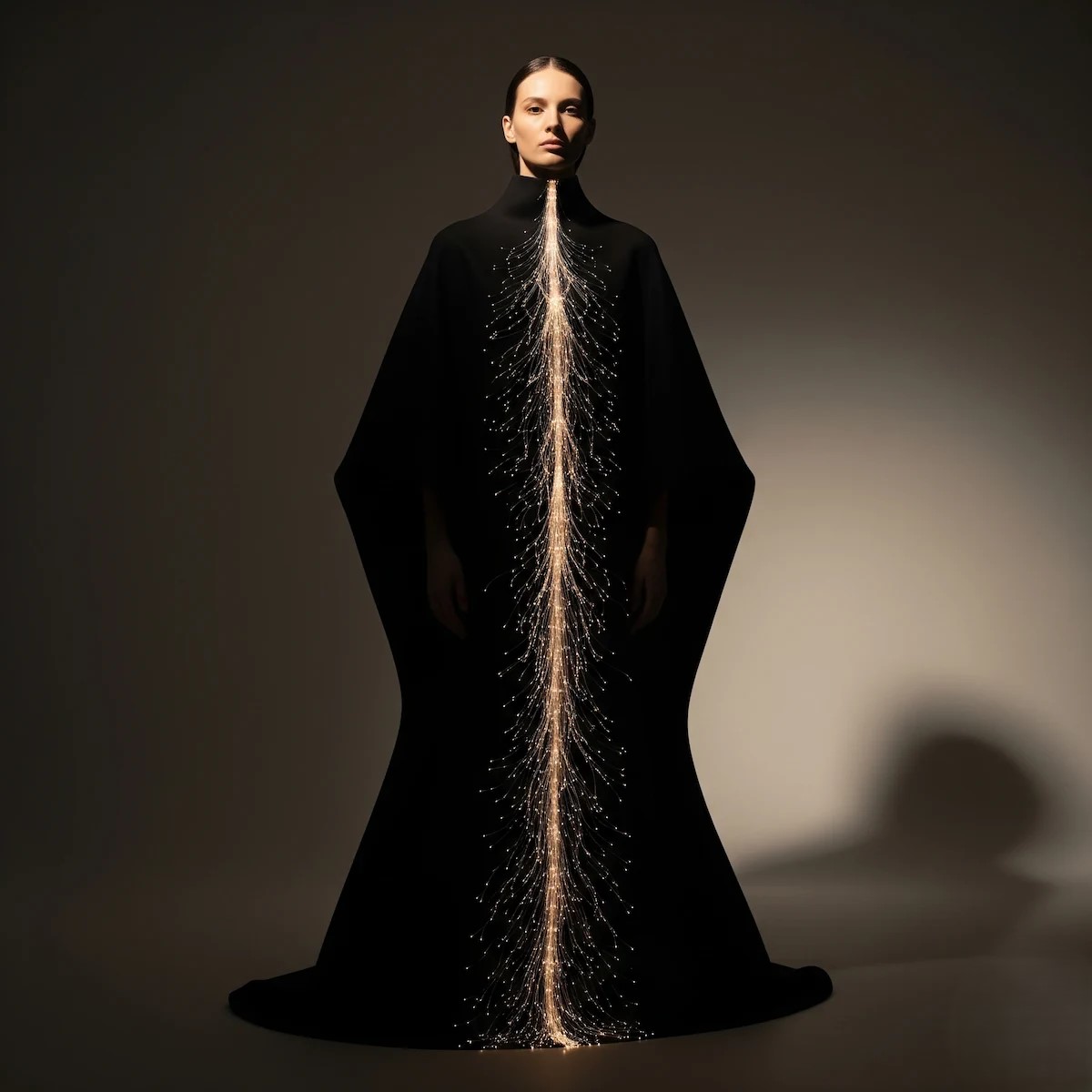
Futuristic fashion doesn’t discard them; it reinterprets them. A cloak can be woven with fiber optics to display data or poetry. Armor can be 3D-printed from a biopolymer that hardens on impact.
By fusing these ancestral forms with vanguard materials, a bridge in time is created. One wears an object that is simultaneously an echo of the deep past and a bold statement about the future.
Wearing our words: the new social fabric
As fashion becomes more intelligent and responsive, it evolves from a static statement into a dynamic communication platform.
Garments are transforming into a “social skin,” a medium for a new kind of dialogue that is more direct, subtle, and potentially more honest than words.
This evolution challenges our understanding of expression, connection, and social interaction itself.
The garment as a live data stream
The smart fabrics we wear are becoming capable of collecting and broadcasting data about our internal state. A shirt that subtly changes hue with our mood, a pattern that shifts with our level of stress—this is the beginning of a wearable, public API for the self.
This prospect is both tantalizing and terrifying. It promises a new layer of non-verbal understanding between people, but also raises profound questions about privacy and the performance of emotion.
When our clothes broadcast our feelings, does that make us more authentic, or simply better actors?
Engineering empathy through what we wear
Could fashion be a tool for fostering empathy? Some designers believe so. Projects like “The Empathy Suit” by The Mill simulate for the wearer the physical and sensory experiences of others (e.g., the elderly or those with certain medical conditions).
On a simpler level, imagine two people wearing connected garments that allow them to feel a subtle vibration in sync with the other’s heartbeat during a conversation.
By creating a shared sensory experience, clothing could become a bridge, a technology for connection in an increasingly isolated world.
Fashion and the emerging hive mind
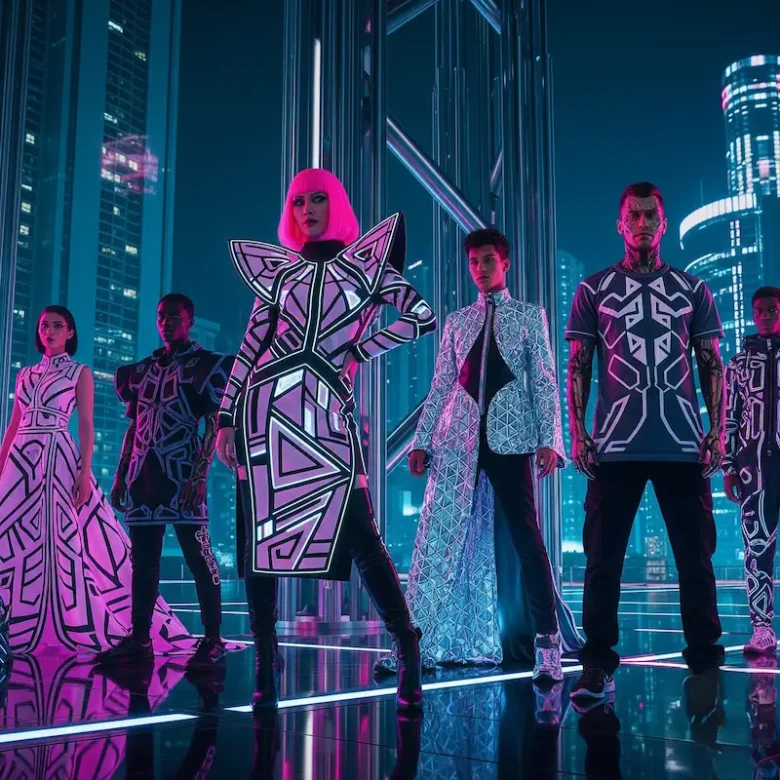
As garments become networked nodes, a collective aesthetic could emerge. Imagine large groups in public spaces whose clothing reacts in unison to an event, creating a massive, coordinated light display.
This could foster a powerful sense of community and shared experience. However, it also brings to mind the spectre of conformity and the “hive mind,” where individual expression is subsumed by the collective.
The new social fabric will force us to navigate the delicate balance between shared identity and personal autonomy.
Dressing for what comes next
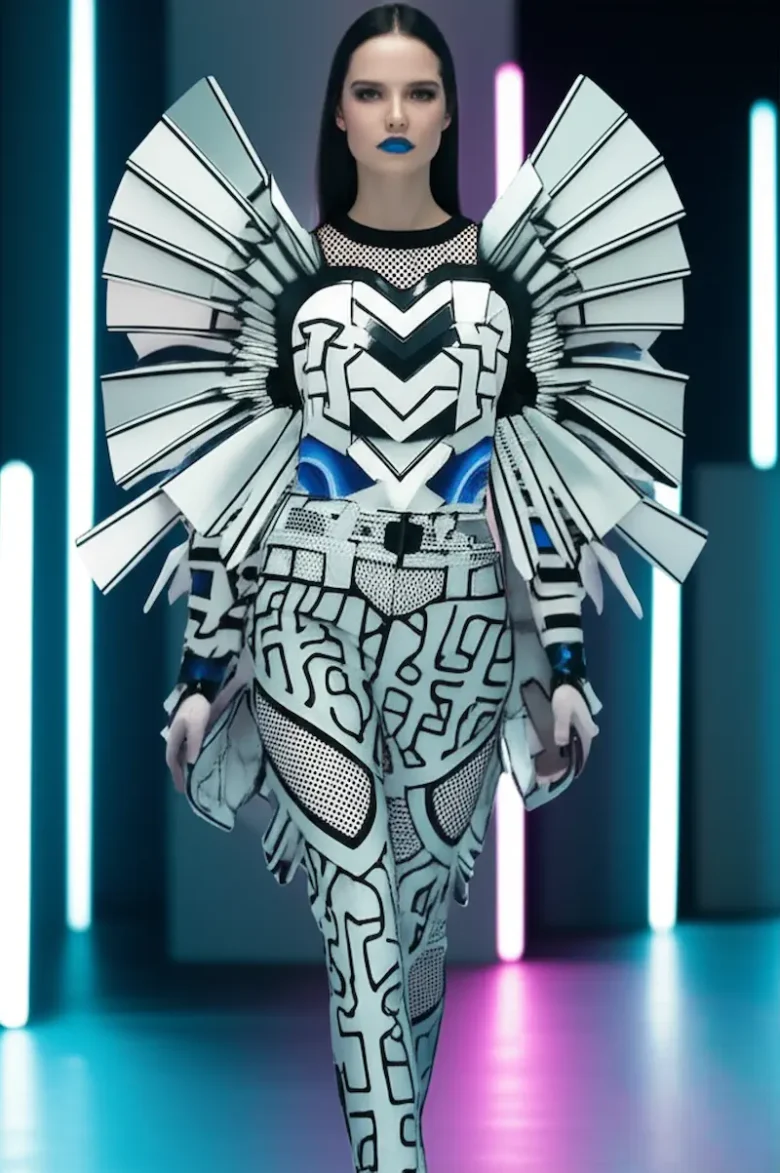
This journey—from living cell to digital pixel, from ecological imperative to social interface—returns us to a central idea: the future of fashion is not a destination of fixed styles, but an open field of inquiry.
Every material innovation, every new silhouette, is an invitation to question the limits of what it means to be human. Fashion, at its highest expression, ceases to dictate answers and instead becomes a platform for asking better questions.
The twilight of trends, the dawn of the self
The top-down system of seasonal trends is a relic of the industrial age. The confluence of on-demand 3D printing, biometric personalization, and fluid digital identities signals its inevitable twilight.
The future belongs not to the next big trend, but to billions of micro-trends—a paradigm of radical singularity. Technology will provide the tools to create a hyper-personalized fashion that reflects our unique narratives, our biology, and our ever-shifting sense of self.
An interface for modern being
The garment is now our most intimate and complex interface, a membrane mediating our relationship with everything. It mediates our biology through sensors, our environment through reactive materials, our digital lives through AR and virtual skins, and our communities through networked communication.
The act of getting dressed is becoming an act of calibration: What version of myself will I load today? What data will I choose to receive and transmit through my second skin?
The wardrobe as an unending question
In the end, it all comes back to the body. That fragile, organic, and imperfect vessel is the canvas upon which all these futuristic anxieties and fantasies are projected.
How we choose to inhabit, augment, protect, and present that body becomes our most powerful manifesto. In an age where anything can be virtualized, the choice of how to appear is the final statement on the future of humanity we wish to build.
To dress for tomorrow is, in essence, to learn to intentionally inhabit the question of who we are becoming.
Charting the course of futuristic fashion is to map the possibilities of being human. The frontiers explored in this article—the living canvas, the digital self, the symbiotic garment, the techno-ritual, the social skin—are not predictions.
They are active, open conversations. It is precisely at this intersection of art, design, and technology that Neomanía Magazine lives and breathes.
Our mission is to remain on that edge, always exploring the concepts and creators who are shaping the aesthetics of tomorrow.
If you are driven by the vanguard and seek to understand the forces crafting our future, we invite you to join our community. Explore more articles, interviews, and galleries at neomania.com and follow us on social media.
Don’t miss a moment of the future as it unfolds.
[mailerlite_form form_id=3]