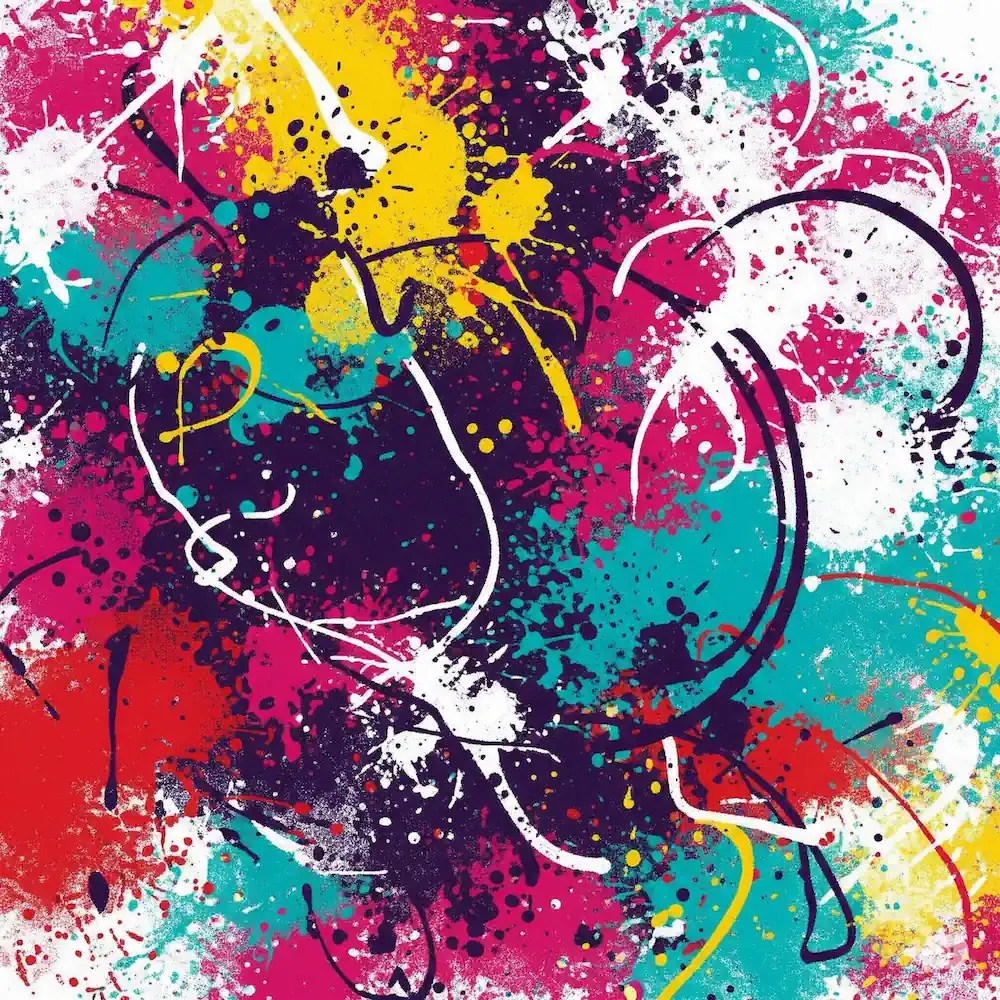
In the charged, anxious atmosphere of post-World War II New York, a new kind of artist emerged. They were titans of a revolution, turning their backs on the figurative traditions of a Europe that had torn itself apart.
The raw, emotional chaos of their work was a direct response to a world grappling with existentialism and the haunting shadow of the atomic bomb.
This was Abstract Expressionism, a movement that wasn’t just about painting, but about the profound, often violent, act of creation itself.
Artists like Jackson Pollock, Willem de Kooning, and Mark Rothko channeled primal energy onto vast canvases, proving the artist’s gesture was a truth in its own right.
Now, three-quarters of a century later, the world is once again being reshaped by forces that feel both liberating and terrifying.
The revolution is digital. The artist’s studio is no longer just a physical space smelling of turpentine and oil paint; it can be a clean, quiet room holding a glowing screen, a humming processor, and a connection to the entire world.
The fundamental question, then, is a compelling one: What happens to the soul of a movement built on raw, physical, and spontaneous gestures when the canvas becomes a screen, the brush a beam of light, and the “happy accident” can be erased with a keystroke?
This is the story of how a revolutionary art movement found new life, new challenges, and a new identity on the digital frontier.
What made the original splash so revolutionary?
To understand the digital evolution of Abstract Expressionism, we must first sink into the world that birthed the original movement.
It was a seismic shift that moved the center of the art world from Paris to New York, championing a radical new vision of what art could be.
It was visceral, intellectual, and deeply personal, prioritizing the artist’s intuitive process over any recognizable final product.
Pollock, de kooning, and the cult of spontaneity
The figureshead of this movement were not just painters; they were cultural icons who embodied a new American confidence. Jackson Pollock, perhaps the most famous, became a legend for his “drip” technique.
He laid his enormous canvases on the floor of his Long Island barn, dancing around them, pouring and dripping industrial paints from cans using sticks and hardened brushes.
His work was not a picture of an experience; it was the recording of the experience itself—a fossilized performance of energy and motion. This was “action painting,” a term that perfectly captured the performative, physical nature of the work.
Similarly, Willem de Kooning attacked his canvases with a ferocious energy, his brushstrokes capturing the frenetic, aggressive pulse of urban life.
His controversial “Woman” series, which blurred the lines between abstraction and violent figuration, demonstrated a commitment to the gestural mark as a carrier of complex, often conflicted, psychological weight.
These artists, along with others like Franz Kline, with his monumental black-and-white architectural abstractions, treated the canvas as an arena for an existential struggle.
The manifesto was simple: emotion over form
The movement’s unofficial manifesto was a rejection of representation in favor of pure emotional and psychological truth. Influenced by the surrealist interest in automatism and Jungian psychology’s focus on the subconscious and universal archetypes, these artists sought to bypass the rational mind entirely.
Mark Rothko, for instance, created his iconic color-field paintings not as decorative panels, but as gateways to the sublime. He layered thin washes of color to create large, hovering rectangles that seemed to breathe and pulsate, wanting viewers to have a quasi-religious experience when confronted with them.
Clyfford Still carved jagged, cracking forms of color onto his canvases, evoking dramatic, primordial landscapes. The goal was never to paint a picture of sadness, joy, or awe, but to create an object that would directly generate those feelings within the viewer.
The canvas is transformed by pixels and code
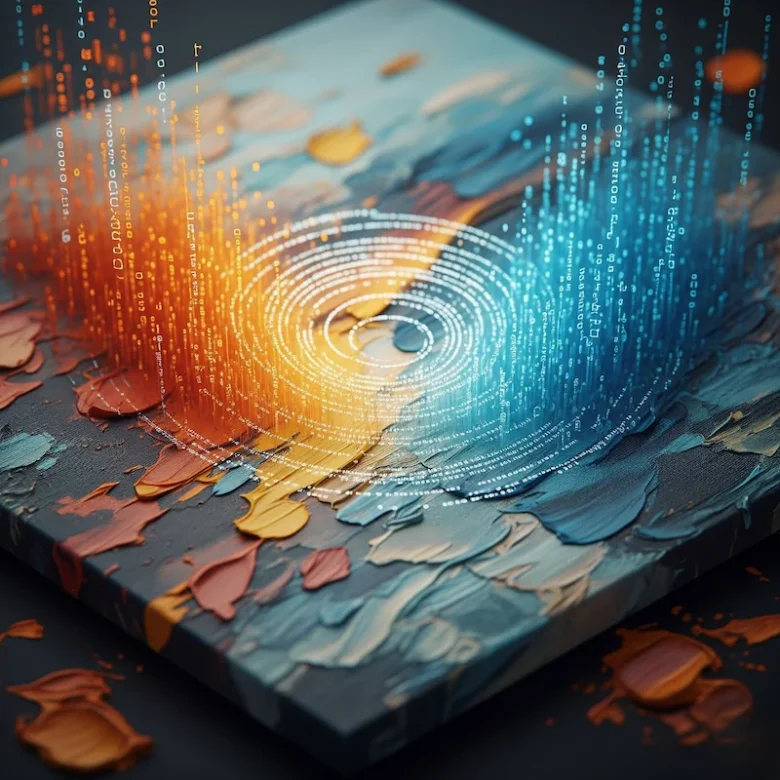
Fast-forward to today, and the artist’s toolkit has expanded into realms the Ab-Ex pioneers could only have dreamed of. The physical constraints of paint, gravity, and the four edges of a canvas have dissolved into the seemingly infinite potential of the digital plane.
This new freedom, however, presents a paradox: does it enhance the expressionist spirit of raw authenticity, or does it inevitably dilute it with the perfection of the machine?
Trading turpentine for a touchscreen
The modern abstract artist’s studio is filled with tools that mimic and extend physical media. Software like Procreate, Adobe Fresco, and Corel Painter offers digital brushes that can replicate the viscosity of oil paint, the watery bleed of watercolor, or the gritty texture of charcoal.
A pressure-sensitive stylus and tablet can translate the artist’s physical gesture—the angle, pressure, and speed of their hand—into a digital mark with stunning fidelity.
Beyond mere simulation, digital tools offer entirely new creative avenues. Artists can work in layers, manipulate color with mathematical precision, and invent their own brushes from algorithms.
The gesture is no longer just a mark on a surface; it can be a vector, a piece of data that can be endlessly manipulated, scaled, and repurposed.
This fundamentally changes the relationship between the artist and their work, creating a fluid dialogue where the creation process is as malleable as the final image.
The “Happy Accident” in the age of undo
A central tenet of Abstract Expressionism was the embrace of the unforeseen—the unintended drip, the spontaneous smear, the beautiful mistake that could redirect the entire course of a painting. In the digital realm, the ever-present Cmd+Z is a powerful safety net, but also a philosophical challenge. Does true spontaneity exist when every action is reversible?
Many digital artists argue that it does, but that it has simply relocated. They find it in “glitch art,” where data is intentionally corrupted to produce unpredictable and visually complex results.
They discover it in procedural generation, setting parameters for an algorithm and then being surprised by its output. Artists often set their own constraints—committing to a mark, limiting their use of the “undo” function, or working in a live, un-editable context—to force a sense of immediacy and risk back into their process, thereby preserving the spirit of the happy accident.
The infinite canvas and the lack of physicality
A key difference is the concept of space. A physical canvas has defined limits and a tangible presence. A digital canvas can be infinite, allowing for compositions that sprawl and evolve without boundaries.
This liberation can be exhilarating, but it also removes the crucial tension that comes from working within constraints. Furthermore, the final product is often dematerialized—a collection of pixels on a screen rather than a physical object with texture, scent, and a unique presence in a room.
This raises questions about the “aura” of the artwork. Does a digital file, infinitely reproducible and lacking a physical body, carry the same weight as a singular, monumental canvas that bears the literal, physical traces of its creator?
Can digital gestures truly be authentic?
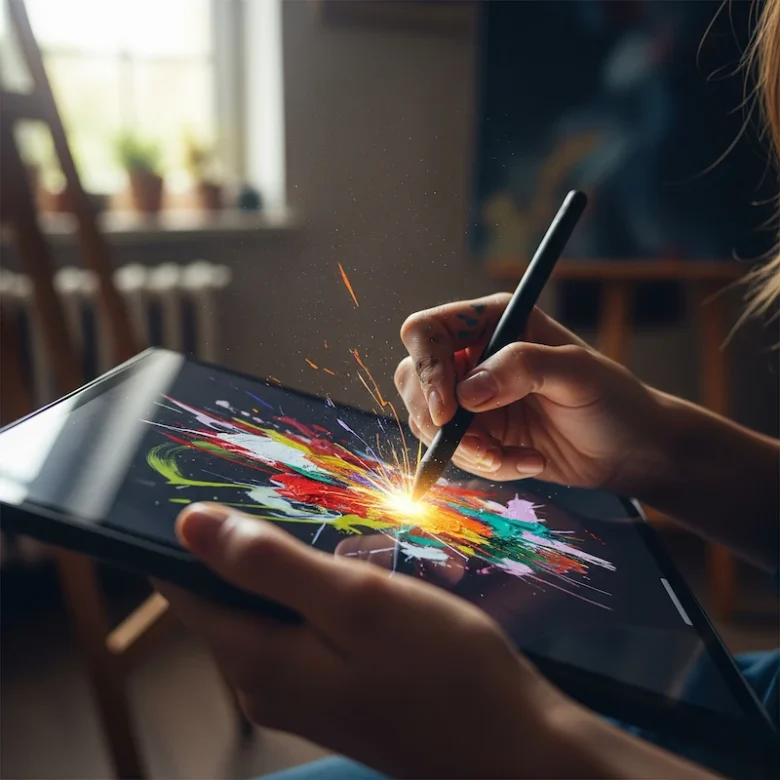
This question of authenticity lies at the heart of the movement’s digital evolution. As the artist’s hand is increasingly mediated by software and hardware, the conversation shifts from solitary action to a complex collaboration between human and machine. It is in this collaborative space that the digital age forges its own unique, and arguably authentic, brand of expressionism.
Generative art as a creative dialogue
Generative art is perhaps the most radical extension of expressionist principles. Here, the artist may not “paint” in the traditional sense at all.
Instead, they write code or design systems that generate the artwork. The artist’s role shifts to that of a creator of worlds, a designer of rules and behaviors.
Artists like Mario Klingemann, known for his work with neural networks, and Manolo Gamboa Naon, with his intricate and chaotic algorithmic compositions, act as both conductors and observers of their digital orchestras.
Consider the work of Refik Anadol, who uses vast public datasets—from archives of photographs to real-time oceanographic data—as his “pigment.” His studio’s “data sculptures” are mesmerizing, fluid symphonies of light and color that are constantly in flux. Is this not a form of subconscious expression, albeit a collective, data-driven one?
The artist curates the input and designs the algorithm, but the final output is a dynamic, unpredictable performance—a perfect digital echo of Pollock’s controlled chaos.
VR and AR offer canvases for raw emotion
Virtual and Augmented Reality may offer the most direct translation of “action painting” into the 21st century. With tools like Tilt Brush and Open Brush, an artist wearing a VR headset can paint with light in three-dimensional space.
The gesture is no longer confined to a flat plane; it moves through space, creating sculptures of pure color and form. The controller in their hand becomes an extension of their body, and the “canvas” is the entire 360-degree environment around them.
The resulting artwork can be experienced immersively. A viewer can walk through a brushstroke, experiencing its scale and texture from all angles.
This creates an all-encompassing environment of raw emotion, arguably achieving Rothko’s goal of a sublime, overwhelming experience even more directly than a painting on a wall ever could.
The human “footprint” in a sea of data
As AI tools become more sophisticated and capable of generating entire images from a simple text prompt, the question of the artist’s role and the authenticity of their “hand” becomes even more critical.
The legacy of Abstract Expressionism, which so deeply valued the individual’s unique, inimitable mark, provides a powerful lens for examining this new creative landscape.
Is digital expression less “real”?
The critique that digital art is cold or sterile often stems from a misunderstanding of where the “humanity” in the work resides. It is easy to see the artist’s hand in the thick impasto of a de Kooning, but harder to see it in a line of code.
Yet, the emotional intent, the intellectual struggle, the joy of discovery—these are all still present. The human “footprint” is not in the texture of the paint, but in the elegance of the algorithm, the curation of the dataset, the deliberate introduction of randomness, and the overarching vision that guides the technology.
Walter Benjamin’s famous concept of the “aura” of an artwork—its unique presence in time and space—is challenged by digital reproduction.
However, many argue the aura isn’t destroyed, but relocated. It can be found in the live performance of a generative piece, the verifiable uniqueness of the code, or the personal connection a viewer feels to a digital image that speaks to their own experience.
Proving authorship in a post-photoshop world
In an era of infinite, perfect reproducibility, the traditional markers of value—uniqueness and scarcity—are threatened. This is the problem that Non-Fungible Tokens (NFTs) sought to solve.
By using blockchain technology, an NFT acts as an unbreakable digital certificate of ownership for a specific digital file. This created a firestorm in the art world, leading to a speculative bubble and headlines about JPEGs selling for millions.
While the market has been volatile and rightly criticized for its environmental impact and “gold rush” mentality, the underlying technology addresses a core Ab-Ex concern: the singular, authentic creative act.
It’s a digital solution to the age-old problem of provenance. Beyond NFTs, artists continue to explore other methods of embedding their signature in their work, from cryptographic watermarks to bespoke software that only they possess, ensuring their digital gesture remains uniquely their own.
The market and the museum in the 21st century
The very institutions that once celebrated Pollock and Rothko are now facing the complex challenge of how to collect, exhibit, and preserve art that is born digital and often has no fixed physical form.
The commodification of the digital gesture
The NFT boom, exemplified by the shocking $69 million sale of Beeple’s “Everydays: The First 5000 Days,” thrust digital art into the mainstream financial conversation.
Online marketplaces like SuperRare and Foundation became the new art galleries, allowing artists to reach global audiences directly.
This democratized access for many creators who were outside the traditional gallery system. However, it also raised pressing questions about speculation, market manipulation, and whether the conversation was more about investment vehicles than aesthetic or emotional value.
How galleries are showcasing born-digital art
Museums are actively adapting to this new world. MoMA in New York recently acquired Refik Anadol’s “Unsupervised,” a work that constantly reinterprets the museum’s entire collection using AI, displayed on a massive, custom-designed screen.
Galleries are installing complex arrays of projectors, VR rooms, and interactive displays. The challenge of preservation is immense.
How do you conserve a piece of art that relies on specific software and hardware that will be obsolete in a decade? Curators and conservators are becoming digital archivists, working to preserve code, emulate old systems, and document the intended experience of these ephemeral works for future generations, ensuring the digital gesture doesn’t simply vanish into the ether.
The future is abstract (and digital)
The revolutionary, soul-searching spirit of Abstract Expressionism is not a relic confined to mid-century art history books. It is alive and well, pulsing through the fiber-optic cables and processing cores of our time.
It has mutated, adapted, and found new languages to speak. The tools have been profoundly transformed, and the canvas has expanded into the infinite realms of data and virtual space.
But the fundamental human impulse that drove Pollock to drip paint on his barn floor—the desperate, ecstatic need to make an external mark that reflects an internal state, to express the inexpressible—remains unchanged.
The digital age hasn’t replaced the artist’s gesture; it has given it an electrifying new nervous system and a boundless new playground. The soul of the movement wasn’t lost; it was simply rebooted.
For more stories on the intersection of art, technology, and cutting-edge culture, explore the world of Neomania Magazine.
[mailerlite_form form_id=3]