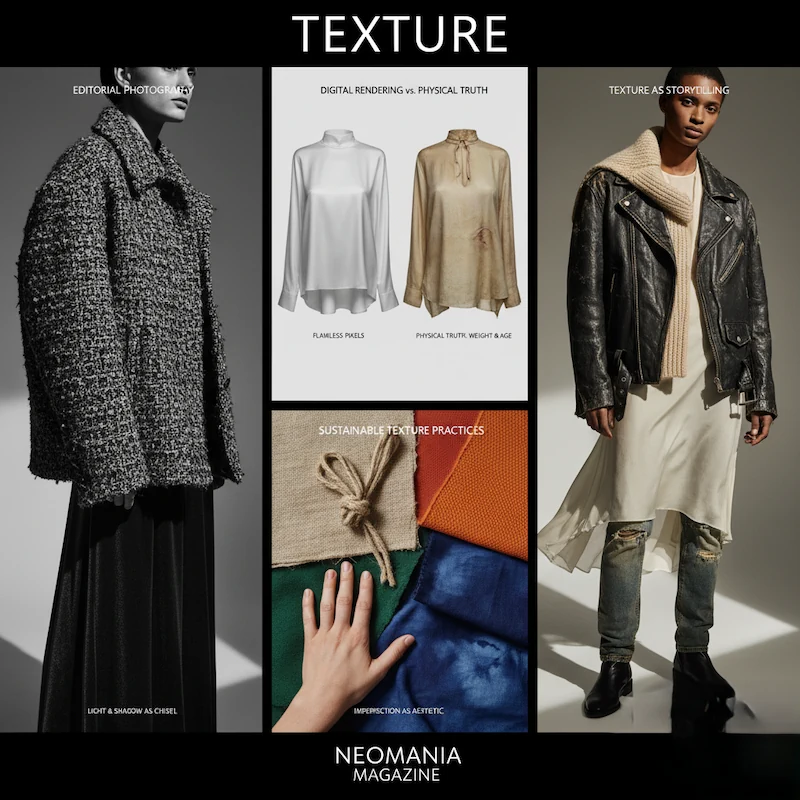
In a culture obsessed with visuals, texture is the quiet radical. It speaks before silhouette. It whispers beneath pattern. In fashion design, texture is more than a detail — it’s a language.
It tells stories through grain, weight, irregularity, and interaction with light. Texture invites the hand before the eye, making fashion not just seen, but felt.
What is texture in fashion design?
In fashion’s lexicon, silhouette shouts and color sings, but texture whispers. It’s an intimate language, perceived in proximity—in the brush of a sleeve against skin, in the weight of a coat on the shoulders.
It’s often the first and last contact we have with a garment, a silent dialogue whose impact frequently outweighs its visual presence. Defining texture means attempting to map the vast territory of sensations.
Beyond visual surface
Texture transcends the surface. It’s not merely how a fabric looks, but how it behaves. It’s its response to light, to touch, and to movement. It’s the way an organza crinkles with a ghostly stiffness, how a liquid satin glides over the skin, how a dense tweed absorbs both light and sound.
It’s the difference between the rough honesty of linen and the absorbent opulence of velvet. Texture is three-dimensional: it possesses relief, temperature, density, and sometimes, even a voice.
It can be a landscape of loops in a bouclé, a desert of ridges in corduroy, or a sea of folds in pleated silk. It is the physical architecture of a material, the infrastructure of its soul.
Sensory and symbolic
Texture isn’t just a physical phenomenon; it’s profoundly psychological. Every surface we touch is loaded with a library of associations, memories, and emotions.
The brain instantly and subconsciously translates sensation into meaning. Velvet isn’t merely soft; it evokes nocturnal opulence, the drama of theater curtains, an almost anachronistic luxury.
Raw linen isn’t simply rough; it suggests earthy humility, the simplicity of a summer home, a connection to the natural. Latex isn’t just smooth; it provokes and unsettles, speaking of fetish, futurism, and an unnerving second skin.
Texture, therefore, is a narrative without words. A designer choosing a fabric isn’t just selecting a material; they are choosing an adjective, a mood, an entire chapter of the story they wish to tell.
Types of texture used in fashion
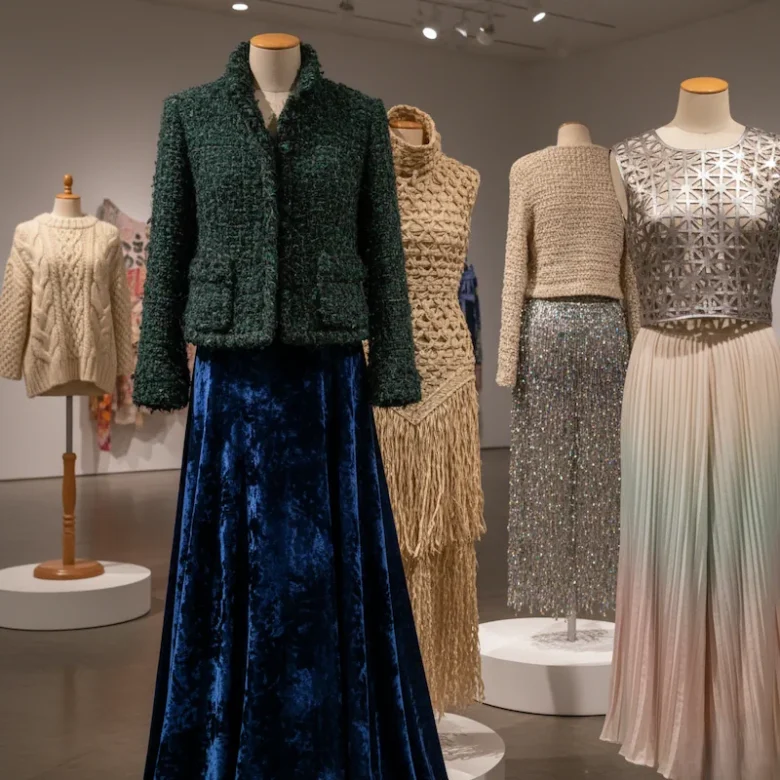
A designer’s textural arsenal is infinite, encompassing both the gifts of nature and industry, as well as surfaces born from their own imagination and hands.
Texture can be broadly categorized into what is inherent to the fabric and what is constructed by the creator.
Tactile fabrics
These are the fundamental building blocks, materials whose personality resides in their inherent feel. They can be grouped by the sensation they evoke:
- The Invitation to touch: Bouclé, mohair, chenille. These are plush, cozy, almost maternal fabrics. Their irregular, soft surfaces beckon us to touch them, to nestle into them. They are the textile equivalent of a warm fireplace on a winter day.
- The luminous caress: Organza, silk, satin. These fabrics are slick, airy, and luminous. They don’t so much invite a caress as perform one themselves, gliding over the skin. Their interaction with light is key: they reflect it, filter it, creating an aura of ethereality and movement.
- The honest structure: Denim, canvas, corduroy. These are structured, rough, utilitarian fabrics. Their texture speaks of work, durability, and unpretentious beauty. The grain of denim or the ridges of corduroy are maps of a functional, resilient life.
- The second skin: Leather, latex, vinyl. These textures are sensual and, at times, severe. They mimic or exaggerate the qualities of skin itself. Leather, with its pores and scars, speaks of organic life; latex, with its artificial sheen and clinging touch, explores the boundary between human and synthetic.
Constructed textures
This is where the designer becomes a surface architect. They don’t settle for a given texture; they create it. Through ancient or innovative techniques, they transform flat fabric into a three-dimensional landscape.
Pleating can turn silk into a kinetic accordion. Quilting can give a light fabric the protective volume of armor. Embroidery is a drawing in relief, adding layers of narrative and tactility.
Draping, gathering, cutwork—these are all techniques for sculpting the surface, giving the fabric a new topography. In this act of construction, the designer doesn’t just decorate the cloth but imbues it with a new voice, a new way of speaking through touch.
Why texture matters in contemporary design
In the 21st century, our relationship with the physical world has become precarious. We increasingly live through smooth, cold screens, in an existence mediated by the visual and the virtual.
In this context, texture in fashion has ceased to be a mere decorative element and has become an act of rebellion and an emotional necessity.
Tactile rebellion in a digital world
Our fingers slide across the flawless glass of smartphones, a surface without friction, history, or life. Experience flattens. Texture in fashion is the antidote to this flatness.
It is a tactile rebellion. The rough feel of a wool sweater, the coolness of a linen shirt, the weight of a leather jacket… these are anchors that return us to the reality of our bodies and the physical world.
Fashion, through texture, offers us a form of sensory resistance. It reminds us that we are embodied beings, that intimacy and connection are built through physical proximity. In a world obsessed with images, texture insists on the importance of sensation.
Emotional impact
We respond to texture in a visceral, instinctive way. Long before the brain processes a garment’s color or shape, our nervous system has already reacted to its touch.
A soft, plush texture can activate the same neural responses as an embrace, releasing oxytocin and generating a sense of comfort and security.
Conversely, a cold, hard, or pointy texture can put us on alert, creating a protective barrier. Designers deliberately use this silent dialogue between fabric and body.
A texture can seduce, like the glide of satin; it can shock, like the coldness of vinyl; it can soothe, like the softness of cashmere. Texture is the most direct and honest communication channel between the garment and its wearer.
Designers who center texture as concept
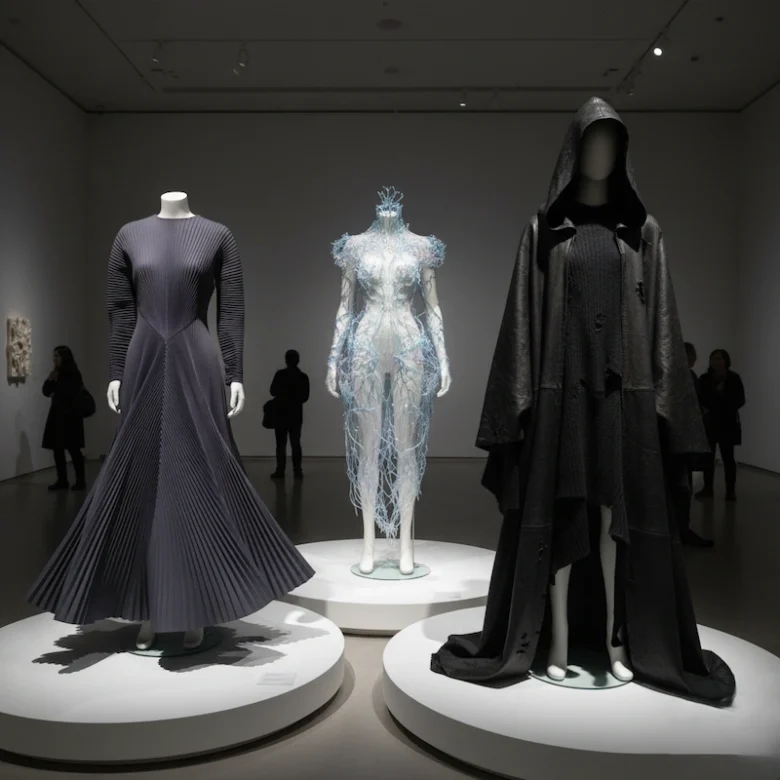
Some of the most visionary designers have made texture not just an element of their work, but the very core of their philosophy. For them, the surface is not a canvas to be decorated, but the message itself, the idea made material.
Issey Miyake
The Japanese master Issey Miyake elevated a texture-building technique, pleating, to the status of art and philosophy. Through his innovative pleating methods, where the garment is first cut and sewn and then pleated, he transformed polyester fabric into kinetic sculpture.
His creations are not static; they live and breathe with the body. Texture is not something on the fabric; texture is the fabric, an architectural memory that folds and unfolds with every movement.
Miyake’s garments don’t adapt to the body; they dance with it, creating a constant dialogue between human form and geometric shape.
Iris van Herpen
Dutch designer Iris van Herpen is a boundary explorer, a bio-futurist who blurs the lines between fashion, architecture, and science.
Her textures don’t come from looms but from 3D printers, laser cutters, and microscopic observation of nature. Her creations mimic bone structures, coral formations, water waves, or insect wings.
She uses transparent materials, silicone filaments, and resins to create exoskeletons of light and dresses that resemble crystallizations.
Her work forces us to reconsider what fabric is, offering a tactile and visual experience that is both organic and otherworldly.
Rick Owens
The Californian designer based in Paris, Rick Owens, is a poet of brutalism. His work is a meditation on rawness, severity, and a dark, monumental beauty. Texture is fundamental to his language.
He uses distressed leathers that seem to have lived a thousand lives, slashed knits that suggest beautiful decay, and heavy drapes that drag and fall with an almost ceremonial gravity.
His textures do not seek easy comfort; they seek tactile drama. His garments possess a weight, not only physical but emotional, creating a silhouette that is both protective and vulnerable, ancient and futuristic.
Texture as identity and gender play
Texture, like all language, is laden with cultural codes. We have learned to associate certain surfaces with ideas about gender, power, and identity. Contemporary designers delight in subverting and rewriting these codes.
Softness and strength redefined
Traditionally, in Western fashion, soft, light, and delicate textures such as lace, silk, or tulle have been associated with femininity.
Conversely, hard, rough, and heavy textures like leather, denim, or thick wool have been linked to masculinity. Contemporary fashion has subverted these associations.
By incorporating lace into menswear or leather into femininity, designers not only play with aesthetics but challenge gender norms at a sensory level.
They demonstrate that softness can be a form of strength and hardness a form of vulnerability, regardless of the body wearing them. Texture thus becomes a tool to free materials from their gendered baggage.
The politics of touch
The surface of a garment can be a political statement. Texture can express power, vulnerability, or resistance. Consider the smooth, impeccable fabric of a power suit, designed to repel wrinkles and project an image of unwavering control.
Now, contrast that with the rough, uneven texture of burlap or recycled fabric, which can speak of authenticity, resistance to consumerism, and a connection to the earthly.
The difference between smooth conformity and rough authenticity is a political choice. The texture of our clothing can be a form of armor, an invitation to intimacy, or a declaration of independence.
The visual role of texture in fashion media
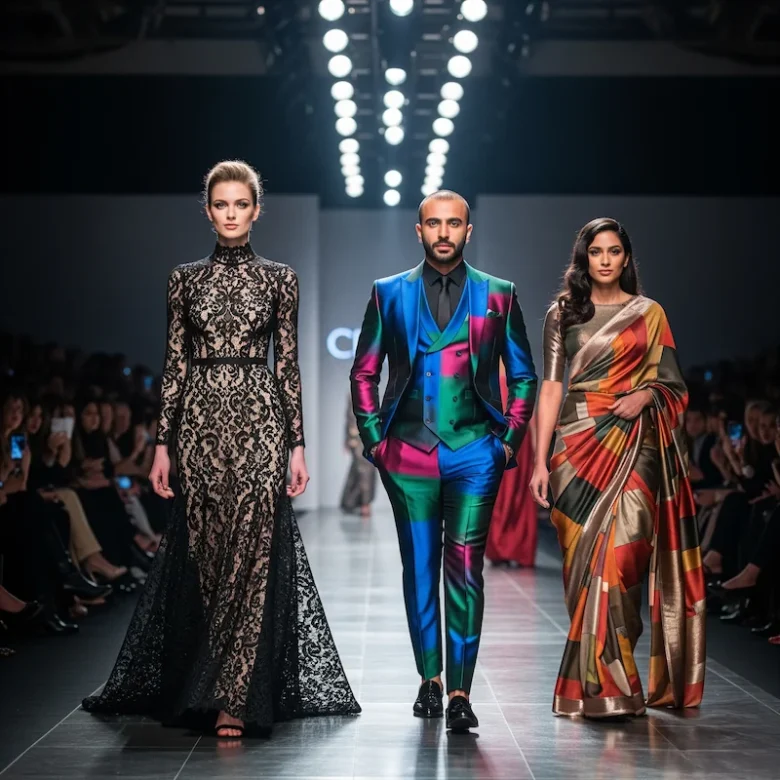
In a world dominated by images, how is something as intrinsically physical as texture communicated? Fashion photography and new digital media constantly face the challenge of translating touch into sight.
Texture in editorial photography
Great fashion photographers are masters at making texture almost audible through an image. They use light and shadow as a sculptor uses a chisel to reveal the surface.
Harsh, raking light can exaggerate the grain of denim or the weave of tweed, turning them into arid landscapes. Soft, diffused light can make velvet glow with unfathomable depth or mohair appear enveloped in a dreamy halo.
Through the lens, texture becomes the main character of the photograph, inviting our tactile memory to imagine the feel of the garment.
Digital rendering vs. physical truth
As digital fashion and metaverses gain ground, the challenge of replicating tactility becomes central. 3D renders can create visually stunning surfaces, mimicking the sheen of satin or the roughness of leather with astonishing precision.
However, what they cannot yet replicate is the physical truth of texture: its weight, its temperature, how it yields to touch, how it ages with wear.
This gap reminds us of the value of the physical. It demonstrates that, for now, no pixel can replace the gravity of silk or the warmth of wool. Texture remains the last bastion of the real in an increasingly virtual world.
Sustainable texture practices
The growing interest in sustainability in fashion has opened an exciting new chapter in the exploration of texture. Designers are turning to natural, recycled, and bio-based materials, discovering that ethics and aesthetics can go hand in hand.
Natural and recycled surfaces
The search for sustainable alternatives is revealing a universe of new textures. Fibers like hemp, organic linen, or innovative materials such as pineapple leather (Piñatex) and mushroom mycelium are not only ethical choices but also offer visually rich and touch-responsive surfaces.
These materials often possess an irregularity and a “life” that synthetics cannot imitate. In a global context, the reevaluation of ancestral fibers and artisanal techniques is allowing designers to create textures that tell a story of biodiversity and local wisdom.
Imperfection as aesthetic
Sustainability has also brought with it a reevaluation of imperfection. Handwoven, naturally dyed, or irregularly finished fabrics carry the imprints of their origin.
The slight color variation in an indigo dye, the occasional knot in a hand-spun wool yarn… these are not flaws. They are the fingerprints of human labor and natural processes.
This aesthetic of imperfection imbues garments with a textural soul, an authenticity that machines cannot replicate and that connects the wearer directly to the story of its creation.
Texture as storytelling
Ultimately, texture is one of the most powerful forms of narrative in fashion. Through the surface of our garments, we tell stories about who we are, where we’ve been, and how we feel.
Clothing as archive
The texture of a garment is its memory. It is a tactile archive of its journey through the world. Worn jeans, with their frayed knees and faded areas, are a map of every movement, every fall, every moment of leisure.
A wool sweater that has developed pilling from constant use holds the memory of every embrace. The cotton of a t-shirt softened by countless washes is a testament to comfort and familiarity.
Each garment, through its changing texture, writes its own tactile autobiography.
Narrative layering
Designers often use the combination of textures like a novelist uses counterpoint. By layering contrasting textures, they can evoke complex emotions, tensions, or transitions.
The combination of something smooth and cool with something rough and warm (like a leather jacket over a silk dress) can tell a story of duality, of protection and vulnerability.
The superposition of delicate, transparent textures can create a narrative of dreaminess and ethereality. Texture, in the hands of a skilled designer, becomes a tool for building complex, wordless narratives.
In fashion, texture is the first language we learn — even before color or cut. It’s what we lean into, what we trust against our skin.
In a time of digital immersion and visual fatigue, texture offers return: to body, to craft, to the poetry of surfaces. It reminds us that fashion isn’t just what we see — it’s what we carry on our skin.
If you believe fashion should be felt, not just seen, and crave stories beyond the surface, Neomania Magazine is your destination. We explore the profound artistry and sensory dialogues woven into modern design.
Engage your senses. Subscribe.