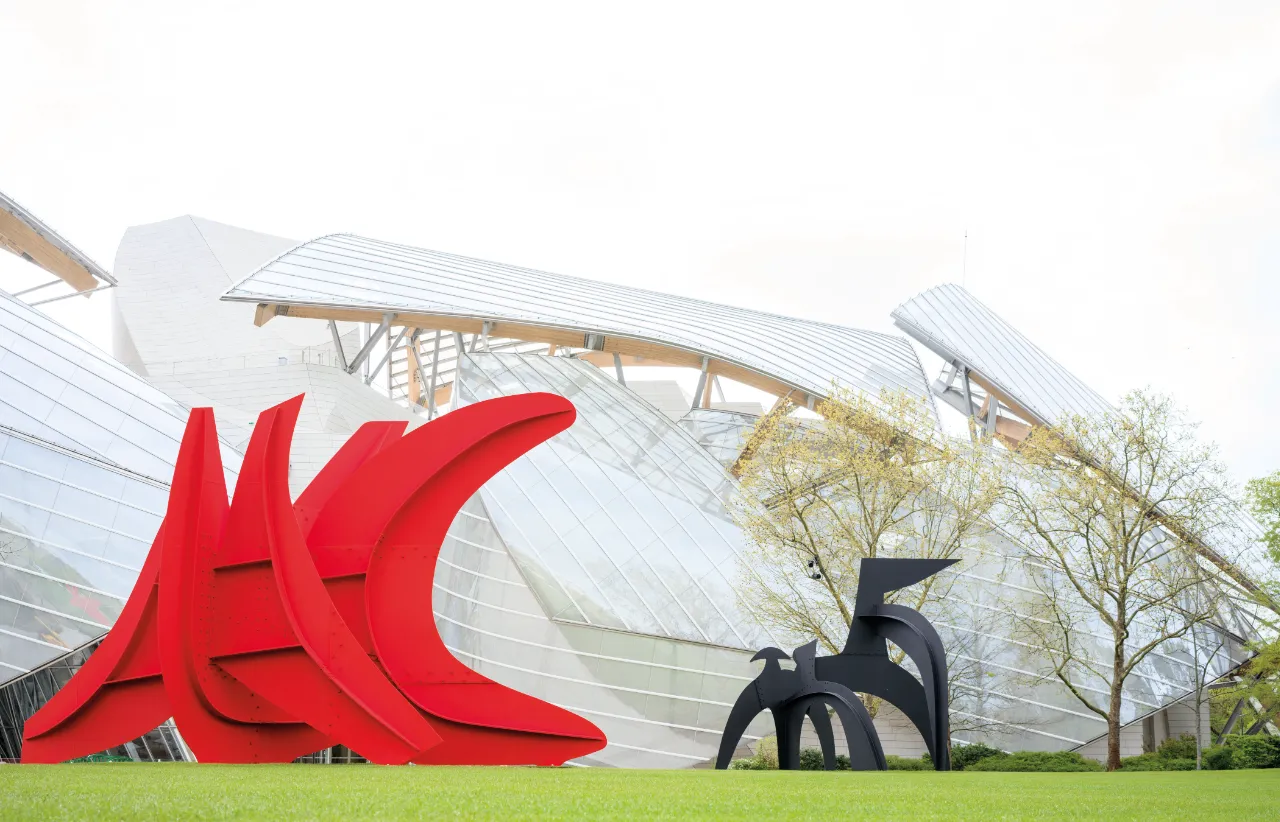
Alexander Calder at Paris Fondation Vuitton
Fifteen years after the unforgettable Centre Pompidou exhibition devoted to Alexander Calder’s Parisian years, the Fondation Louis Vuitton hosted a major retrospective of the American artist.
His inventive moving sculptures and designs explore life-size dreams and bring childhood games to life on a grand scale.
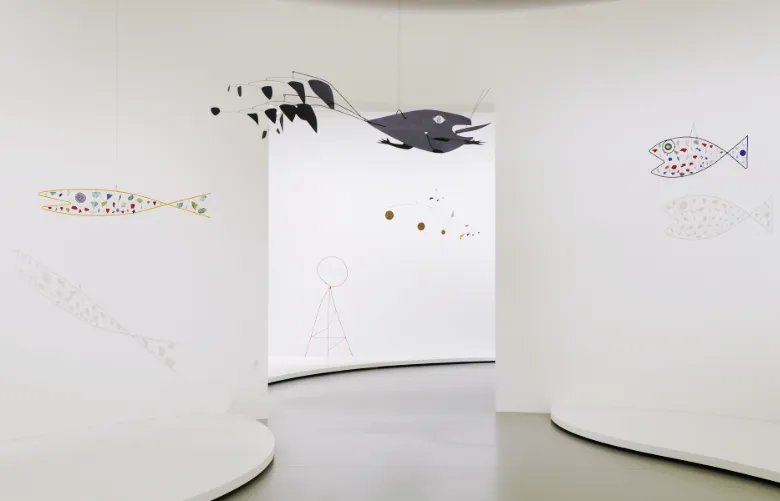
Populated with hypnotic designs of mobiles, miniature circuses, graphic abstractions and large geometric structures, his delightful art work found a majestic home in the expansive spaces and garden of the Parisian foundation. It enhances with Calder’s shimmering colours and designs.
It was in Paris that Calder became a sculptor, and it is to Paris that he returns, a century later, with a masterful exhibition at Fondation Louis Vuitton.
Mobiles, stabiles, jewelry, drawings: nearly 300 works unfold the universe of the artist.
“Calder is the highest expression of the plastic freedom of sculpture and design.”
Marcel Duchamp
This landmark exhibition offered Calder’s universe in all its forms unfolding and inhabiting Frank Gehry’s glass vessel at the Parisian Foundation.
Calder is irreducibly original, with great poetic power. It’s time to rediscover him as the symbol of modern art. His art work captures the forces of nature: it is a sublimation, a conversation between heaven and earth.
In the field of jewelry design, Calder excelled, numerous specific commissions from art connoisseurs such as Peggy Guggenheim, Mary Rockefeller, Charlotte Perriand…
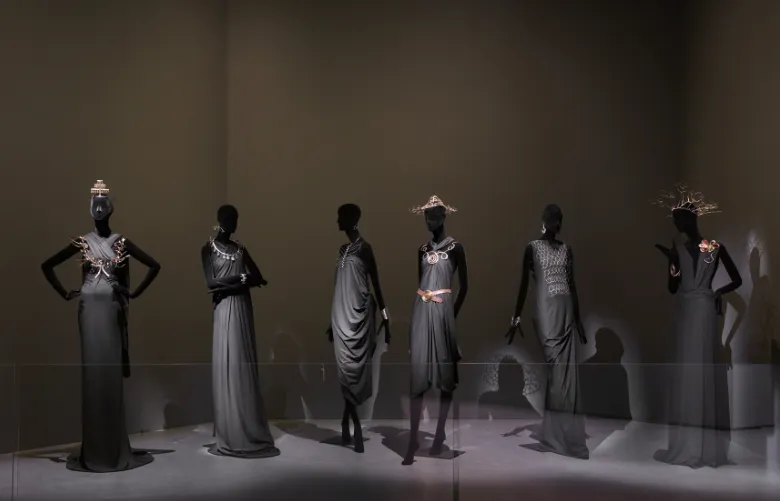
Alexander Calder’s (1898-1976) strength undoubtedly lies in his free and creative, maverick approach, always following his intuition, with an atypical style, like a tightrope walker who was both poetic and scientific.
He began tinkering with whatever he could find from a very young age, displaying a knack for repurposing materials.
He was born into a family of artists: his father and grandfather were sculptors, his mother a painter.
He was interested in design and mechanical engineering, choosing this path for his studies, before turning to art.
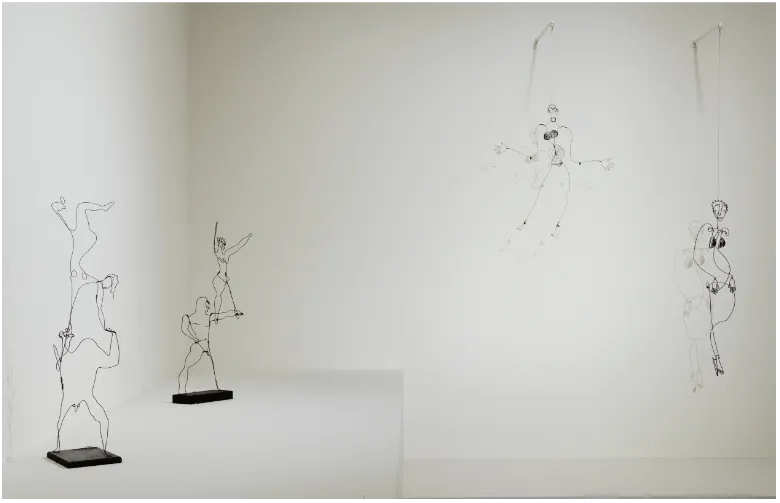
His gift for observation is exceptional. This is evident in his fascination with the circus and the extraordinary sketches he created with a single stroke, capturing the posture of an animal with precision, truthfulness and humor.
Then came figures literally drawn in wire: portraits of Josephine Baker, Fernand Léger, Jean-Paul Sartre, and Amédée Ozenfant.
Calder began to create his own world, with toy-like figures in wire such as a Roman chariot with horses, acrobats and tightrope walkers that would foreshadow his famous Circus, all made with wire. He conducted like a dilettante child but with determination.
“It’s serious without seeming so.”
Fernand Léger
Since settling in Paris in 1926, world epicenter of art, Calder captivated intellectuals and avant-garde artists with the ingenuity and spontaneity of his miniature circus and his dreamlike universe.
A decisive turning point occurred in 1930, during a visit to Piet Mondrian’s studio. Upon discovering the colourful rectangular works on the walls, Calder wanted to make them move, much to Mondrian’s dismay.
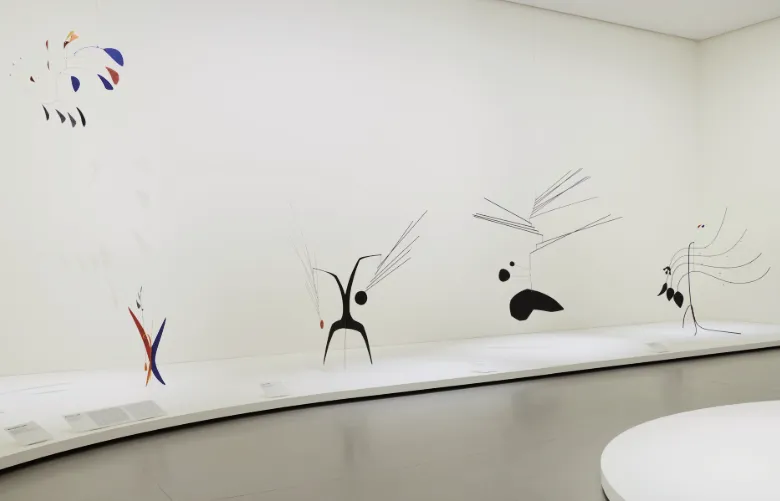
He then became aware of his kinetic perception of things and opted for abstraction.
Always using whatever materials were available, Calder cut shapes from metal, painted in primary colours or in black and white. He later suspended and arranged them so that they could move with poetic grace.
“We are like two brothers who speak the same language, but with different accents. Calder makes iron dance, I make colours dance.”
Joan Miro
Calder’s style and his abstract expression, was born with his extraordinary invention of the “mobile,” a term coined by Marcel Duchamp for these abstract sculptures. His “mobiles” were initially motorised and later moved by the wind or breezes.
From 1930 he created similar static sculptures standing on the ground. Arp called them “stabiles”.
Calder brings sculpture design to life, that is the essence of his extraordinary art. He finds his formal design inspiration in the system of the universe.
In 1934, MOMA New York acquired one of his first motorised mobiles: “Universe”.
“Calder is a big kid playing with the stars. He has the secret to the balance of worlds.”
Jean Arp
This notion of balance is fundamental. Calder moves from the terrestrial to the stellar, his feet on the ground and his head in the stars. This helps us understand how he can harmoniously oscillate between his aerial “mobiles” and the earthy “stabiles”.
Despite isolation and deprivations of war, ever confident and optimistic, the sculptor embarked on his Constellations, a series that contains the essence of his artistic convictions about designing with metal and wire.
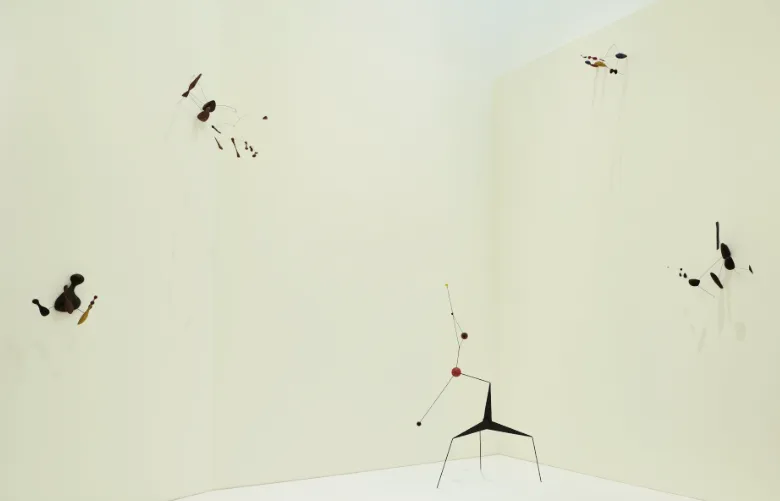
His first retrospective exhibition at MOMA in New York (1943) marked the beginning of his acclaim.
He even dared inviting visitors to interact with his works. His mobiles could be activated by touch and had a sign:
“Please Touch.”
This novel invitation would find its echo in Marcel Duchamp’s famous art piece “Please Touch” (1947).
From 1950 Calder created enormous sculptures and enjoyed growing international recognition, culminating in 1976 with the retrospective “Calder’s Universe” at Whitney Museum, New York.
His monumental commissions have become prominent features in public spaces: Spiral in 1958 (UNESCO, Paris), Teodelapio in 1962 (Spoleto, Italy), Monsieur Loyal in 1967 (Grenoble, France), Flamingo in 1974 (Chicago, France), Red Spider in 1976 (La Défense, France).
Calder also received numerous private commissions to design garden stabiles.
Organised in collaboration with the Calder Foundation, directed by Alexander Rower (the artist’s grandson), this major exhibition brought together loans from institutions and private collections worldwide.
It shows 300 works: sculptures, jewelry, drawings, designs and paintings. It provides context for his work with pieces by Calder’s friends such as Jean Arp, Piet Mondrian, Paul Klee, Pablo Picasso… There are also images by the greatest 20th-century photographers showing Calder at work.
Calder huge outdoor sculptures pose a real challenge. Such as the audacious installation of two big stabiles in the garden of the Foundation.
Celebrating the centenary of his arrival in Paris, Fondation Vuitton celebrates a major retrospective.
Calder was as ingenious as he was poetic. His vision completely revolutionised modern sculpture with designs that could move on the air.
No wonder it is entitled “Dreaming in balance”.