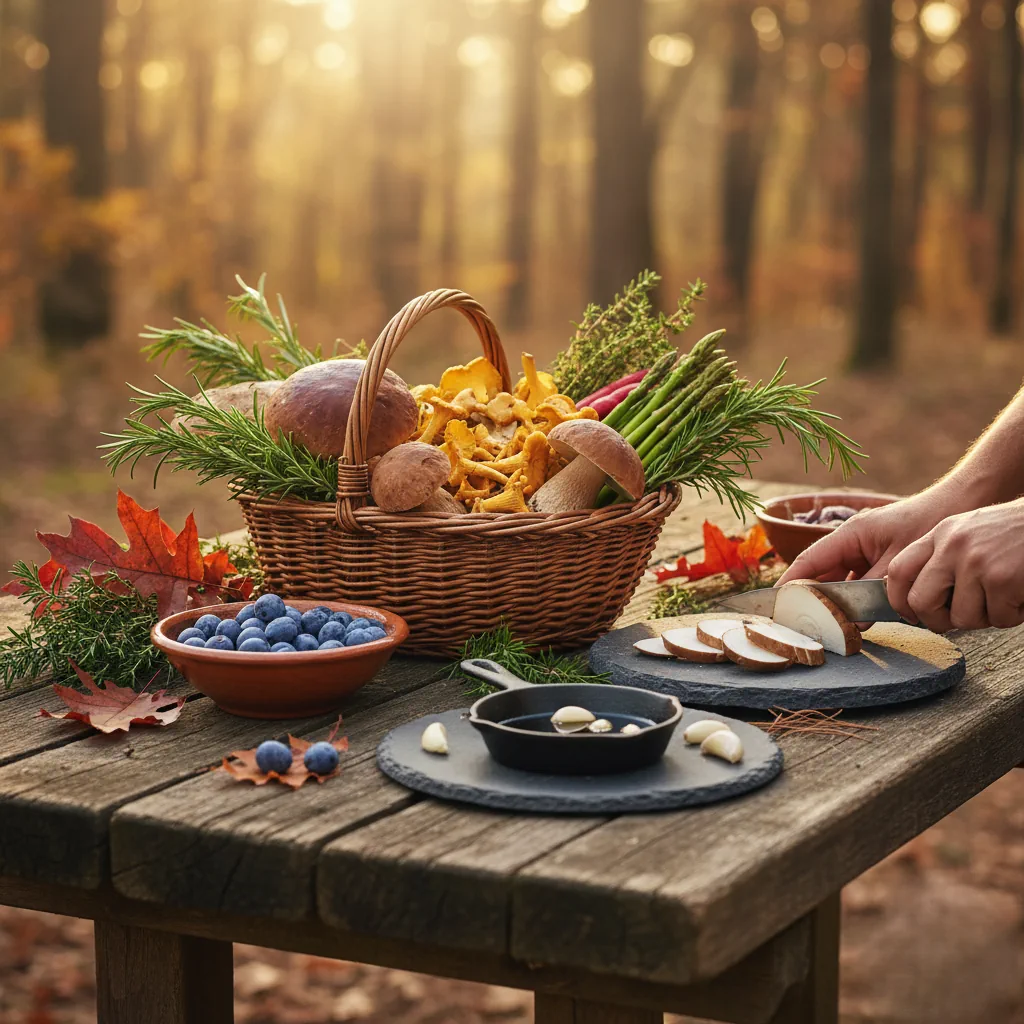
Long before supermarkets and supply chains, people lived and cooked by the rhythms of the wild. The sunrise dictated the search for sustenance; the turning of the seasons painted the palate of daily life.
In the silent, verdant cathedrals of the forest and along the wind-swept symphony of the coastline, humanity’s first kitchens were found.
Today, in the midst of industrial food systems and the relentless hum of instant gratification, cooking with foraged ingredients offers a radical return — not to the past, but to place, presence, and purpose.
It represents a quiet rebellion against the homogenization of flavor and the disconnection from our food’s true origin. It’s about more than ingredients.
It’s about intimacy with the land. It is a dialogue, a dance, a rediscovery of a language we almost forgot we knew.
What does foraging mean in modern cuisine?
In an age where food arrives in sterile packaging, detached from its story, the act of foraging has been transmuted from a simple act into a profound statement.
It is a conscious pilgrimage into the wild, a deliberate choice to step outside the ordered aisles of the grocery store and into the beautiful, untamed chaos of nature.
It’s an immersion, a sensory baptism in the terroir that shapes every leaf, root, and mushroom. The modern forager is not just a collector of food; they are a reader of landscapes, a student of ecosystems, and a participant in the grand, cyclical narrative of the earth.
From necessity to philosophy
Foraging is woven into the very fabric of our ancestry. For millennia, it was the fundamental chord of human existence, a matter of immediate survival.
The knowledge of which berry nourished and which root poisoned was a currency more valuable than gold, passed down through generations as a sacred text of sustainability.
Every hunt for mushrooms after a cleansing rain, every gathering of coastal herbs kissed by salt spray, was an act dictated by necessity.
Today, for most in the developed world, that primal urgency has faded. Yet, in its place, something remarkable has bloomed. Foraging has been reborn, transforming from a survivalist craft into a rich culinary and ecological philosophy.
It is no longer solely about filling the stomach but about feeding the soul. It is a deliberate act of reconnection in a world that champions disconnection.
It is a practice rooted in respect for the intricate web of life, a deep knowledge of botany and ecology, and a clear intention to harvest in a way that honors and sustains the environment.
The modern chef or home cook who forages is seeking more than a new ingredient; they are seeking a new relationship with the world, one built on patience, observation, and reciprocity.
What we forage today
The bounty of the wild is as diverse as the landscapes that cradle it. What we gather is not merely a list of items but a collection of stories, each speaking of a specific time and place. These are not static commodities but ephemeral gifts from the earth.
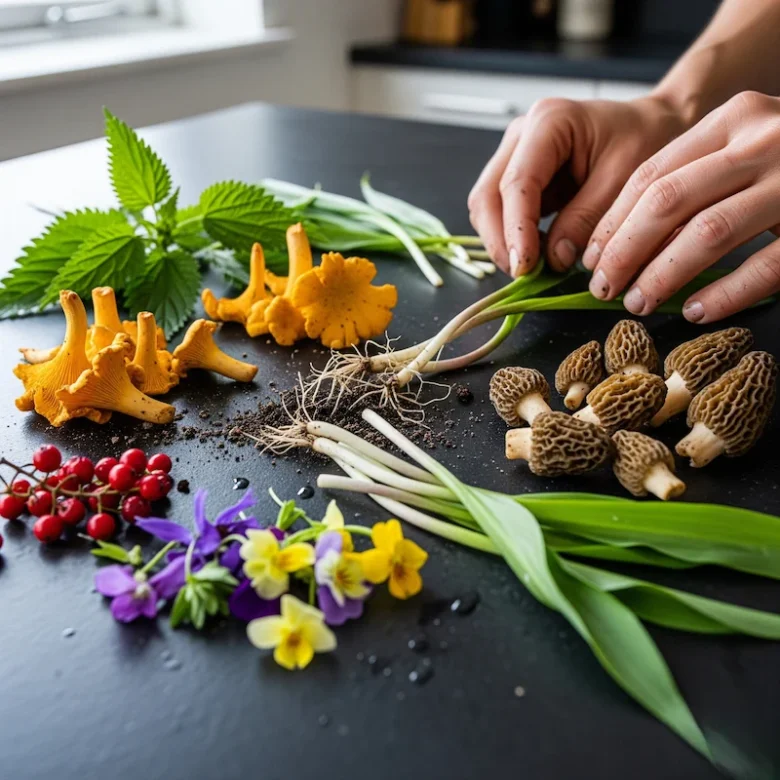
The forest floor offers up its earthly jewels: wild mushrooms. Chanterelles, with their delicate, trumpet-like forms and faint apricot scent, emerge like scattered gold after a summer storm.
Morels, with their mysterious, honeycombed caps, are the coveted treasures of spring, their deep, nutty flavor a reward for the patient hunter. These fungi are the embodiment of the forest’s dark, damp, and fertile soul.
From the undergrowth and meadows come the vibrant whispers of spring: nettles, ramps, and wild greens. Stinging nettles, their bite tamed by a touch of heat, offer a flavor reminiscent of spinach but imbued with a wild, mineral depth.
Ramps, or wild leeks, carpet the forest floor for a fleeting moment, their potent blend of onion and garlic a clarion call of the awakening earth. These are the first defiant greens to break through the thawing soil, a taste of resilience itself.
Where the land meets the sea, a unique palette emerges. Seaweed and coastal herbs offer the briny kiss of the ocean. Dulse, with its leathery texture and smoky, saline taste, clings to rocks pounded by the surf.
Sea buckthorn, thriving in sandy dunes, yields berries like tiny, blazing suns, their tartness a jolt of pure, unadulterated energy. These are flavors shaped by salt, wind, and tide.
As the seasons progress, the landscape offers bursts of wild sweetness. Tiny, intensely flavored wild strawberries, tart elderberries, and the crimson gems of rose hips provide a counterpoint to the earthier tones of the wild pantry.
Even the trees themselves contribute; pine needles can be steeped into a fragrant, citrusy tea, while the sap of birch and maple can be rendered into sublime syrups.
The wild larder extends to the most delicate of offerings: edible flowers like elderflower, violet, and wild rose, whose ephemeral beauty and floral notes can elevate a dish into a work of art.
The appeal of wild ingredients
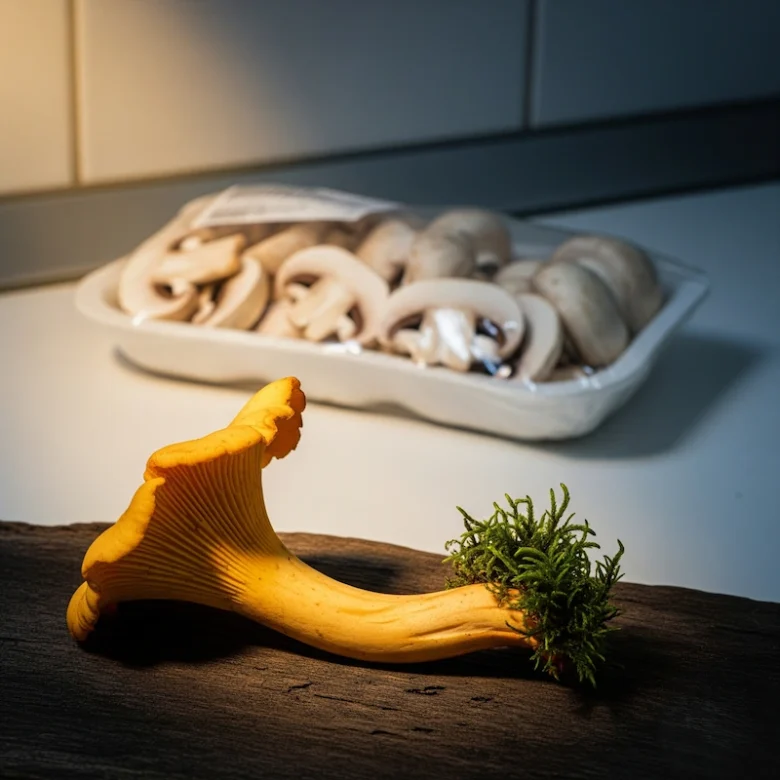
What is it about these untamed flavors that captivates the modern palate and inspires the world’s most innovative chefs? The allure lies in their authenticity, their defiance of cultivation, and the very scarcity that defines them.
Wild ingredients possess a vitality, a life force that cannot be replicated in the controlled environment of a farm. They are the voice of a place, singing its unique song.
Flavors you can’t farm
Industrial agriculture, for all its efficiency, tends towards uniformity. It seeks to tame nature, to produce consistent, predictable crops year after year. The result is often a muting of flavor, a softening of character.
Foraged ingredients are the antithesis of this. They offer an untamed chorus of bold, unreplicable taste profiles that are a direct expression of their environment.
A wild blueberry, having struggled for sunlight on a rocky mountainside, possesses a concentrated, complex sweetness that its coddled, cultivated cousin can only dream of.
The resinous tang of pine speaks of cold, clear air and ancient forests. The floral bitterness of a mountain herb tells a story of thin soil, high altitude, and survival.
These are flavors with jagged edges and surprising depths—bitter, floral, earthy, resinous, musky—that speak of place and season with an honesty that is both startling and profound.
They carry the taste of the rain that nourished them, the soil that anchored them, and the sun that ripened them. This is the definition of terroir in its purest form.
Scarcity as luxury
In a world saturated with mass-produced goods, true luxury is shifting. It is no longer defined simply by price or brand, but by rarity, experience, and meaning.
In this new paradigm, foraged ingredients represent the ultimate luxury. Their value lies not in their market price, but in their temporality and glorious unpredictability.
You cannot summon a patch of morels on demand. You cannot force a wild ramp to grow outside its fleeting season. These ephemeral treasures are gifts, offered up by the ecosystem on its own terms.
Their appearance is a dialogue with chance, weather, and deep ecological knowledge. This scarcity makes them precious. A dish featuring wild chanterelles is more than a meal; it is a celebration of a specific moment in time, a culinary experience that is unique and unrepeatable.
This fleetingness invites a sense of presence and gratitude, transforming the act of eating from mere consumption into a mindful communion with the rhythm of the seasons.
Foraging as a design mindset
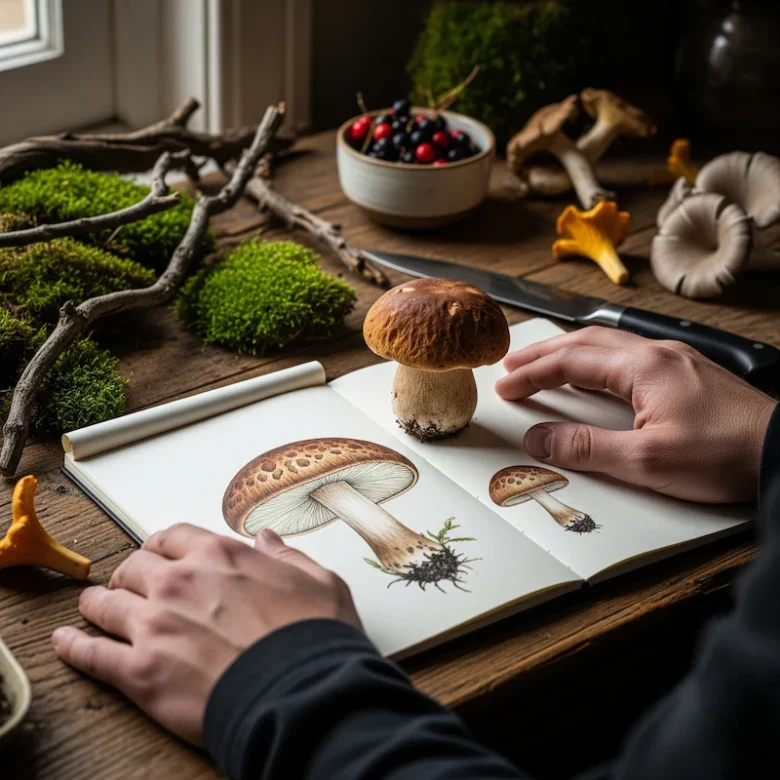
The practice of foraging extends beyond the kitchen; it is a way of seeing the world. It is a mindset that finds profound parallels in the world of design, art, and curation.
To forage is to engage in an act of creative selection, to find harmony in the wilderness, and to tell a story with the elements you have gathered.
Curation from chaos
The forest, the meadow, the coastline—these are not ordered pantries. They are complex, chaotic, and living systems. The forager, much like a designer or an artist, steps into this beautiful chaos and begins a process of curation.
They are not merely grabbing what they see; they are editing, selecting, and composing. They see the potential in a gnarled root, the elegance in a humble weed, the narrative power in a handful of wild berries.
They are curators of the wild, finding symphonies in the undergrowth and composing palettes from the forest floor. This act of selection is a form of storytelling.
Each chosen ingredient is a word, and the final dish is a poem about a walk in the woods on an autumn afternoon. It is about finding beauty in the unexpected, structure in the wild, and making sense of a world that defies simple categorization.
The kitchen as an extension of the forest
Cooking with foraged ingredients fundamentally changes the nature of the kitchen. It ceases to be a sterile, enclosed laboratory, isolated from the outside world.
Instead, it becomes a liminal space, a sanctuary where the forest breathes and the sea whispers. The boundary between interior and exterior, domestic and wild, becomes beautifully blurred.
The ingredients brought in from the wild carry with them the scent of rain-soaked earth, the texture of rough bark, and the vibrant colors of the living landscape.
A basket of freshly picked mushrooms on the counter is not just produce; it is a piece of the forest itself. This infusion of the wild transforms the kitchen into an annex of the natural world, a place where the processes of nature continue, not on a forest floor, but in a pot, a pan, or on a plate.
The act of cooking becomes a collaboration with the ecosystem, a continuation of the story that began with a seed, a spore, or a bud.
Contemporary chefs leading the movement
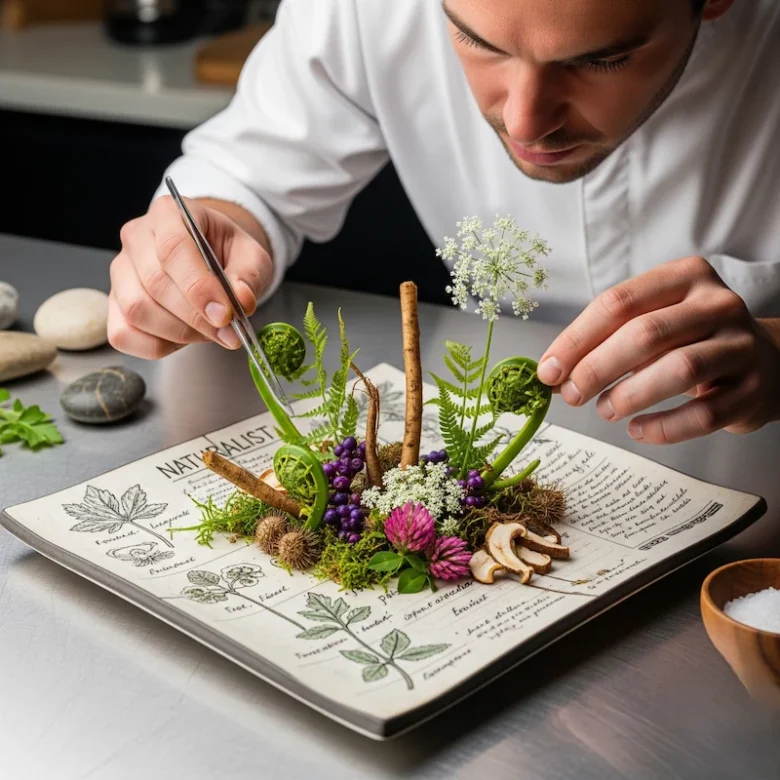
While foraging is an ancient practice, its renaissance in contemporary haute cuisine can be attributed to a handful of visionary chefs.
These culinary pioneers did not just put wild ingredients on the menu; they built entire philosophies around them, challenging the conventions of fine dining and creating a new language of flavor that is deeply connected to place.
René Redzepi (Noma, Denmark)
Perhaps no single figure is more synonymous with the modern foraging movement than René Redzepi. As the creative force behind Noma in Copenhagen, consistently ranked among the world’s best restaurants, Redzepi became the high priest of the New Nordic Cuisine.
He turned his gaze away from the traditional luxury ingredients of the south—foie gras, truffles, olive oil—and looked intensely at his own backyard.
He composed an entirely new culinary syntax from the overlooked and the underestimated: lichen scraped from rocks, pungent wild herbs, seaweeds, ants for their citrusy bite, and moss.
His impact was seismic, inspiring a generation of chefs globally to explore their own local landscapes and to find extraordinary flavor in the ordinary.
Redzepi proved that the most profound luxury could be found in a humble, perfectly expressed taste of a specific place and time.
Michel Bras (France)
Long before the Nordic renaissance, in the remote Aubrac region of France, Michel Bras was quietly practicing a form of culinary poetry deeply intertwined with nature.
A chef, artist, and philosopher, Bras is revered for his iconic dish, le gargouillou de jeunes légumes. While often described as a vegetable dish, it is in truth a living mosaic, a botanical sonnet composed of dozens of individually prepared wild plants, roots, herbs, and flowers, many foraged from the surrounding fields.
The dish is a snapshot of a meadow on a particular day, layered with textures and flavors that ebb and flow like a walk through the landscape itself.
Bras’s approach is one of reverence and deep intimacy, treating each humble herb with the same respect as a prime cut of meat. His work is a testament to the idea that a plate can be a naturalist’s diary.
Jeremiah Langhorne (The Dabney, Washington D.C.)
In the United States, Jeremiah Langhorne of The Dabney has become a powerful voice for a uniquely American terroir. Drawing inspiration from the rich, often overlooked culinary traditions of the Appalachian and Mid-Atlantic regions, Langhorne channels the spirit of a place through his cooking.
His menu is a direct reflection of what his network of foragers, farmers, and fishermen bring to his kitchen door each day. He showcases ingredients like pawpaws—a creamy, tropical-tasting fruit native to the region—wild persimmons, and a variety of foraged greens and mushrooms.
Langhorne’s cooking is not an imitation of European ideals but a confident assertion of American identity. His dishes are edible histories, telling stories of the land, its people, and their enduring relationship with the wild.
The aesthetics of wild food
The philosophy of foraging naturally extends to the plate itself, giving rise to a distinct visual language. The aesthetics of wild food are a rejection of contrived perfection and an embrace of the raw, organic beauty of the ingredients themselves. The presentation is not an afterthought; it is an integral part of the story.
Earthy elegance
Foraged dishes often possess a minimalist, asymmetrical, and elemental beauty. There is a deliberate rejection of perfect geometry and ornate garnishes. Instead, the focus is on the honest imperfection of the ingredients.
A twisted sunchoke root is presented as it was pulled from the ground; a scattering of elderflowers appears as if they were just carried in on a breeze.
The beauty lies in the authenticity of the forms, textures, and colors provided by nature. This aesthetic of authenticity celebrates the gnarl of a root, the delicate veins of a leaf, and the vibrant hue of a berry, allowing the inherent elegance of the wild to speak for itself.
Plates that echo landscape
The canvas for this earthy elegance is just as important as the food itself. Chefs in this movement have abandoned pristine white porcelain in favor of serveware that completes the connection to the natural world.
Plates become microcosms of the ecosystem from which the ingredients were gathered. Rough-hewn ceramics with earthy glazes, weathered wooden boards, and smooth, cool river stones are used to enhance the visual and tactile link between forest, food, and form.
Eating from a stone that could have been plucked from the same stream as the watercress on the plate creates a powerful, multi-sensory experience.
The serveware is no longer a passive container but an active participant in the narrative, grounding the dish firmly in its landscape.
Ethics and sustainability in foraging
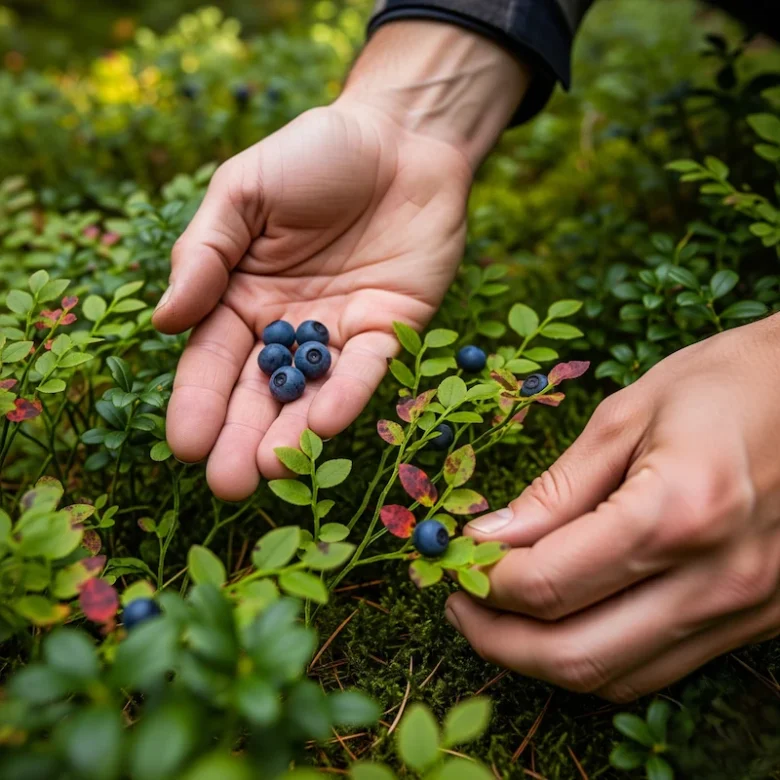
The romantic appeal of foraging must be tempered with a profound sense of responsibility. The practice is not a simple act of taking; it is a delicate dance of reciprocity.
True foraging is built on a foundation of deep ecological knowledge and an unwavering ethical commitment to sustainability.
Take less, know more
To forage responsibly is to understand that you are a guest in a complex, living system. It is not a supermarket with endless stock. This requires deep knowledge—the ability to identify plants with absolute certainty, to understand their life cycles, and to recognize their role within the ecosystem.
A responsible forager knows which parts of a plant to harvest without harming it, when to take only a few leaves from a patch to ensure its continued health, and, most importantly, what to leave untouched.
The cardinal rule is to take only a small fraction of what is available, ensuring that plenty remains for wildlife and for the plant community to regenerate. It is a practice of restraint, humility, and foresight.
From extraction to relationship
The dominant mindset of our modern food system is one of extraction—taking as much as possible, as efficiently as possible. Foraging, when practiced ethically, offers a powerful alternative: a relational approach.
It is not about harvesting from nature, but about coexisting with it. The forager is not a conqueror but a steward, a participant who understands that their well-being is intrinsically linked to the health of the ecosystem.
This mindset views the forest and fields not as resources to be exploited, but as communities to be respected. The goal is to cook and eat in a way that is regenerative, not depleting, ensuring that the wild pantries that sustain us will continue to thrive for generations to come.
Foraging in urban environments
The wild is not confined to remote forests and pristine coastlines. Nature is resilient, and it pushes through the cracks of our built environments, offering an overlooked abundance in the most unexpected of places.
Urban foraging is a testament to this, an invitation to see our cities not as concrete jungles, but as complex, hybrid ecosystems.
The overlooked abundance
City parks, neglected alleyways, riverbanks, and abandoned lots can be treasure troves of edible surprises for those who know how to look.
The common dandelion, often cursed as a weed, is entirely edible, from its bitter greens to its sun-yellow flowers. Purslane, a succulent green, thrives in the cracks of sidewalks, offering a surprising crunch and a dose of omega-3s.
Mulberry trees, often planted for ornamental purposes, drop their sweet, dark fruit onto city streets, a feast for anyone willing to gather them.
Urban foraging is an act of rediscovery, a way to engage with our immediate surroundings on a deeper level and to recognize the wildness that persists even in the heart of the metropolis.
Designing urban spaces for wild edibility
This recognition of urban abundance is beginning to influence the very design of our cities. A new wave of landscape architects and urban planners is moving beyond purely aesthetic planting and starting to integrate forage-friendly flora into public spaces.
Imagine parks with designated “food forests” featuring fruit and nut trees, bike paths lined with berry bushes, and public plazas planted with edible herbs.
These initiatives do more than provide free, healthy food; they foster community, encourage ecological literacy, and reconnect city dwellers to the food cycles that sustain them.
Designing for edibility transforms sterile green spaces into vibrant, productive landscapes that nourish both body and spirit.
Challenges and cultural questions
As foraging grows in popularity, it enters a more complex cultural and legal landscape. The practice is not without its challenges, and its modern expression raises important questions about access, appropriation, risk, and responsibility. A mindful approach requires navigating these issues with awareness and respect.
Access, appropriation, and knowledge
Foraging is not a new trend; it is an ancient practice with deep and continuous roots in Indigenous cultures worldwide. For countless generations, Indigenous peoples have cultivated a sophisticated and sacred body of Traditional Ecological Knowledge (TEK) about how to live in balance with their environments.
As modern, often non-Indigenous chefs and enthusiasts embrace foraging, there is a critical responsibility to acknowledge and honor this legacy. The movement must be vigilant to avoid appropriation—taking knowledge and practices without credit, context, or permission.
True respect means recognizing foraging’s origins, supporting Indigenous food sovereignty, and understanding that this knowledge is a precious cultural inheritance, not a trend to be capitalized upon.
Risk and regulation
The wild is not inherently benign. The line between an edible and a toxic plant can be dangerously thin. The romanticism of foraging must be grounded in the harsh reality that a single mistake can have severe consequences.
Education, caution, and absolute certainty in identification are non-negotiable. Beyond the natural risks, there are legal ones. Laws regarding foraging vary dramatically by location, dictating what can be gathered, how much, and from where.
Navigating the patchwork of regulations governing public parks, national forests, and private land is essential to practicing foraging legally and ethically.
Responsibility in foraging means being accountable for one’s own safety, respecting the law, and upholding the integrity of the practice.
Cooking with foraged ingredients is more than a culinary trend — it’s a cultural reset. It is a quiet but powerful antidote to the speed and alienation of modern life.
It invites us to slow down, to pay attention, to kneel on the earth and observe the intricate details of a single plant. It asks us to engage all of our senses—to smell the damp soil, to see the subtle variations in green, to feel the texture of a leaf.
It invites us to taste the world as it truly is: complex, wild, beautiful, and alive. In every stem, leaf, and root, we rediscover a fundamental truth that our industrial world has tried to make us forget: that food isn’t made — it’s found.
Foraging is about more than food—it’s about the thrill of discovery. Neomania Magazine is a curated hunt for the most inspiring ideas in the wild landscapes of modern culture. Start foraging for your next inspiration.