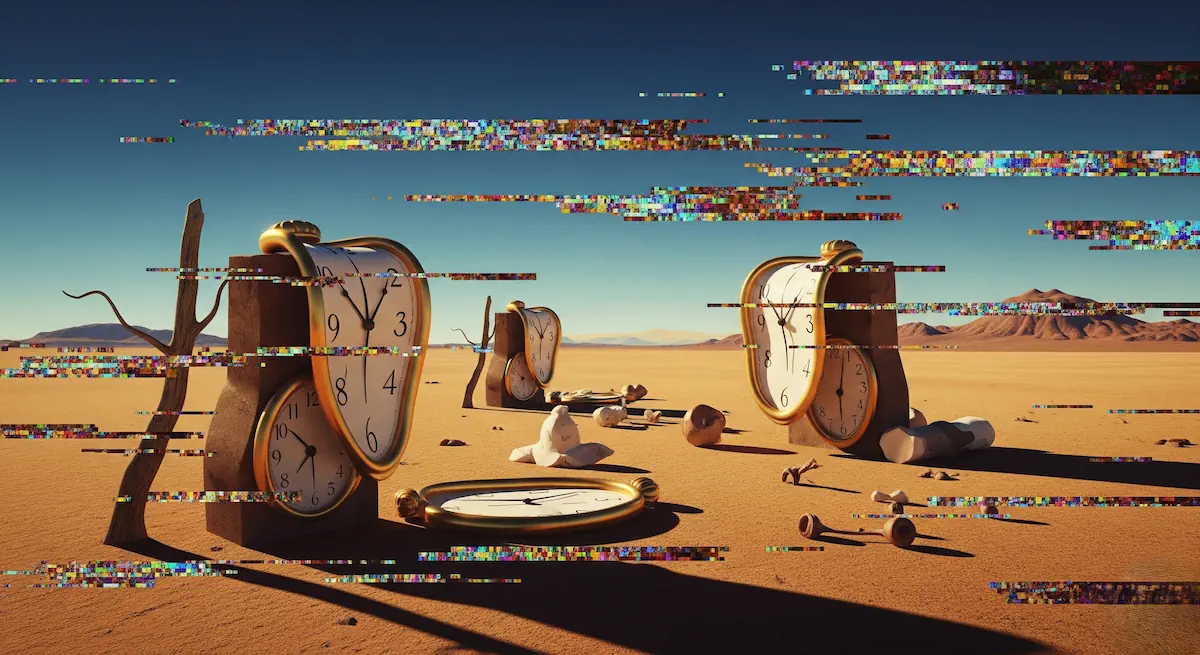
You’ve felt it. That fleeting, uncanny moment when technology’s seamless facade cracks. It’s the frozen Zoom call that captures your colleague in a grotesque, pixelated grimace that feels more honest than their practiced smile.
It’s the GPS navigation that suddenly reroutes you through a phantom street, a momentary tear in the fabric of digital cartography.
It’s the deepfake video so plausible it makes your perception stutter, forcing you to question the evidence of your own eyes. These digital hiccups are more than just trivial errors; they are fissures in our curated reality, moments where the ghost in the machine shows its face.
And in that brief, chaotic breakdown, we often find a strange, compelling beauty. Why are we so fascinated by this digital decay? Why does a corrupted image feel, in some ways, more authentic than a perfect one?
The answer may lie not in the forward march of progress, but almost a century in the past, in the smoke-filled cafés of post-war Paris.
There, a group of artists and poets, reeling from a world torn apart by the cold, hard logic of industrial warfare, sought refuge in the illogical sanctuary of the dream.
They called themselves Surrealists, and their quest was to unlock the truths hidden within the subconscious. Today, a new avant-garde, born from code and electricity, is exploring a similar frontier.
They are the glitch artists, and their work suggests that our modern anxieties, digital obsessions, and the very nature of our perception are creating a new form of surrealism—one written in the language of system failure.
The ghost in the machine: embracing the aesthetic of error
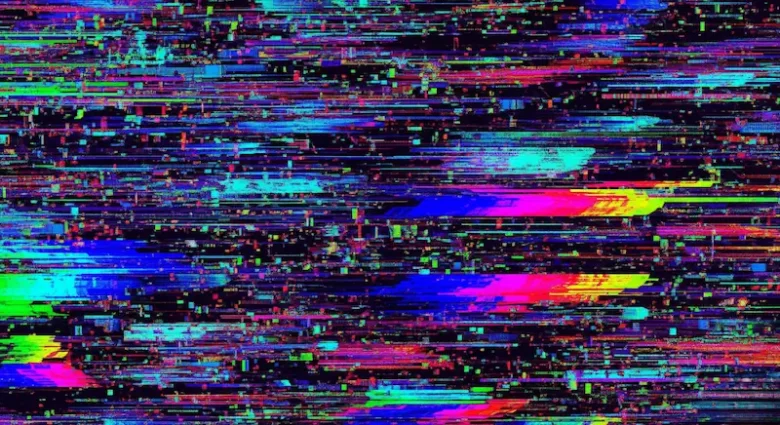
At its core, Glitch Art is the practice of weaponizing error. It’s the deliberate corruption of digital data to produce visuals that are unpredictable, fractured, and often breathtakingly beautiful.
For decades, a “glitch” was a bug, an enemy of functionality for engineers to squash. But as our lives migrated into digital spaces, a counter-cultural perspective emerged.
Artists began to see the machine’s unintended output not as a flaw, but as its most honest form of expression—a raw, unfiltered look at the chaotic processes humming beneath the polished user experience.
This aesthetic has seeped into the very fabric of our digital culture, often acting as a signifier for the edgy, the deconstructed, or the futuristic.
You see it in the intentional visual stutters of Travis Scott’s music videos or the digital disintegration in the title sequences of shows like Mr. Robot, where it perfectly visualizes the theme of hacking reality itself.
In cinema, the unsettling beauty of the “Shimmer” in Alex Garland’s film Annihilation—a zone where biological and digital codes seem to melt into one another—is a powerful, mainstream manifestation of glitch aesthetics. For a generation raised on the internet, the glitch is a native visual language.
Beyond its pop culture presence, a dedicated movement of artists has turned the glitch into a serious medium. Consider the work of Phillip Stearns, whose “Year of the Glitch” project involved using short-circuited cameras and other broken electronics to generate one new glitch image every day.
His work isn’t about simply creating cool, abstract patterns; it’s a disciplined investigation into the visual potential of broken technology, a collaboration with malfunctioning hardware.
Similarly, the pioneering work of Chicago-based artist Jon Satrom explores “Dirty New Media,” deliberately pushing software and hardware to their breaking points to reveal their underlying assumptions and poetic failures.
The techniques themselves are a form of digital alchemy, a way to peer into the machine’s soul. Databending, one of the classic methods, is akin to a technological séance.
An artist might take the code of a JPEG file and open it in an audio editing program like Audacity. The visual data, now represented as a soundwave, can be manipulated using audio effects—reverb, echo, distortion.
When the file is saved and reopened as an image, the sonic manipulations are translated back into visual artifacts, creating spectacular color shifts and structural collapses.
Pixel sorting, another popular technique, uses simple algorithms to isolate pixels of a certain brightness or color and then rearranges them, creating elegant, data-driven waterfalls of color that seem to pour out of the original image.
This isn’t destruction; it’s a controlled deconstruction, a way of speaking to the machine in a language it wasn’t designed for, and then listening to its surprising reply.
A journey back: the uncanny dream-logic of surrealism
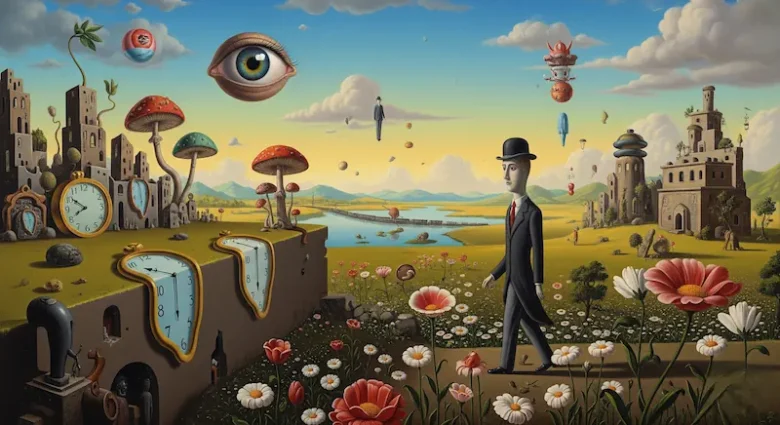
To understand why the glitch feels so psychologically resonant, we must look back at its philosophical source code: Surrealism. Born in 1924 with André Breton’s Manifesto of Surrealism, the movement was a direct response to the perceived failures of a world drowning in its own rationality.
The Surrealists proposed a radical alternative: to tap into the subconscious mind—the realm of dreams, repressed desires, and free association—as a source of a greater, more profound truth.
Its influence on Anglo-American culture, while less overt than in continental Europe, is pervasive and profound. You can see its uncanny dream logic in the films of Alfred Hitchcock.
The famous dream sequence in Spellbound, designed by Salvador Dalí himself, is a cascade of pure Surrealist imagery: faceless men, giant eyes, and distorted perspectives that directly visualize the protagonist’s psychological trauma.
Decades later, David Lynch built his entire filmmaking career on this foundation. The iconic Red Room in Twin Peaks, with its backwards-talking inhabitants and non-Euclidean space, is a perfect television-era manifestation of a Surrealist dreamscape, a place where logic is inverted to reveal emotional truth.
This influence extends beyond the screen. The British-Mexican painter Leonora Carrington, who was personally involved with the movement, created deeply personal canvases filled with alchemical symbols, mythical beasts, and hybrid figures.
Her work was a direct transcription of her own mythology, a testament to the Surrealist ideal of the artist as a spiritual explorer.
In the United States, Joseph Cornell, though working in relative isolation, created his famous “shadow boxes.” These small, glass-fronted boxes containing carefully arranged found objects—marbles, maps, clay pipes—are miniature, self-contained theaters of memory and dream, poetic juxtapositions that create a silent, enigmatic narrative.
Surrealism even made a lasting mark on the world of high fashion, most notably through the collaborations between designer Elsa Schiaparelli and Salvador Dalí, which resulted in creations like the iconic “Lobster Dress” and the “Shoe Hat”—wearable sculptures that injected a dose of subversive, dreamlike wit into the world of couture.
The core connection: randomness, rebellion, and reality
The kinship between a melting clock and a pixelated screen is not just aesthetic; it’s philosophical. Both movements are founded on the twin pillars of randomness and rebellion.
The Surrealists’ use of automatism was a profound surrender of control. Whether through automatic drawing or stream-of-consciousness writing, the goal was to silence the conscious ego and allow chance, guided by the subconscious, to become a co-creator.
It was a partnership with the unknown. The glitch artist performs a similar ritual, but their partner is not the Freudian psyche; it is the algorithm.
In databending a file or sorting its pixels, they are ceding their authority to the machine’s processes, inviting the system to “dream” for them.
The source of the randomness is different—one psychological, the other mathematical—but the core principle is identical: a rejection of total control in favor of a surprising, emergent beauty.
Furthermore, both are acts of rebellion against a dominant form of perfection. Surrealism was a revolt against the rigid social and aesthetic norms of the 1920s bourgeoisie.
It championed the absurd, the shocking, and the deeply personal in a world that valued order, propriety, and classical beauty. It was an affront to the establishment.
Glitch Art mounts a similar rebellion against the pristine, frictionless perfection of the 21st-century digital establishment: Silicon Valley.
In an age of algorithmically smoothed social media feeds, flawless 4K resolution, and intuitive interfaces designed to be invisible, the glitch is a radical act. It is a loud, chaotic, and beautifully imperfect reminder that our digital world is a man-made construct, and a fragile one at that.
It critiques the corporate push for seamlessness, re-introducing friction into a world desperately trying to eliminate it.
Glitch as a cultural mirror: what digital errors say about us
Here, however, the paths diverge, and Glitch Art becomes a distinctly 21st-century phenomenon. It holds a mirror to our most contemporary anxieties.
Where Surrealism explored the personal, Freudian landscape of dreams, desire, and neurosis, Glitch Art grapples with the collective anxieties of a networked, data-driven society.
First, it speaks to our deep-seated distrust of the image. In the “post-truth” era, where deepfakes can generate plausible realities and every photograph is subject to invisible manipulation, a corrupted image can feel, paradoxically, more authentic than a “perfect” one.
The glitch acts as a mark of digital truth. It exposes the artifice, a scar that proves the image’s constructed and mediated nature. It visually confirms what we instinctively know: all digital information is fragile and subject to interpretation and decay.
The perfect, polished image is the one we should be most suspicious of; the glitch, at least, is honest about its own corruption.
Second, the glitch aesthetic is a powerful metaphor for information overload. The experience of looking at a complex glitch piece—with its barrage of overlapping data, fractured forms, competing colors, and visual noise—is a perfect representation of the daily cognitive experience of navigating the internet.
It’s the visual equivalent of having twenty browser tabs open in your brain, of being bombarded by notifications, headlines, and advertisements simultaneously.
It captures the feeling of a signal breaking down under the weight of too much information, a feeling that has become a baseline state of modern consciousness.
Finally, and perhaps most profoundly, the glitch reflects our fractured and performative digital identity. We meticulously craft our online personas on platforms like Instagram and LinkedIn, presenting idealized versions of our lives and selves.
The glitch disrupts this performance. A glitched portrait, with its face deconstructed into pure data, is a powerful symbol of this modern condition.
It reminds us that behind the carefully chosen profile picture, we are assemblages of data points, vulnerable to the logic and errors of the system.
It visualizes the anxiety of losing control of our own narrative, of being reduced, fragmented, or misinterpreted by the very technologies we use to define ourselves.
In the end, Glitch Art is more than just a successor to Surrealism; it is its logical evolution in a world where reality itself has become a programmable, editable medium. The Surrealists dreamed of a reality that existed beyond the visible world.
We now live in it—a vast, virtual space where the very distinction between the real and the artificial is the central, animating question of our time.
The artists of the glitch are not just showing us broken images; they are showing us ourselves, reflected in the beautiful, chaotic static of the 21st century.
Want to continue deciphering the art and culture that define our times? Subscribe to Neomanía Magazine and don’t just watch the future, get ahead of it.
[mailerlite_form form_id=3]