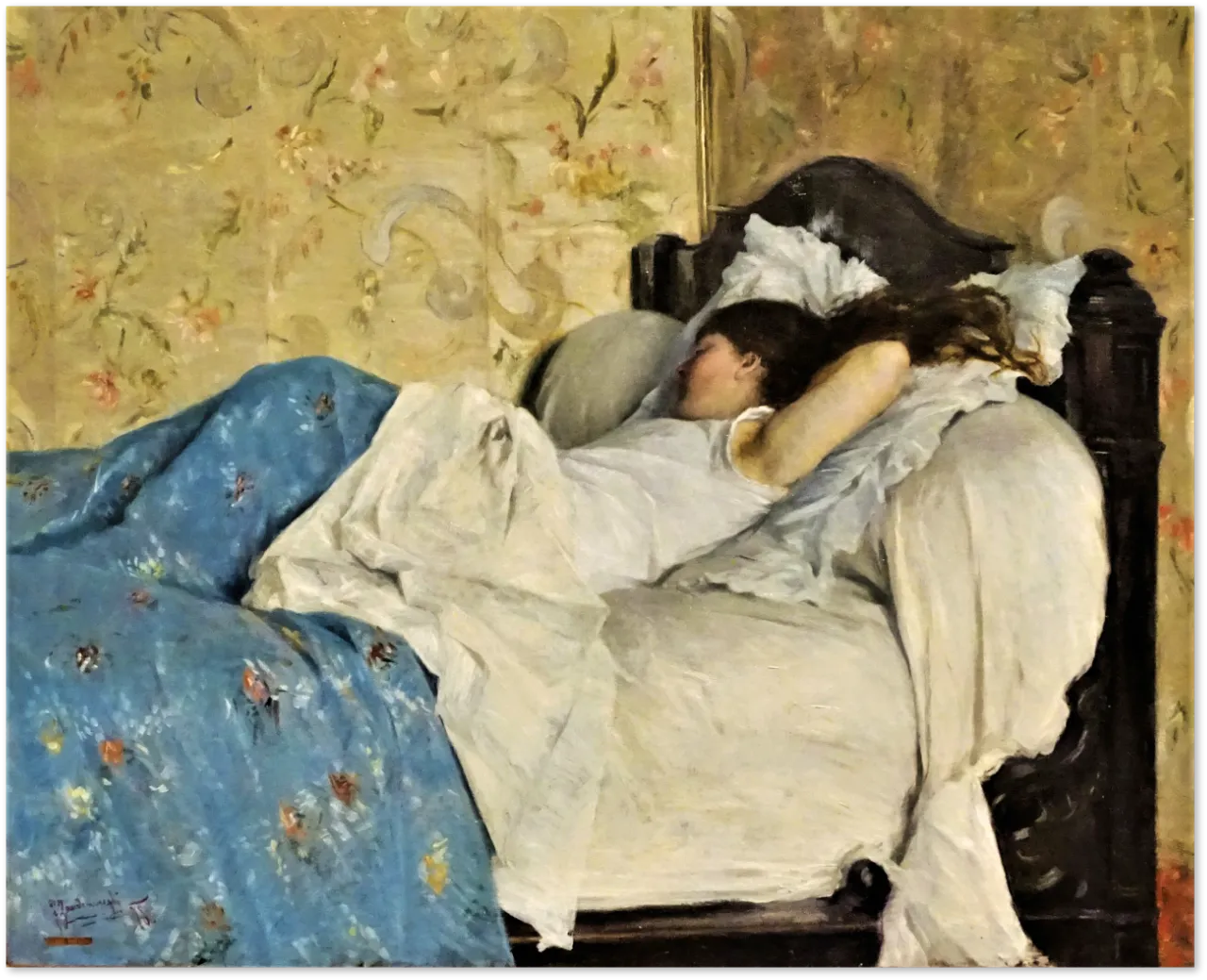
From erotic dreams to nightmares, including insomnia, artificial paradises, and sleepwalking, these are dream themes that fascinate our subconscious. They appear reflected in paintings, sculptures, drawings, and objects throughout the centuries.
Many artists have explored the empire of sleep, a theme that has inspired painters and writers since antiquity.
Delving into its pleasures and disturbances, we admire masterpieces by Delacroix and Goya, as well as scientific objects related to sleep research.
In Greek mythology, Hypnos personified sleep. He was the twin brother of Nyx, son of Night. Thanatos, who symbolises natural death, acts as the agent of Hades, who peacefully transports the dead to the underworld.
The psychologist Sigmund Freud defined Thanatos as the death drive, self‑destruction, and aggression, opposed to Eros, the life drive.
Between Hypnos, Eros, and Thanatos, this state of rest has inspired countless stories from artists about the tranquility or anguish it brings to sleepers.
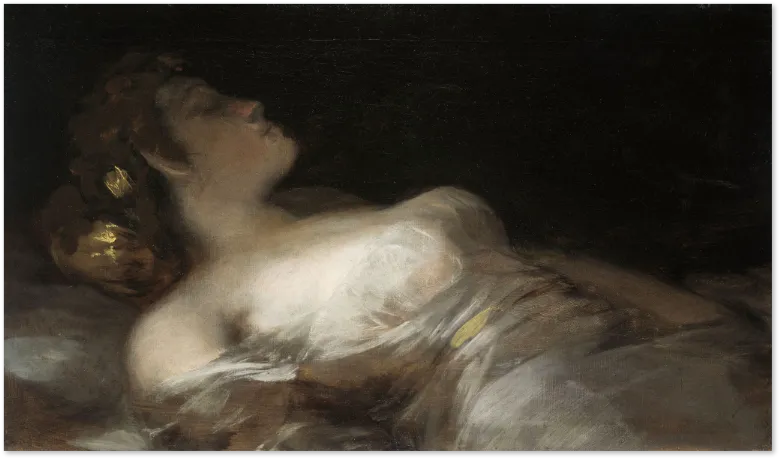
Sleep, a sensual pleasure associated with the bedroom, is a space-time intimately linked to sensuality.
We find a peaceful escape in the verses of the dreamy poet John Faed, contemplating with wonder a romantic landscape, the evocative nymphs of Ingres, or the sculptures of Auguste Rodin, with their intertwined figures of Cupid and Psyche.
This state of tranquility reaches a mystical dimension in the work of the symbolist Odilon Redon.
It is also illustrated by the delicate scene of a sleeping mother beside her child, a work by Joaquín Sorolla.
“Sweet sleep, you come like pure happiness…”
Goethe
Dreams full of dreams, nights of restlessness. However, even when moving away from Thanatos, sleep remains dark.
It is even the ultimate realm of the strangest tales, like the nocturnal creatures drawn by Alfred Kubin, the symbolist engravings of Jean-Jacques Grandville or the portrait of a night owl painted by Edvard Munch.
Tormented by nightmares, the sleeper travels to eccentric, distressing, irrational worlds or tries to escape them by remaining awake.
Whether we sleep well or suffer from chronic insomnia, we inevitably find ourselves immersed in this inescapable dream empire.
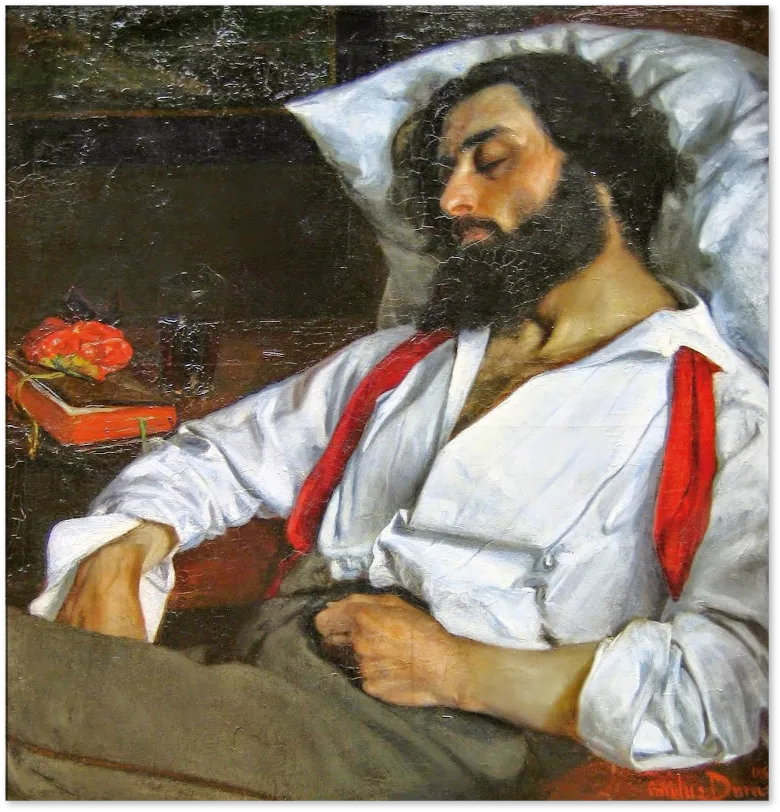
Sleep became a symbolic theme, rich in interpretations, both mystical and scientific.
The 19th and 20th centuries allow us to explore the impact of Romanticism, industrialisation, and the birth of psychoanalysis with Sigmund Freud.
The image of the sleeper raises questions: Did they fall asleep suddenly? Or did they breathe their last, and will we never see their eyes open again?
Artists play with this ambiguity, juxtaposing sleepy faces with the faces of the dead. Like the photograph of Victor Hugo taken by Felix Nadar on his deathbed, or the portrait of the deceased Camille, painted by her husband Monet.
A similar theme is the biblical Raising of Jairus’s Daughter by Gabriel von Max. The girl is not dead, but simply asleep as Jesus has resurrected her.
Paul Rubens painted his nephews lost in sleep. This tradition continued into the 19th century with Swiss painters like Albert Anker. We discover magnificent canvases with sleeping children, such as My Second Sermon (1864) by John Everett Millais and the poignant Violet Seller by Fernand Pelez (1885).
According to Christian tradition, in the final moments of the Virgin Mary’s life, the Dormition (Latin for sleep) precedes the Assumption. The twelve apostles appear gathered around the bed of the dying Virgin Mary before her ascension into heaven.
The exhibition explores the connection between the two sons of Nyx, goddess of Night, in Greek mythology: Hypnos and his twin brother Thanatos, representing Sleep and Death.
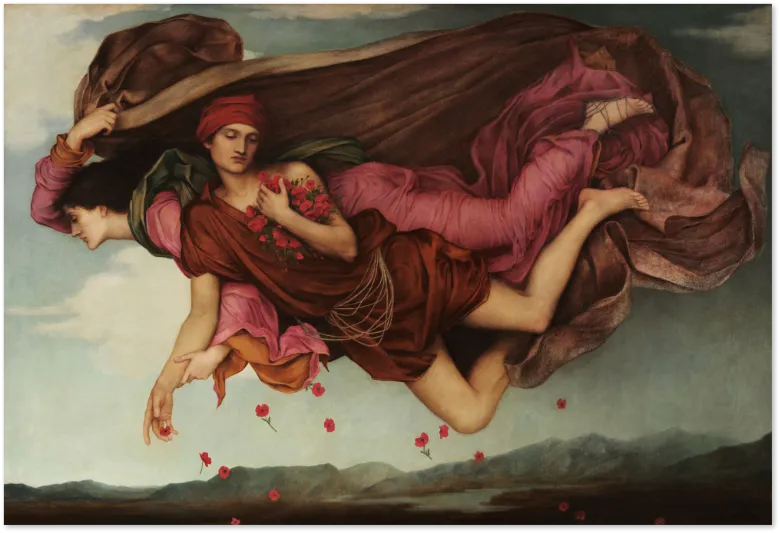
This large canvas is the work of the London Pre-Raphaelite painter Evelyn De Morgan. It depicts Night taking Sleep by the arm, who holds a bouquet of poppies. Their two figures float in the sky and Night’s great cloak completely envelops Sleep’s body.
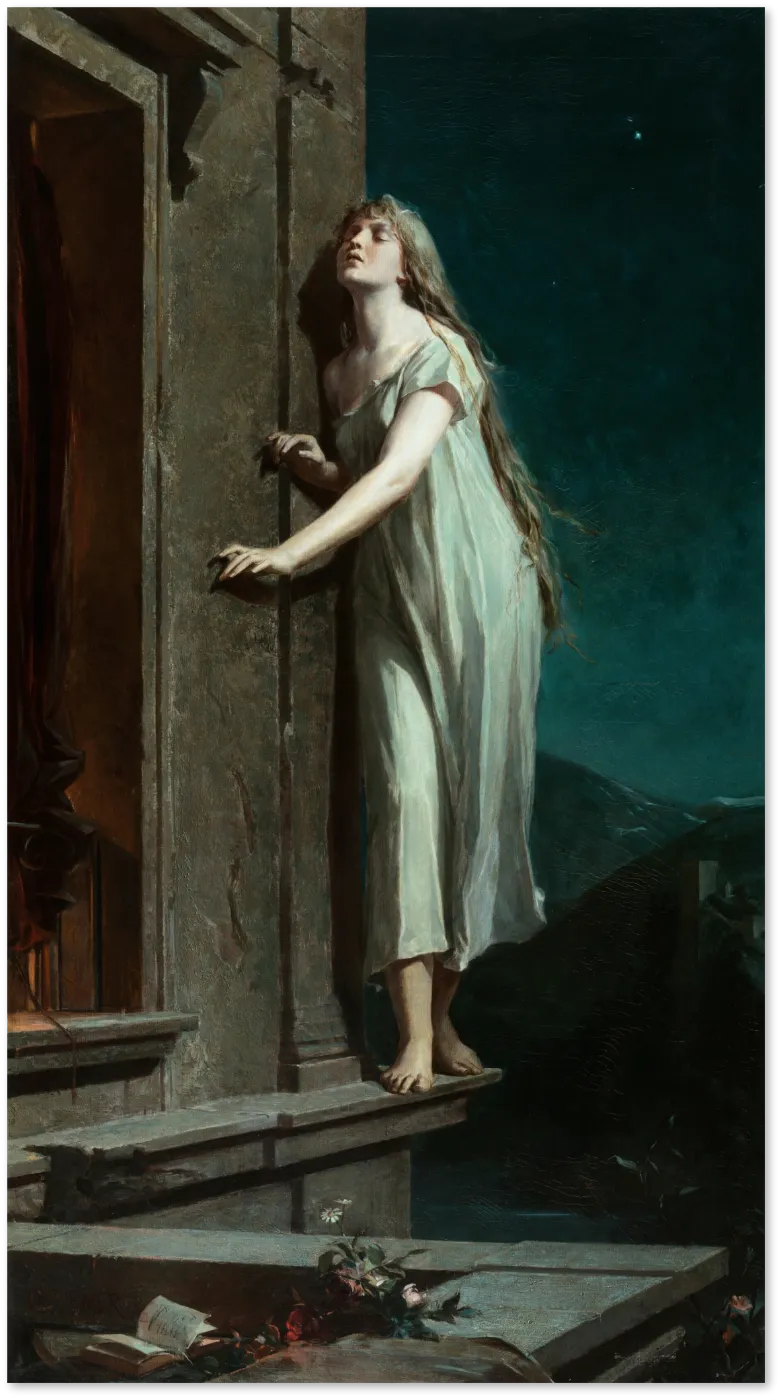
Maximile Pirner offers a romantic vision of sleepwalking. A young woman in a nightgown balances on a ledge, as if sleep were carrying her along a fragile walkway, on the edge of a precipice. With the ledge in the foreground, the artist reinforces the feeling of imbalance.
We see a haunting self-portrait by Edvard Munch, with cavernous eyes, titled The Sleepwalker.
In contrast, there is a whimsical painting by Ditlev Blunck, The Nightmare, where a kind of monkey with a hare’s head appears on the languid body of a young woman.
The Siesta by Michael Ancher shows a young woman dressed in blue, dozing peacefully on a bench. Capture that pause where time stands still.
A detour through biblical origins with Giuseppe Petrini‘s Le Sommeil de Saint Pierre transports us to deeper realms, where sleep becomes synonymous with dreams, desire, anxiety and even death.
Arturo Martini‘s sculpture La Pisana depicts a reclining nude woman, caught in the act of sleep. It inspires a fusion of feelings: serenity and sensuality.
The final surprise is Charles Matton‘s La chambre d’un collectionneur romantique, a miniature reconstruction of a messy bedroom.
How else could such an exhibition end but where dreams take shape?
Bathed in yellow tones, this final room recreates the bedroom, a sanctuary for those who love the siesta. Every little detail captivates us, from the slippers abandoned at the foot of the bed to the chair covered in clothes—that familiar image where we’re all guilty… We love discovering the evolution of this intimate space, from a private, veiled room to a place of total surrender and sensuality.
We spend an average of a third of our lives sleeping. We have a serene view of sleep, conceived as pure happiness, as a moment of escape from life’s worries.
We succumb to these delightful works where their protagonists have fallen into the arms of Morpheus.
The recent exhibition The Empire of Sleep reminds us that canvases could also dream. And that, sometimes, it is better to close our eyes to see more clearly.