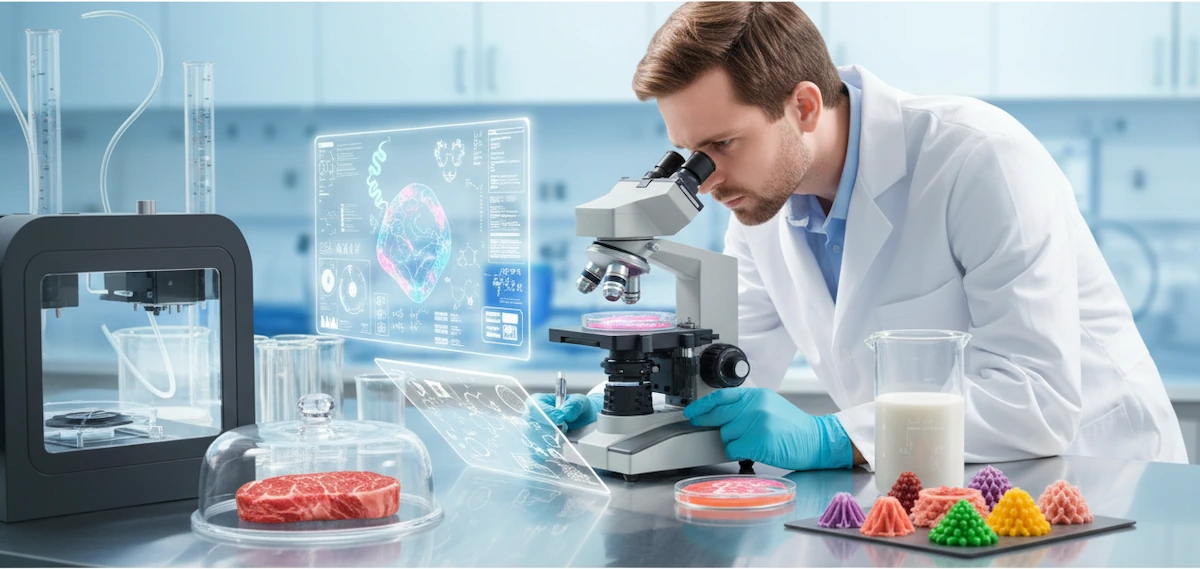
The global food system is at a definitive inflection point, forced by existential pressures to abandon millennia of agrarian practice for the controlled confines of the lab and the factory floor.
This transition, from agriculture to bio-fabrication, is not merely a technological upgrade but a fundamental redefinition of what food is, how it’s made, and its relationship to the planet.
The pressures are undeniable and interconnected, forming the Anthropocene Mandate: a global population pushing ten billion, climate volatility that renders traditional farming systems unreliable, and the ecological exhaustion caused by industrialized livestock and monoculture practices, which consume vast amounts of land and water while generating significant greenhouse gases.
The response from the tech sector is radical: if nature is too slow, inefficient, and unpredictable, then food must be engineered.
This shift means moving away from the messy, complex system of biological growth—dependent on soil, seasons, and rain—to the clean, optimized system of cellular engineering and data management.
The core premise is that resources can be maximized and waste minimized by treating sustenance as a formula rather than a harvest.
As we observe this seismic shift, the critical challenge is clear: how to ensure that this pursuit of efficiency, scalability, and profit does not compromise the fundamental values of equity, access, and ethics that underpin human food systems.
The menu of the future is being written in code, and we must understand its syntax before it’s finalized.
Biopolitics on the plate: food as engineered material
The tools driving the FoodTech revolution—CRISPR, synthetic biology, and precision fermentation—are the real-world scale-up of concepts once confined to the rarefied space of philosophical and artistic debate.
Where Bioart used living organisms as media to provoke questions about genetic control and the sanctity of life, FoodTech has commercialized that power.
The ethical critique inherent in manipulating life has transitioned from the gallery to the grocery store.
This development elevates food to a biopolitical material—a resource whose existence, quality, and distribution are increasingly governed by intellectual property (IP), proprietary code, and legislative frameworks designed to manage engineered life.
The source of our sustenance is shifting from decentralized nature to centralized corporate and technological control. This requires a heightened level of critical scrutiny.
When the most intimate act of human life—eating—becomes subject to the optimized algorithms of Silicon Valley and the stringent legal definitions of the pharmaceutical and biotech industries, every consumer is obligated to become an informed critic of the biopolitical forces shaping their plate. We are no longer simply consuming nature; we are consuming code, and that code must be transparent.
The code on the plate: cultured meat and synthetic biology
The cultivated meat paradigm: decoupling meat from the animal
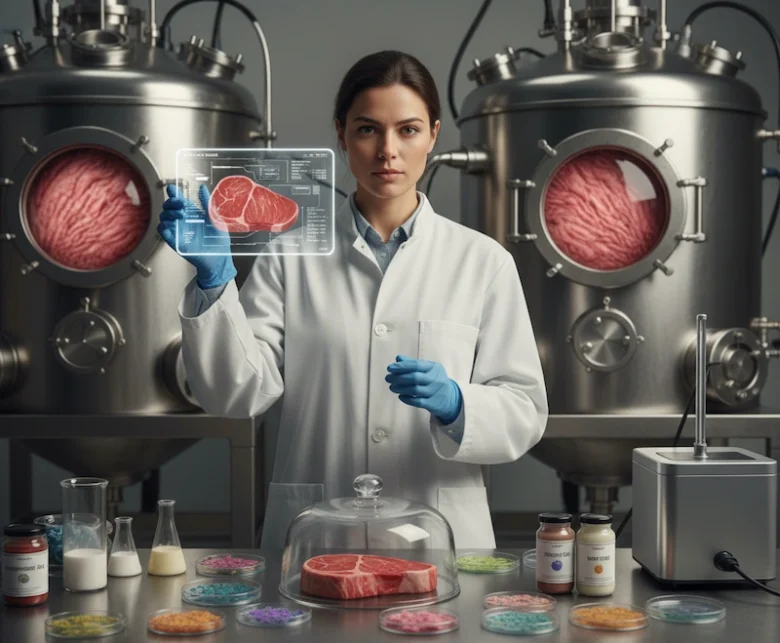
Cultivated meat (also known as cell-based or lab-grown meat) represents the most direct and visceral challenge to traditional food culture.
It promises a final product that is molecularly identical to conventional meat—muscle and fat tissue—but grown entirely outside an animal.
The process begins with taking a small sample of cells from a living animal (a biopsy), which are then introduced into a rich, specialized nutrient bath—the growth media—and incubated inside a bioreactor (similar to those used in brewing beer or manufacturing pharmaceuticals). The controlled environment stimulates rapid proliferation and differentiation into edible tissue.
The technical promise:
Advocates emphasize the drastic reduction in land and water use (often cited at over 90%), the elimination of animal suffering, and the enhanced food safety due to production in sterile, disease-free environments.
It is presented as a rational, optimized solution to satisfying the global appetite for meat without the planetary cost.
The critique of reality: scale and substrate:
The biggest hurdles are not biological, but economic and logistical. The cost of the specialized growth media (historically and in some cases still reliant on Fetal Bovine Serum, though plant-based, serum-free alternatives are rapidly developing) remains a key factor in limiting commercial scale.
Furthermore, the energy footprint of operating massive, constantly monitored bioreactor facilities and the associated HVAC (Heating, Ventilation, and Air Conditioning) systems is significant.
Critics argue that the promised sustainability benefit is conditional upon sourcing 100% renewable energy, a standard few current facilities can meet.
The product, while technically sound, is a sophisticated replica, and its lack of the subtle, complex variances that arise from an animal’s life in an ecological system is a difficult hurdle for culinary purists.
Ethical trade-offs:
While eliminating the ethical cruelty of factory farming is a significant moral win, the technology introduces new anxieties. It frames the complex moral quandary of animal use as a simple technical problem, solvable by IP and engineering.
This shift reinforces the anthropocentric view that all life, even in its most basic cellular form, is material to be manufactured and controlled for human consumption, rather than an entity deserving of existence outside of human utility.
Precision fermentation and genome editing
Beyond growing whole cuts of meat, Synthetic Biology (SynBio) is targeting the food system at the ingredient level. Precision Fermentation involves engineering microorganisms (like yeast, bacteria, or algae) to serve as micro-factories.
By programming their DNA, these microbes can be directed to produce specific target molecules—a particular protein (like whey or casein), a custom-designed fat, or a rare flavor compound—with absolute fidelity and high yield.
This enables the creation of animal-free dairy, egg proteins without the chicken, and bio-identical ingredients that previously required farming animals or specialized plants.
The critique of efficiency: the black box effect
This method is ultra-efficient, but it creates a “black box” product. The ingredient is entirely separated from its traditional biological or geographical origin, produced by a patented microbial strain in a proprietary process.
This efficiency is a form of technological solutionism that carries a risk: by focusing on the perfection of a single molecule, we may disregard the unintended benefits and ecological resilience that traditional, complex ingredients offer.
The historical stability of our food supply is rooted in biodiversity and ecological complexity; centralized, singular engineered ingredients could introduce systemic vulnerability if a single microbial strain were to fail or be compromised.
The CRISPR debate:
The application of CRISPR in plant science (often categorized as New Genomic Techniques or NGTs in Europe) further complicates the notion of naturalness.
This technology allows for precise, internal edits to a plant’s own DNA to enhance traits like drought resistance, fungal resistance, or nutrient density.
Scientists argue this is fundamentally different from traditional GMOs because it avoids inserting foreign DNA and mimics mutations that could occur in nature, only faster. However, the core critical issue remains the intentional, non-evolutionary manipulation of the food’s foundational code.
Public anxiety lingers, revolving around the lack of long-term environmental studies, the potential for unforeseen consequences on biodiversity when introducing traits like pest resistance, and the consolidation of seed ownership under the few corporations that hold the patents for the editing process.
Architectural food: control, cost, and customization
Vertical farming: the architecture of controlled environments
Vertical Farming (VF) is the architectural and logistical response to resource scarcity, formally categorized as Controlled-Environment Agriculture (CEA).
It involves cultivating crops in stacked layers within fully sealed facilities, utilizing hydroponics or aeroponics, and optimizing growth with precise LED light spectrums and climate control.
This technology offers a complete divorce of food production from geography, soil, and volatile weather patterns.
The logistical solution:
VF is exceptionally powerful for its ability to reduce food miles, guarantee year-round harvests, and produce clean, pesticide-free crops.
It is the perfect system for perishable, high-value goods in dense urban markets. However, the critical analysis must address the system’s dependence on technology.
The economic critique:
VFs are fundamentally capital-intensive and highly energy-dependent. The electricity required to power sophisticated HVAC systems and, most significantly, the LED lighting, is the largest operational cost.
This means that the touted sustainability benefit (drastic water saving) is often neutralized if the energy source is not 100% renewable.
Therefore, VFs are arguably less a universal sustainability solution and more a logistical luxury for wealthy urban centers with access to high volumes of cheap, clean energy.
The high barrier to entry limits competition and tends to centralize control, making it a solution for maximizing profit on premium items rather than solving global poverty or famine.
The aesthetic of control:
The product from a vertical farm is flawless, uniform, and perfectly standardized. This aesthetic reflects an industrial mandate to engineer out the natural variation, seasonality, and “imperfection” that have historically defined agricultural products.
It is the food equivalent of mass-market luxury: impeccable, predictable, and technically flawless, but lacking the soul and individuality of its traditional counterparts.
3D food printing: food as personalized data
3D Food Printing takes the concept of food as an engineered product to its logical, individualized conclusion. It uses hydrocolloids, proteins, starches, and nutrient mixtures as “inks” to construct food based on digital blueprints (CAD files), allowing for hyper-customization of texture, shape, and, critically, nutritional content.
The digital plate:
This technology formalizes the food item as a data packet. The recipe is an algorithm; the meal is an executable file. This enables personalized nutrition at an unparalleled level—meals can be printed to precisely match an individual’s DNA, allergies, fitness goals, or medical requirements.
While this promises revolutionary medical and dietary applications, it simultaneously reduces the dining experience to a purely biochemical transaction.
The cultural loss:
The shift is profound: it moves the preparation of food from the artisanal touch—the accumulated, subtle wisdom of the chef, the baker, or the grandmother—to the precision algorithm of a machine.
This challenges the very notion of culinary skill and tradition. When any food item can be materialized from a fundamental powder and a set of instructions, the historical, emotional, and communal significance of the traditional kitchen is threatened with obsolescence.
Ethical plate: biopolitics, access, and cultural erosion
The geopolitics of foodtech: ip and corporate control
The ethical core of the FoodTech revolution lies in the centralization of power. The sheer amount of Venture Capital (VC) flowing into this sector is consolidating the control of life’s basic inputs—proteins, microbes, and genetic codes—into the hands of a few powerful players, often aligned with existing agri-business and pharmaceutical giants.
The monopolistic threat:
When engineered microbes, perfected cell lines for meat, and optimized NGT-seeds are protected by patents and Intellectual Property (IP), the global food system substitutes the unpredictability of climate with the rigidity of corporate power.
Farmers and food producers around the world risk becoming mere users of proprietary systems, paying licenses for the very building blocks of life.
This directly undermines the principle of food sovereignty—the right of communities and nations to define their own food systems and secure access to non-proprietary seeds and inputs.
Regulation as a barrier:
The complex and costly regulatory processes in developed markets (e.g., the EU’s Novel Food status) act as a severe bottleneck, which paradoxically favors large, well-funded corporations that can afford the multi-year, multi-million dollar regulatory pathways.
This reinforces the consolidation of the industry, further sidelining smaller, open-source, or local initiatives.
Cultural erosion vs. equitable access
Food is, fundamentally, a cultural artifact—a vehicle for history, memory, and social ritual. High-tech efficiency risks sterilizing this essential human experience.
The loss of terroir and narrative:
A steak grown in a vat or a vegetable grown under artificial light lacks terroir—the unique flavor and character imparted by the soil, the local climate, and the human tradition of care.
When efficiency becomes the highest value, the narrative, cultural context, and ritualistic value of food are lost. This erosion is particularly acute for Indigenous and traditional cultures whose identity is inextricably linked to their specific agricultural practices and biodiversity.
The access divide (food apartheid):
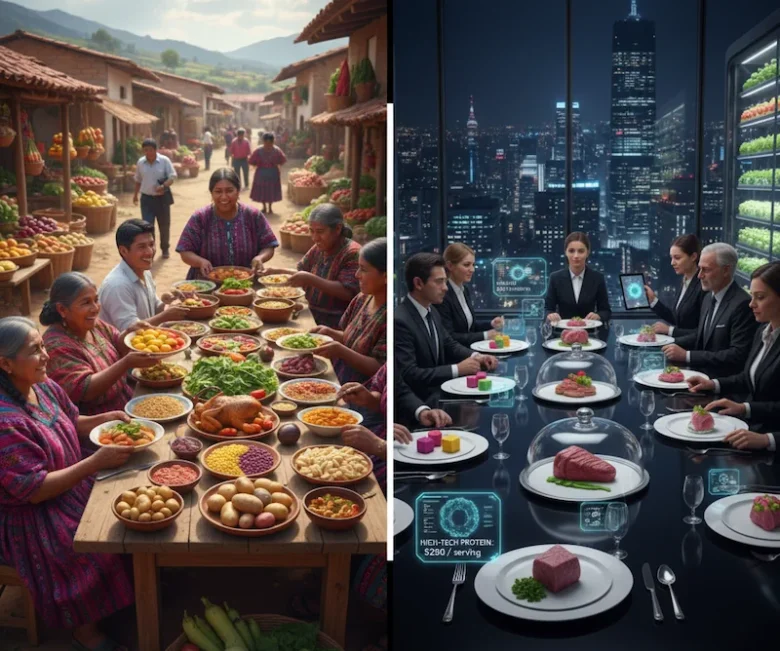
The most critical ethical concern is the risk of creating a two-tiered food system. If premium, sustainable, high-tech food (e.g., clean, cultivated meat; pesticide-free VF crops) is priced at a premium, it will only be accessible to the wealthy global North and elite consumers.
The vast majority of the world’s population, the poor, will remain dependent on—or be forced to accept—the cheapest, lowest-quality outputs of the traditional, environmentally taxing system, or the most basic, nutritionally sparse engineered products.
The ethical mandate for FoodTech is to prove that its innovations are not just profitable, but that they contribute to the democratization of access to high-quality, sustainable food.
The future of eating is a choice
The arrival of high-tech food capacity promises the eventual resolution of the problem of scarcity. However, this success brings us face-to-face with the enduring problem of meaning.
When faced with the choice between a meal that is technically perfect, sterile, and hyper-efficient, and a meal that is imperfect, resource-intensive, but rich in cultural heritage and connection to the land, how will humanity choose?
The future of food will be defined by this ongoing negotiation between maximum efficiency and cultural significance. We cannot simply reject technology, but we must guide its integration.
The only viable path forward is a hybrid system—one that uses the speed and precision of the lab to supplement, stabilize, and protect the best of traditional, ecologically resilient farming practices.
This requires a public that is informed, critical, and engaged, demanding that technological innovation be a servant of human well-being and ecological health, not merely a vehicle for corporate profit.
The decisions being made now—in bioreactors, regulatory agencies, and VC boardrooms—will shape not just what we eat, but who we are as a civilization.
Don’t just eat the future. critique it.
Subscribe to Neomania Magazine and get our exclusive report: the genome grind: biopolitical power and the new edible code.