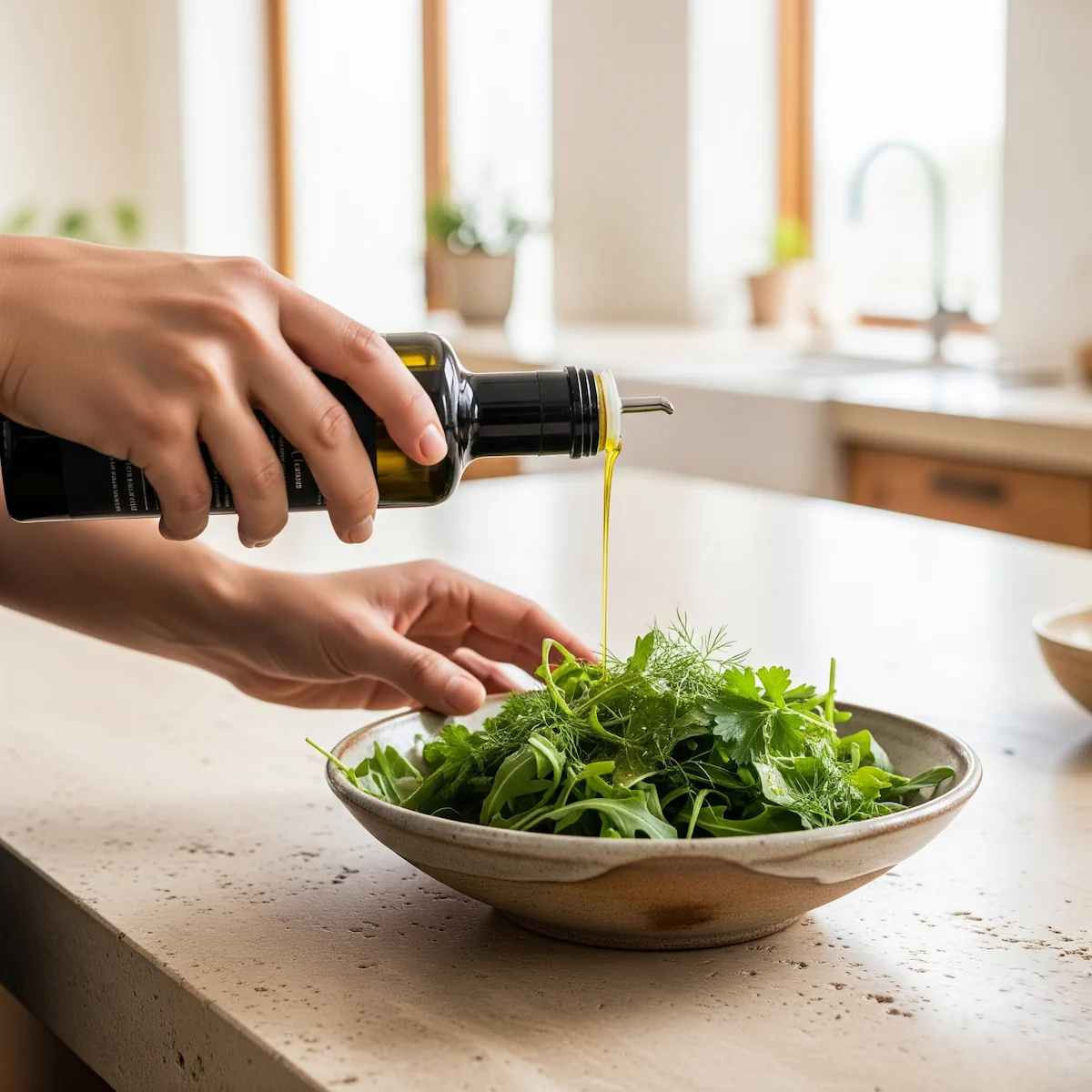
In a culture engineered for speed and optimized for consumption, the simple, deliberate act of cooking slowly has become a radical gesture.
We live in an age of algorithmic urgency, where efficiency is the prevailing virtue and time is a resource to be conquered, not inhabited.
Our meals are summoned by apps, our recipes are delivered in fleeting digital bursts, and our supply chains promise the eternal summer of perpetual availability.
This relentless acceleration has frayed the threads connecting us to the origin, process, and patience that have defined human nourishment for millennia.
Against this backdrop of manufactured immediacy, to choose slowness is not an act of nostalgia; it is an act of conscious rebellion. It is a quiet but firm refusal of the world’s noise, a turning inward to rediscover a more meaningful rhythm.
The aesthetics of slowness reflect a profoundly minimalist philosophy: fewer ingredients, fewer steps, more presence. Here, the act of cooking is not just about the result on the plate; it is about the inherent beauty of the process itself—a process that transforms the kitchen from a site of production into a sanctuary for the senses, embodying a true minimalist cooking lifestyle.
Defining the minimalist culinary philosophy
To define this approach is to describe a philosophy before a set of rules. It is not a new culinary technique or a fleeting dietary trend, but a paradigm shift in how we approach the preparation of food and the space in which it happens.
It is an invitation to unlearn haste, to question needless complexity, and to find a potent form of abundance in simplicity. This way of life is built upon two interconnected pillars: the primacy of essence over excess and the embrace of slowness itself as an active, shaping principle of design.
Essence over excess: the core of the minimalist kitchen
At its core, minimalist cooking is a devotional pursuit of purity—purity of flavor, of space, and of motion. In a culinary landscape often dominated by fusion, foams, and an arms race of complexity, minimalism proposes a radical distillation.
This is not merely about “doing less,” a common misinterpretation that confuses simplicity with a lack of sophistication. It is about doing everything with absolute clarity and intention.
Each element on the plate must have a reason to exist, a distinct voice that is allowed to speak without being drowned out by a chorus of competing flavors.
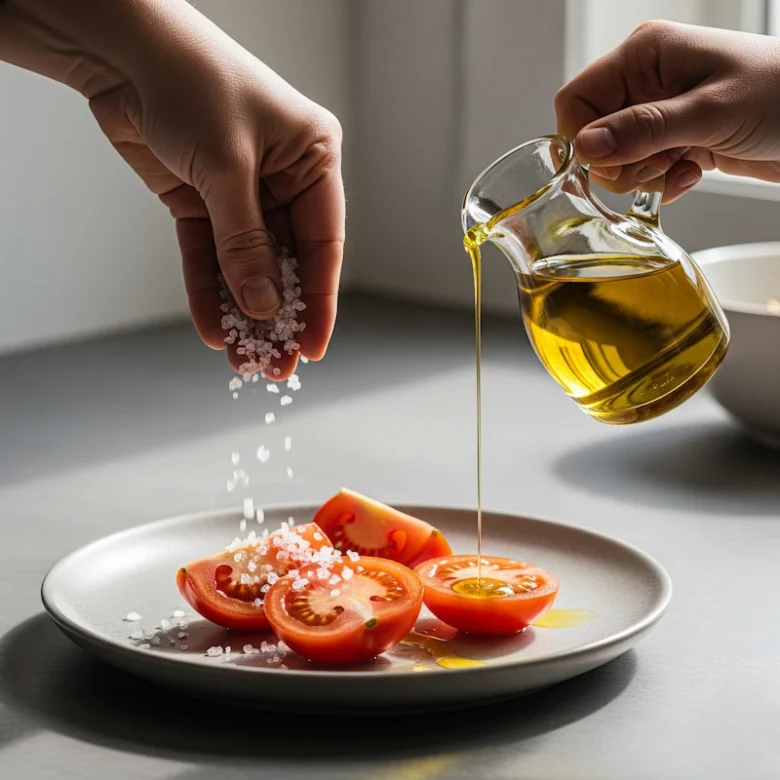
A sun-ripened tomato, at its peak, requires nothing more than a few crystals of sea salt and a thread of pure olive oil to tell its story—a story of the soil, the water, and the light that created it.
This approach demands a deep and unwavering trust in the quality of the raw materials. Excess often serves as a mask for mediocrity, but essence reveals all. The minimalist cook, therefore, is first and foremost a curator.
They might spend more time sourcing the perfect leek or the freshest catch than they do composing an elaborate sauce. For the minimalist cook, the culinary act begins long before the flame is lit; it starts at the farmer’s market, in the garden, in a conversation with the producer.
It is a constant exercise in editing, in asking, “What can be removed so that what remains can shine more brightly?” The reward is a clarity of flavor that is at once subtle and profound, an echo of an ingredient’s unadorned truth.
Slowness as a design principle
If essence is the “what,” slowness is the “how.” In the minimalist kitchen, time is not an adversary to be outrun but an active ingredient—perhaps the most crucial one. The slower the pace, the more each action becomes ritualized.
Mundane, often-rushed gestures are elevated to a higher plane of meaning through mindful repetition and focused attention. The act of washing rice under cool water, feeling the grains shift and the water clear, ceases to be a chore and becomes a rite of purification.
Peeling a piece of fruit, tracing its organic curve with the blade of a knife in one continuous motion, is transformed into an act of sculptural discovery.
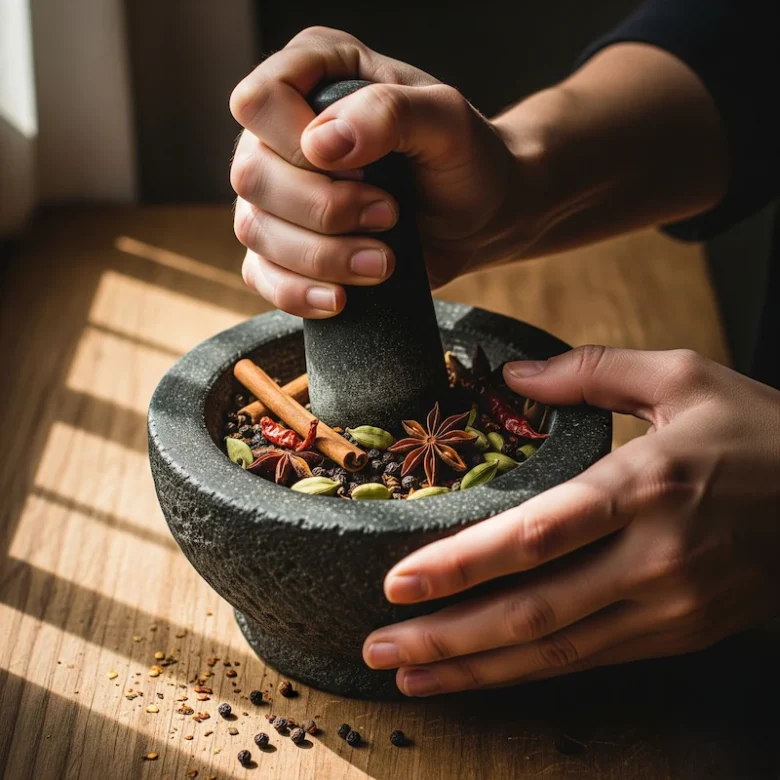
This deliberate tempo designs the entire experience. In the quiet, every sound is amplified: the crisp fracture of an onion being sliced, the gentle murmur of a simmering pot, the resonant thud of a stone pestle against a mortar.
Time expands our sensory perception. Here, repetition does not lead to monotony but to mastery and a state of flow, where the mind stills and the body moves with an intuitive grace.
Folding dough, again and again, is a dance between force and surrender, a haptic conversation with a living material that responds to the warmth of the hands.
In this choreography of slowness, the process of cooking becomes a practice of presence—a powerful reminder that beauty is found not in the extraordinary, but in the ordinary observed with extraordinary attention.
The visual language of culinary minimalism
The philosophy of slow, minimalist cooking extends organically beyond process and into presentation. Its visual language is a natural expression of its core principles, a tangible manifestation of the search for calm, clarity, and essential beauty.
Just as a single brushstroke on an empty canvas can carry more weight than a riot of color, the minimalist table uses space, light, and texture to create a quiet and profound impact.
It is an aesthetic of restraint, where every object and every empty space contributes to a unified whole, defining its distinct visual appeal.
A table stripped bare
The visual stage for a slow meal is intentionally spare. It begins with a neutral palette—creams, beiges, stone grays, and earthy tones—that does not compete for attention but instead serves as a serene backdrop for the food itself.
Natural light is a key material, celebrated for the way it shifts and softens, casting long shadows and illuminating the subtle textures of the objects it touches.
Surfaces are chosen for their tactile and visual honesty: the rough weave of an undyed linen napkin, the matte glaze of a hand-thrown ceramic bowl, the warm grain of an oiled wooden plank.
On this carefully curated stage, every element is intentional. There is no clutter, no superfluous decoration. A single sprig of fresh herb might be the only garnish, its vibrant green a focal point against the muted tones of the plate.
A solitary candle can define the atmosphere of an entire room. This is the power of negative space in composition; the emptiness around an object gives it significance and allows it to breathe.
The table, stripped bare, is not empty—it is full of potential, silence, and calm. It is a visual invitation to slow down and pay attention, a signature of this mindful approach.
Reduction as refinement
In both minimalist design and slow cooking, the act of reduction is a path to refinement. To remove the non-essential is not to diminish, but to clarify. Less becomes a lens through which both form and flavor become sharper, purer, and more profound.
Think of a Brancusi sculpture, where the form of a bird has been abstracted to its most elemental, aerodynamic essence. Or a building by the architect Tadao Ando, where unadorned concrete walls and masterful plays of light create a space of deep spiritual resonance. The power of these works lies not in what has been added, but in what has been bravely taken away.
This same principle applies to a plate of food. By removing a multitude of competing flavors, the true character of the main ingredient is revealed.
A simple dish of perfectly steamed asparagus with a squeeze of lemon allows the complex, grassy, and slightly sweet notes of the vegetable to take center stage.
A clear broth, simmered for hours, can hold more depth and complexity than a heavy, cream-laden sauce. This process of reduction demands confidence from the cook. It is a declaration that the ingredients, in their simplicity, are enough.
It is an understanding that refinement is not about ornamentation, but about distillation—boiling something down to its most potent and honest form, a cornerstone of the minimalist ethos.
Minimalism in ingredients and technique
The minimalist ethos finds its most practical application in the choice of ingredients and the methods used to prepare them. It is a culinary approach that champions depth over breadth, favoring a few high-quality components and time-honored techniques that allow them to express their intrinsic character fully.
The focus shifts from the cook’s technical virtuosity to their ability to listen to the ingredients and honor their nature, truly defining this culinary philosophy.
Letting ingredients speak: the foundation of flavor
When a dish is composed of only three or four elements, each one must be exceptional. A minimalist pantry is not about scarcity, but about quality. Fewer ingredients create more space—both on the plate and on the palate—for each one to shine.
In this space, subtleties emerge that would otherwise be lost. Olive oil is no longer just a fat but a complex liquid with notes of pepper, grass, and almond—it tastes like captured sunlight.
A tomato is not a generic red orb but a vessel of concentrated sweetness and acidity, a taste of the late summer soil—it tastes like time. A single clove of garlic, slowly roasted, sheds its aggressive pungency and reveals a deep, caramelized sweetness.
This approach requires the cook to become a student of terroir, to understand that the flavor of a carrot is directly linked to the earth it grew in, and the sweetness of a scallop is a reflection of the cold, clean water it inhabited.
It is a celebration of specificity. Instead of masking or transforming, the goal is to reveal. The cook’s role is that of a facilitator, a gentle guide whose primary task is to get out of the way and allow the ingredients to tell their own stories in their own voices.
Slower techniques, deeper results
In the minimalist kitchen, time replaces technology, and patience becomes a primary agent of transformation. The techniques favored are often ancient, simple, and require little more than heat, pressure, and waiting. They are methods that coax flavor out rather than imposing it.
- Slow simmering: A gentle, barely perceptible bubble over many hours does what a rolling boil cannot. It coaxes out collagen from bones to create a rich, soulful broth; it marries flavors in a stew until they become a seamless whole; it tenderizes tough cuts of meat into sublime softness. It is a technique of gentle alchemy.
- Cold infusions: Steeping herbs, spices, or fruit in cool water or oil over a day or two creates flavors that are cleaner, brighter, and more nuanced than those extracted by heat. It captures the ephemeral, aromatic essence of an ingredient without cooking it.
- Hand-grinding spices: The act of grinding spices in a mortar and pestle just before use releases their volatile oils, resulting in an aromatic intensity that pre-ground powders can never match. The rhythmic, physical effort connects the cook directly to the ingredient’s fragrant power.
- Fermenting and drying: These are perhaps the slowest techniques of all, collaborations with time and the unseen world of microbes. Fermentation builds layers of funky, complex umami, while drying concentrates sugars and flavors into potent essences.
In all these methods, the most important work is done in the quiet moments of waiting. The cook sets the stage and then steps back, allowing the slow, inexorable work of time to develop a depth and complexity of flavor that no amount of frantic, high-tech cooking can replicate. Patience becomes the ultimate seasoning, embodying the essence of this patient craft.
Designing kitchens for a slower way of life
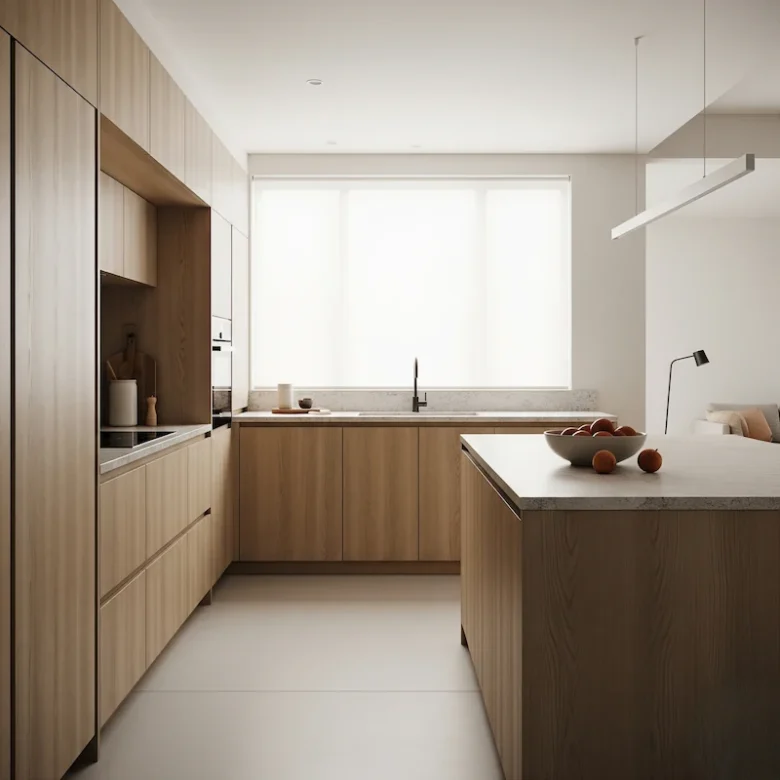
The physical environment profoundly shapes our state of mind. A kitchen designed for slowness is more than just a functional workspace; it is a sanctuary conceived to calm the mind, encourage mindfulness, and facilitate a deeper connection to the ritual of cooking.
It applies the principles of minimalism—clarity, intentionality, and a focus on the essential—to the architecture and design of the domestic heart.
Open, empty, intentional
Slow kitchens embrace clean surfaces, natural materials, and an atmosphere of serene order. The design prioritizes open space and uncluttered countertops, creating a sense of visual and mental breathing room.
An empty counter is not a void; it is an invitation, a clean slate upon which the focused work of cooking can begin. This visual clarity helps to reduce cognitive load, allowing the cook to be more present and deliberate in their actions.
Materials are chosen for their honesty, tactility, and ability to age gracefully. Warm wood, cool stone, smooth concrete, and textured linen ground the senses and connect the space to the natural world.
These materials are not sterile or inert; they carry a history and a character that deepens over time. Light is treated as a primary architectural element, with an emphasis on soft, diffused natural light that changes throughout the day.
Sound, too, is considered; the design seeks to soften the harsh clatter of a busy kitchen, creating quiet zones where the gentle sounds of cooking—a soft simmer, a gentle chop—can be appreciated. The goal is to create a space that feels less like a factory for food production and more like a studio for a quiet craft.
Storage as silence
One of the defining features of a slow kitchen is its approach to storage. In a conventional kitchen, countertops are often crowded with appliances, utensil jars, and spice racks—a constant visual chatter that competes for our attention. The slow kitchen, by contrast, favors hidden storage and visual stillness. Calm begins with clarity.
Custom cabinetry with seamless fronts, deep drawers, and integrated pantries allow tools and ingredients to be kept out of sight but within easy reach. The principle is to curate what is visible.
Perhaps only a few essential, beautiful objects are left out: a worn wooden cutting board, a simple ceramic bowl for salt, a single knife. This is not about hiding a mess, but about creating an intentional environment where the mind can be at ease.
By removing visual clutter, the kitchen becomes a place of refuge. This “storage as silence” is a powerful design tool; it transforms the kitchen into a calm, contemplative stage, ready for the quiet, deliberate ritual of cooking to unfold.
Cultural influences and slow traditions
The philosophy of slow, minimalist cooking is not a modern invention but a rediscovery of ancient wisdom. Across cultures and throughout history, traditions have emerged that celebrate simplicity, seasonality, and a deep, respectful connection to food.
These practices, born from both spiritual discipline and practical necessity, offer timeless models for a more mindful way of cooking and eating.
Japanese Kaiseki and Zen cooking
Nowhere is the aesthetic of slowness and minimalism more refined than in Japanese culinary traditions, particularly Kaiseki and the Zen Buddhist practice of shōjin ryōri. In these disciplines, cooking is understood as a spiritual practice.
Every gesture in the kitchen—from the washing of rice to the precise slicing of a vegetable—is performed with a sense of mindfulness and economy of motion. The goal is not just to create a delicious meal, but to cultivate a state of presence and gratitude.
Seasonality, or shun, is a paramount principle. Ingredients are used only at their absolute peak, capturing a fleeting moment in nature’s cycle.
A Kaiseki menu is a poem to the season, composed of many small, exquisite dishes that are balanced in flavor, texture, color, and cooking method.
The presentation is equally minimal and profound, often incorporating elements of wabi-sabi—the appreciation of beauty in imperfection, transience, and humility.
A single, perfectly grilled fish on a simple ceramic plate, garnished with a single maple leaf to evoke the autumn season, speaks volumes. It is a testament to the idea that slowness and attention can elevate food to the level of art and spiritual expression.
Italian cucina povera
From the serene temples of Japan, we can turn to the rustic kitchens of rural Italy to find another powerful expression of minimalism: cucina povera, or “poor cooking.” This tradition was not born from aesthetic theory but from stark necessity.
For generations, Italian peasants and farmers had to create nourishing, satisfying meals with humble, readily available ingredients: seasonal vegetables, beans, grains, and lesser cuts of meat.
What they lacked in expensive products, they made up for with ingenuity, patience, and a profound respect for what the land provided.
Cucina povera is the art of turning scarcity into abundance. It is the slow simmering of a tomato sauce for hours to coax out every drop of its rich, sweet flavor. It is the use of stale bread to create hearty soups like ribollita or salads like panzanella, ensuring nothing goes to waste.
It is the patient process of hand-rolling pasta from simple flour and water. These dishes are a testament to the idea that deliciousness does not depend on luxury. They are built on a foundation of care, resourcefulness, and the slow, deliberate work of hands.
A legacy of necessity has been transformed into a celebrated culinary art form, reminding us that some of the most profound flavors come from the simplest of origins.
Chefs and designers who embrace the minimalist ethos
The principles of slow, minimalist cooking resonate deeply with certain visionary chefs and designers who have built their careers on the power of simplicity, integrity, and intentionality.
These figures stand as modern exemplars of the philosophy, demonstrating how restraint and a focus on the essential can lead to extraordinary results, whether on the plate or in the design of the space itself.
Alice Waters
Perhaps no single figure in American cuisine has championed ingredient-led simplicity more fervently than Alice Waters, the founder of the iconic restaurant Chez Panisse in Berkeley, California.
For decades, her philosophy has been deceptively simple: find the most perfect, locally sourced, seasonal ingredients and do as little to them as possible. Her cooking is a masterclass in restraint, a radical act of trust in the inherent quality of the food itself.
The lore of Chez Panisse is filled with stories that illustrate this ethos, the most famous being the offering of a single, perfect peach on a plate for dessert.
There was no sauce, no garnish, no technical flourish—just the unadorned fruit, served at the peak of its ripeness. This was not laziness; it was the height of confidence. It was a declaration that the work had already been done by the farmer and by nature.
Waters’s contribution was context, timing, and the wisdom to know when to step aside. Her legacy is a powerful reminder that sometimes the most profound culinary statement is not a complex composition, but a humble celebration of a perfect ingredient in its perfect moment.
John Pawson (Kitchen Design)
Just as Alice Waters strips cooking down to its essence, British architectural designer John Pawson strips space down to its fundamental components: light, volume, and material.
Known for his rigorously minimal aesthetic, Pawson applies this architectural philosophy to the kitchen, transforming it from a cluttered workshop into a space for presence, not performance. He designs what could be described as domestic chapels for the daily ritual of preparing food.
In a Pawson kitchen, function is seamlessly integrated and hidden from view. There is no visual noise. Surfaces are broad and uninterrupted, crafted from elemental materials like wood, stone, and plaster that feel ancient and calming to the touch.
Light, both natural and artificial, is carefully modulated to create an atmosphere of serenity. Emptiness is a key design element, providing a sense of order and tranquility that allows the mind to focus.
His kitchens are not designed to show off expensive appliances or to facilitate frantic, multi-tasking performance. They are designed to be still, to encourage a slower, more deliberate way of being. They are spaces that honor the quiet, meditative nature of the culinary act itself.
The emotional and sensory benefits of this lifestyle
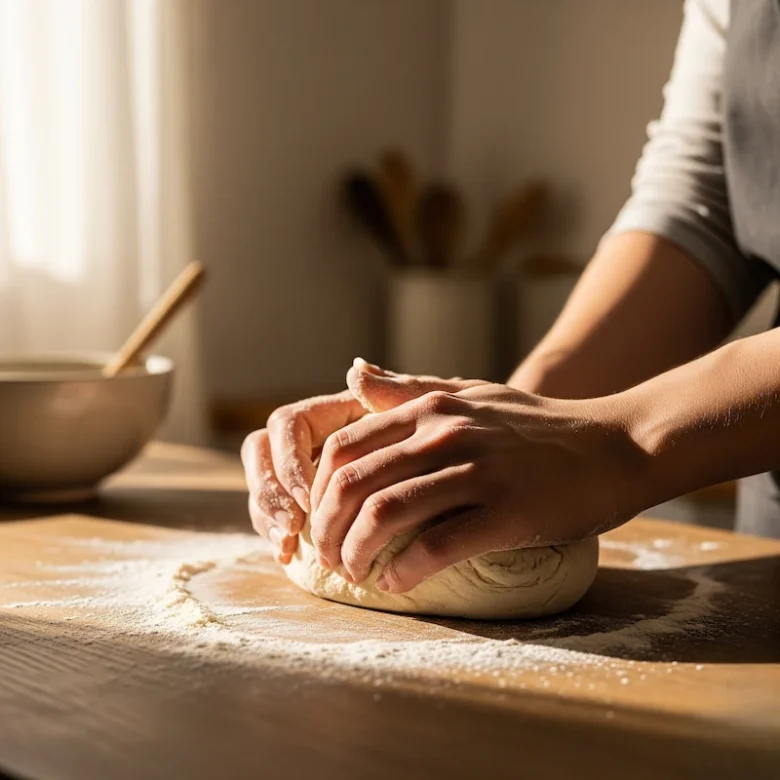
Beyond the aesthetic and culinary rewards, embracing this slow and simple approach to cooking offers profound emotional and sensory benefits. In a world that constantly pulls our attention outward toward screens and endless stimuli, this practice serves as a powerful anchor to the present moment, grounding us in our bodies and reawakening our senses.
Cooking as grounding
The slow, repetitive, and tactile nature of minimalist cooking can be a form of meditation. The rhythmic chopping of vegetables, the circular motion of stirring a pot, the gentle pressure of kneading dough—these simple, deliberate actions become a mantra for the hands.
This physical engagement requires a focus that quiets the anxious, chattering mind. It pulls us out of abstract worries about the past or future and into the tangible reality of the here and now: the weight of a knife, the texture of a carrot, the earthy scent of a mushroom.
This return to the senses is a potent antidote to the disembodiment of modern life. It is a practice of grounding, of reconnecting with the physical self and the physical world. Plating a dish simply, with care and attention to every element, is a final act of this moving meditation.
In these moments of focused, sensory engagement, the kitchen becomes a space for mental clarity and emotional restoration. Each action becomes a small ritual of care, a way of nourishing the self as much as feeding the body.
Time becomes seasoning
In slow cooking, the intangible elements of the process become part of the final flavor profile. You can, in a very real sense, taste the wait. A broth that has simmered for a full day holds not just the flavor of its ingredients, but the accumulated warmth of the room and the long, quiet hours of its transformation.
A piece of sourdough bread carries the memory of its slow fermentation, a complex, tangy note that speaks of patience and collaboration with living cultures.
The quiet between steps, the focused attention of the cook, the calm of the environment—these all infuse the food with an invisible quality. This is what it means when we say something is cooked with love; it is another way of saying it was cooked with undivided presence.
In a world of instant gratification, slow food offers a different kind of pleasure: the pleasure of anticipation, of process, of depth. You taste your own attention. Time, in its slow and generous passage, becomes the most subtle and most satisfying seasoning of all.
A minimalist approach in a digital world
Adopting the aesthetics of slowness today feels more vital and more defiant than ever, precisely because it stands in such stark contrast to the prevailing currents of our digital culture.
The internet, and particularly social media, has fundamentally reshaped our relationship with food, often accelerating it to a frantic, superficial pace. A slow, minimalist approach offers a powerful and necessary counterbalance.
Countering algorithmic urgency
The internet has taught us to cook fast. Our feeds are saturated with hyper-lapse videos, 30-second recipe hacks, and the pressure to create visually spectacular, shareable meals in record time. This culture prioritizes exposure over experience.
The goal is often the creation of an image—a beautiful photo for the grid—rather than the immersive, multi-sensory process of cooking itself. The algorithmic demand for novelty and speed pushes us toward complexity, shortcuts, and a constant churn of trends.
A minimalist culinary practice actively resists the scroll. It is an invitation to log off and tune in. It champions a deep, embodied knowledge that cannot be learned in a viral clip.
It brings food back to the realm of private experience rather than public performance. By choosing a path that is intentionally slow, simple, and process-oriented, we push back against the digital world’s relentless demand for more, faster, newer. We reclaim cooking as a personal, restorative practice rather than another form of content creation.
Offline kitchens
The ultimate expression of this resistance is the offline kitchen—a space where intuition and senses take precedence over digital aids. It means putting away the phone, silencing the tablet, and trusting oneself.
Instead of relying on a precise timer, we learn to listen for the sound of a simmer changing, to look for the visual cue of caramelization, to smell the exact moment when garlic becomes fragrant.
This is not a Luddite rejection of technology, but a reclamation of our own innate human instincts. It is about trusting the memory in our hands that knows the feel of perfectly kneaded dough.
It is about honoring the intuitive wisdom of the body to guide the recipe. In an offline kitchen, we are not passively following a set of external instructions; we are actively engaging in a responsive dialogue with our ingredients.
We become present to the process in a way that is impossible when our attention is split by a screen. It is in this quiet, focused space that cooking ceases to be about executing a formula and becomes a truly creative and personal act.
The ultimate luxury: the abundance of the essential
Ultimately, we discover that the minimalist cooking lifestyle is not an aesthetic of deprivation, but the very definition of luxury in the 21st century. In a world that screams that opulence lies in accumulation, this philosophy whispers that true richness resides in radical simplicity.
It is the luxury of having time, not because the day has more hours, but because we have shed the distractions that steal it. It is the luxury of mental clarity, born from an uncluttered environment and intentional decisions.
And, above all, it is the luxury of an authentic and profound connection: with the earth that nourishes us, with the culinary heritage that defines us, and, ultimately, with ourselves.
The kitchen thus becomes the epicenter of a more deliberate life, a laboratory where we practice patience, attention, and an appreciation for the beauty of the simple. What we learn at the stove—to value quality, to eliminate excess, to find joy in the process—radiates outward into all other facets of our existence.
This pursuit of essence doesn’t end in the kitchen; it’s the language that defines our era. If these ideas about how simplicity shapes our future resonate with you, we invite you to explore more in Neomania Magazine. Subscribe to receive content that unveils the frontiers of design, culture, and a more conscious way of life.