There’s a certain quiet magic to it. The scent of aging paper and leather bindings, the soft scratch of a fountain pen across a heavy cream page, the hushed echo of footsteps in a vaulted hall.
It’s a feeling, a deep, resonant hum of intellectual pursuit and romantic melancholy that has captured the imagination of a generation seeking substance in a world of fleeting digital noise.
This cultural current, often labeled the Dark Academia trend, is far more than a curated collection of tweed blazers and dog-eared classics.
It’s a philosophical stance, a conscious choice to embrace a slower, more deliberate way of engaging with the world, one rooted in the pursuit of knowledge for its own sake.
This movement speaks to a profound human need for connection—not just with each other, but with the long, unbroken chain of human thought and creativity that came before us.
It’s a rebellion against the cult of the new, a turning away from the relentless pressure to optimize and produce. Instead, it proposes a different kind of value system, one where the reward is not external validation but internal enrichment.
It finds beauty in the tragic verses of a Romantic poet, excitement in the dusty corners of a forgotten archive, and solace in the quiet companionship of books.
It is an invitation to build a life around intellectual curiosity, aesthetic appreciation, and the timeless questions that have haunted and inspired thinkers for centuries.
It asks us not what we can achieve, but what we can learn, feel, and understand. And in a world that often feels chaotic and disposable, that question feels more urgent and necessary than ever.
The literary heart of the movement
At its core, this scholarly aesthetic is a love letter to the written word. It’s built upon a foundation of stories, poems, and philosophical treatises that explore the heights of human intellect and the depths of human passion.
It isn’t just about being seen with the right book; it’s about allowing those books to seep into your soul, to challenge your worldview, and to become a part of your own narrative.

The literature that defines this subculture is often characterized by its intellectual rigor, its emotional intensity, and its fascination with the darker, more complex aspects of life and learning. It’s a canon that values depth over breadth, and introspection over spectacle.
This literary devotion is not a passive act of consumption. It is an active, immersive engagement. It’s about the thrill of discovery, the painstaking process of interpretation, and the joy of sharing those insights with a community of fellow seekers.
It’s a reminder that literature is not a relic of the past but a living, breathing conversation that we are all invited to join.
From the Romantics to the moderns: Tracing the literary DNA
The intellectual lineage of this movement stretches back centuries, finding its earliest whispers in the passionate, brooding verses of the Romantic poets.
Figures like Lord Byron, Percy Bysshe Shelley, and John Keats, with their obsession with beauty, mortality, and the sublime, laid the groundwork for an aesthetic that finds profound meaning in tragedy and fleeting moments of intense emotion.
Their work celebrated the individual genius, often isolated and misunderstood, striving against the confines of society in a quest for truth and transcendence. This romantic ideal of the tortured artist and scholar is a central pillar of the aesthetic’s identity.
From there, the trail leads through the Gothic novels of the 19th century, with their atmospheric settings, ancient secrets, and sense of psychological dread.
Mary Shelley’s Frankenstein is a quintessential text, exploring the dangerous consequences of forbidden knowledge and the moral responsibilities of the creator.
The ivy-covered universities, crumbling manors, and shadowy libraries of these stories became the archetypal landscapes of the academic world, places where intellect and intuition collide, often with devastating results.
However, the single most influential text in the modern formation of this subculture is arguably Donna Tartt’s 1992 novel, The Secret History. The book crystallized the aesthetic for a contemporary audience.
It tells the story of a small, elite group of classics students at a Vermont college who, under the influence of their charismatic professor, push the boundaries of morality in their pursuit of a transcendent, Dionysian state of being.
Tartt masterfully captures the intoxicating allure of intellectual elitism, the beauty of ancient Greek traditions, and the dark, corrosive secrets that can fester within a closed academic circle.
The novel is not just a story; it is a mood board, a complete sensory experience that has defined the look, feel, and philosophical underpinnings of the movement for decades.
Its influence is so pervasive that it serves as a common touchstone, a shared secret language for those who feel a kinship with its world of intense friendships, moral ambiguity, and the dangerous beauty of classic literature.
The ritual of reading: More than just consumption
In an age of endless scrolling and bite-sized content, the aesthetic champions a radically different approach to reading. It revives the idea of the physical book as a sacred object, something to be cherished, annotated, and lived with.
This is not about speed-reading or hitting a certain number of books per year. It is about deep, slow, and immersive reading—the kind that leaves an indelible mark on the reader.
The act of reading becomes a ritual. It involves creating a specific atmosphere: a comfortable armchair, a warm cup of tea or black coffee, the soft glow of a lamp in an otherwise dark room.
It’s about engaging with the text on a physical level. This means underlining powerful passages, scribbling questions and reflections in the margins, and even dog-earring pages that resonate.
This practice, known as marginalia, transforms the book from a static object into a dynamic record of a personal intellectual journey. It’s a conversation between the reader and the author, carried on across time.
This reverence for the physical book is also a quiet protest against the ephemerality of digital culture. An e-book can be deleted with a click, but a well-loved paperback, with its cracked spine and faded cover, carries a history.
It tells a story not only of the words inside but of the hands that have held it, the places it has been, and the thoughts it has provoked.
Collecting first editions or beautifully bound classics is not just about ownership; it’s about becoming a custodian of literary history, preserving a small piece of our shared cultural heritage.
This mindful, tactile engagement with text fosters a deeper connection to the material and encourages a more profound level of understanding and reflection.
Building a personal canon in a world of endless content
One of the most empowering aspects of this intellectual subculture is its emphasis on curating a personal library. In a world where algorithms constantly push new content at us, the act of consciously selecting which voices to listen to is a powerful form of intellectual autonomy.
It’s about moving beyond bestseller lists and building a collection of books that genuinely speak to your soul, challenge your assumptions, and fuel your passions.
This process of building a personal canon is a journey of self-discovery. It involves exploring different genres, time periods, and philosophical schools of thought to find what truly resonates.
It’s a rejection of the idea that there is a single, authoritative list of “great books” that everyone must read. Instead, it encourages a more personal and eclectic approach to learning.
Your personal canon might include ancient Greek tragedies alongside contemporary poetry, dense philosophical texts next to worn-out detective novels. The only criterion is that each book has earned its place on your shelf.
Here is a list of foundational authors and works often found at the heart of these personal libraries, serving as a starting point for any aspiring scholar:
- Ancient Classics: Homer’s The Iliad and The Odyssey, Plato’s The Republic, Virgil’s The Aeneid.
- Gothic & Romantic Literature: Mary Shelley’s Frankenstein, the poetry of Keats and Byron, Oscar Wilde’s The Picture of Dorian Gray.
- Modernist Masters: Virginia Woolf’s To the Lighthouse, T.S. Eliot’s The Waste Land, James Joyce’s A Portrait of the Artist as a Young Man.
- Campus Novels & Modern Touchstones: Donna Tartt’s The Secret History, M.L. Rio’s If We Were Villains, Susanna Clarke’s Jonathan Strange & Mr Norrell.
This curated approach fosters a deep and lasting relationship with literature. It transforms a bookshelf from a piece of furniture into a map of your intellectual and emotional life, a testament to the questions you’ve asked and the worlds you’ve explored.
Crafting an aesthetic lifestyle beyond the screen
While literature forms the intellectual foundation, the movement’s appeal is also deeply visual and experiential. It’s about translating a love for history, art, and knowledge into a tangible, everyday reality.
This is not about creating a costume or a stage set, but about making conscious choices that infuse daily life with a sense of intention, beauty, and intellectual weight.
It’s an aesthetic lifestyle that finds meaning in the details: the texture of a woolen sweater, the weight of a silver spoon, the quiet focus of a dedicated workspace.
This commitment to a curated life is a form of mindfulness. It’s about being present in your surroundings and finding joy in simple, analog pleasures.
It pushes back against the modern impulse to optimize every moment for productivity, and instead, it encourages us to create spaces and routines that nourish the mind and spirit.
It’s a holistic approach to living, where your environment, your clothing, and your daily habits all reflect a core set of values centered on learning, beauty, and a connection to the past.
The sartorial scholar: Decoding the vintage fashion
The clothing associated with this aesthetic is more than just a uniform; it’s a form of storytelling. The style draws heavily on the academic attire of the mid-20th century, particularly from institutions in New England and the UK.
It favors natural fabrics, classic silhouettes, and a muted, earthy color palette of browns, greens, grays, and creams. The key is an appreciation for quality, longevity, and pieces that have a sense of history.
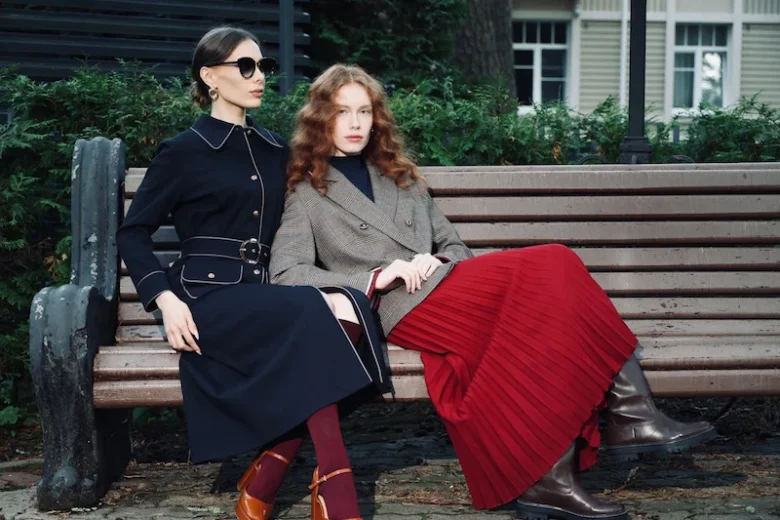
This approach to vintage fashion is a direct response to the fast-fashion industry. Instead of chasing fleeting trends, the focus is on building a timeless, durable wardrobe.
Pieces are often sourced from thrift stores, vintage shops, or are inherited, each with its own unique history. A well-worn tweed blazer, a pair of sturdy leather brogues, a soft cashmere turtleneck—these are not just garments, but companions on an intellectual journey.
They suggest a life spent in libraries and lecture halls, a person who values substance over style, and tradition over novelty.
The look is practical yet romantic. It’s about layering textures—wool, corduroy, cotton, silk—to create a look that is both comfortable and considered.
Accessories are minimal but meaningful: a classic watch, a leather satchel large enough to hold several books, perhaps a simple signet ring.
The overall effect is one of effortless intelligence and a quiet confidence. It’s a style that doesn’t shout for attention but rather whispers of a rich inner world. It communicates a set of values without saying a word.
The art of the study space: Creating a sanctuary for thought
Just as important as personal attire is the creation of an environment that inspires deep work and contemplation. The ideal study space is a sanctuary, a retreat from the distractions of the modern world where the mind is free to wander, question, and create. It’s a space that is both functional and deeply personal, filled with objects that have meaning and purpose.
The aesthetic favors analog tools over digital ones. A heavy, dark wood desk takes precedence over a sleek, minimalist standing desk.
Fountain pens and bottled ink are preferred over ballpoints, and thick, cream-colored notebooks are chosen over glowing screens.
These choices are not merely stylistic; they are designed to slow down the thinking process, to encourage more deliberate and thoughtful work.
The physical act of writing by hand, for example, has been shown to engage the brain more deeply than typing, leading to better retention and more creative connections.
The atmosphere is just as crucial as the tools. Lighting is often soft and warm, coming from a brass desk lamp or even candlelight, creating a cozy, intimate mood conducive to focus.
Classical music or ambient sounds often play softly in the background, blocking out external noise and creating a sonic cocoon.

The space is decorated with objects that spark intellectual curiosity: stacks of books, of course, but also maps, globes, scientific illustrations, small sculptures, or natural artifacts like skulls or pressed flowers. Each object serves as a memento mori or a prompt for contemplation.
Here are some key elements for creating an inspired workspace in this style:
- A Solid Desk: Preferably made of dark wood, with a sense of history and gravitas.
- Quality Stationery: A fountain pen, good quality ink, and heavy paper or a leather-bound journal.
- Atmospheric Lighting: A vintage-style desk lamp with a warm bulb; candles are an optional but popular addition.
- Curated Objects: Items that inspire you, such as a globe, a piece of art, a fossil, or a bust of a historical figure.
- An Organized Library: Books should be accessible and arranged in a way that makes sense to you, whether by subject, author, or color.
This carefully constructed environment is not about showing off; it’s about building a personal haven that supports and reflects a life dedicated to learning and reflection.
Pursuing knowledge for its own sake
Perhaps the most radical and inspiring aspect of this lifestyle is its philosophical core: the belief in learning as an end in itself. In a society that often measures education by its career prospects and return on investment, this movement champions a more humanistic approach.
It celebrates the pursuit of knowledge simply for the joy of understanding, for the way it expands one’s perspective and enriches one’s inner life.
This philosophy manifests in the hobbies and interests that are popular within the subculture. These are often activities that require patience, skill, and a deep appreciation for history and craft.
Learning a dead language like Latin or Ancient Greek is a common pursuit, not for any practical application, but for the direct connection it provides to the foundational texts of Western civilization.
Other popular activities include practicing calligraphy, studying art history, learning to play a classical instrument like the piano or cello, or engaging in amateur botany or astronomy.
These pursuits are a form of active resistance against the relentless demand for productivity and efficiency. They are deliberately “unproductive” in a capitalist sense.
You cannot optimize learning a Bach cello suite or mastering the nuances of Platonic philosophy. These activities require time, dedication, and a willingness to embrace the process without being fixated on the outcome.
This focus on process over product is deeply fulfilling, offering a sense of purpose and meaning that is often absent in the fast-paced, goal-oriented modern workplace.
It’s a reminder that the most valuable parts of life are often the ones that cannot be measured, quantified, or monetized.
The modern paradox: A nostalgic aesthetic in a digital age
One of the most fascinating aspects of this deeply analog-focused movement is that it was born, and continues to thrive, in the most digital of spaces.
It exists as a beautiful contradiction: a yearning for a pre-internet past that is expressed and shared through social media platforms.
This paradox is central to understanding its modern identity, its appeal, and its inherent tensions. The community grapples with questions of authenticity, inclusivity, and how to maintain a philosophy of slow, deep engagement while using tools designed for rapid, superficial interaction.
This tension is not necessarily a weakness. In fact, it may be the very thing that gives the movement its dynamism and relevance.
It is a living experiment in how to carve out spaces for quiet contemplation and historical appreciation within the architecture of the 21st century.
It shows a generation actively negotiating its relationship with technology, using it not as an escape, but as a tool to build a more meaningful and aesthetically coherent reality.
Idealization versus reality: The critique of elitism
No cultural movement is without its critics, and the academic aesthetic has faced its share of valid critiques. The most persistent of these is the charge of elitism.
With its focus on classical education, European architecture, and a specific sartorial code, the aesthetic can, at first glance, appear exclusive and inaccessible.
The imagery often centers on prestigious, centuries-old universities that have historically been the domain of the wealthy and privileged. This can inadvertently romanticize an educational system that has excluded many.
Furthermore, there is a danger of aestheticizing unhealthy behaviors. The “dark” aspect of the Dark Academia trend can sometimes veer into the glorification of mental anguish, sleep deprivation fueled by caffeine and obsessive study, and a general sense of romantic melancholy.
The tortured genius trope, while compelling in fiction, is a damaging model for real-life intellectual pursuit. It’s crucial for participants to separate the inspiring parts of the aesthetic—the love of learning, the appreciation for beauty—from its potentially harmful romanticizations.
Acknowledging these criticisms is essential for the movement’s health and growth. The community is actively engaged in these conversations, with many creators and participants working to make the aesthetic more inclusive and grounded.
They emphasize that the spirit of the movement is not about attending an Ivy League school or owning expensive first editions. It is about a mindset.
It’s about finding the “academic” in a public library, a community college classroom, or a secondhand bookstore. It’s about understanding that intellectual curiosity and a love for beauty are universal human traits that belong to everyone, regardless of their background or circumstances.
Finding community on digital campuses
Ironically, the very platforms often blamed for our shortened attention spans—Instagram, Pinterest, TikTok, and Tumblr—have become the de facto campuses for this global community.
These digital spaces allow like-minded individuals, who might feel isolated in their immediate surroundings, to connect, share ideas, and inspire one another.
A student in a small town in the Midwest can share notes on Plato with a peer in São Paulo, or discuss the symbolism in a Virginia Woolf novel with someone in Tokyo.
On these platforms, the aesthetic comes to life. Users share photographs of their study spaces, their latest thrift store finds, and the pages of the books they are reading.
They create video essays on literary themes, compile playlists of classical music for studying, and offer tutorials on everything from writing with a fountain pen to identifying different architectural styles.
This digital ecosystem serves as a collaborative library and a common room, a place where knowledge is not hoarded but freely exchanged.
This online community provides a crucial support system. It offers a space where a passion for learning is celebrated, not seen as strange or pretentious.
It allows individuals to find their “tribe,” a group of people who understand their enthusiasm for obscure historical facts or the beauty of a perfectly constructed sentence.
In this way, technology, far from being the enemy of the aesthetic, has become its most powerful enabler, creating a decentralized, global university open to anyone with an internet connection and a thirst for knowledge.
The team here at Neomania Magazine has watched this evolution with fascination, seeing it as a testament to the enduring human need for connection around shared intellectual passions.
The evolution of the aesthetic: From trend to timeless philosophy
Like any cultural trend, the surface-level aspects of the movement may fade over time. The specific style of blazer or brand of notebook might fall out of fashion. However, the underlying philosophy is far more resilient.
The core values—the pursuit of knowledge, the appreciation for history and art, the search for meaning beyond the material, and the creation of a deliberate and beautiful life—are not trendy. They are timeless.
As the aesthetic has matured, it has also diversified. Sub-genres have emerged, each offering a different flavor of the core concept.
“Light Academia” offers a more optimistic and cheerful counterpoint, focusing on themes of friendship, happy endings, and the simple joys of learning, with a lighter color palette and a sunnier disposition.
“Art Academia” shifts the focus from literature to the visual arts, celebrating painters, sculptors, and museum culture. Other variations, like “Chaotic Academia,” embrace a more disorganized and passionately messy approach to the intellectual life.
This evolution demonstrates the robustness of the core idea. It is not a rigid set of rules but a flexible framework that individuals can adapt to fit their own personalities and interests.
What began as a specific online subculture is slowly transforming into a broader philosophical movement. It is a quiet but powerful call to live more thoughtfully, to read more deeply, and to find beauty and meaning in the rich tapestry of human knowledge.
It suggests that the most profound adventures are not those that take us across the world, but those that take us deep into the pages of a book, the strokes of a painting, or the complexities of our own minds.
The enduring appeal of this way of life lies in its promise of a richer, more textured existence. It offers an antidote to the anxieties of the modern world, not through escapism, but through deep engagement.
It reminds us that we are part of a long and fascinating story, and invites us to write our own chapter with intelligence, passion, and style.
The stories we choose to surround ourselves with, the knowledge we pursue, and the beauty we cultivate in our daily lives are not trivial details; they are the very substance of a life well-lived.
At Neomania Magazine, we believe in the power of stories that challenge and worlds that captivate. This movement is a living narrative, a collective story written by thousands of individuals seeking a deeper connection to knowledge and beauty.
If you feel that pull—the desire to explore the essence of ideas, to appreciate the risks artists and thinkers take, and to be moved by narratives that linger long after the page is turned—then you’ve found your intellectual home.
Continue this journey with us. Subscribe to our publication and become part of a community that values the disquieting, the emotional, and the beautifully disconcerting stories that shape our world.